


In the field of business management and production, having an efficient Material Requirements Planning (MRP) has become an indispensable strategy to optimize the supply chain and ensure a smooth and profitable production.
The MRP is a fundamental tool that allows organizations to accurately identify what, how much, and when the necessary materials should be acquired for the manufacture of products or the provision of services.
In this article, we will learn what a Material Requirements Planning is exactly and how to apply it effectively to maximize operational efficiency and minimize costs, paving the way for business success.
What is a Material Requirements Planning MRP?
A Material Requirements Planning (MRP, for its acronym in English: Material Requirements Planning) is an inventory and production management system used by companies to ensure they have the right amount of materials available to manufacture their products.
The main objective of the MRP is to avoid shortages of raw materials and minimize a company's inventory costs, while guaranteeing that products are available when needed.
The MRP process is based on the planning and scheduling of production based on the expected demand for products, current inventory levels, and supplier lead times.
Through the MRP, companies can calculate and determine the quantity and the optimal time to purchase or produce the necessary materials to meet orders and maintain adequate inventory levels.
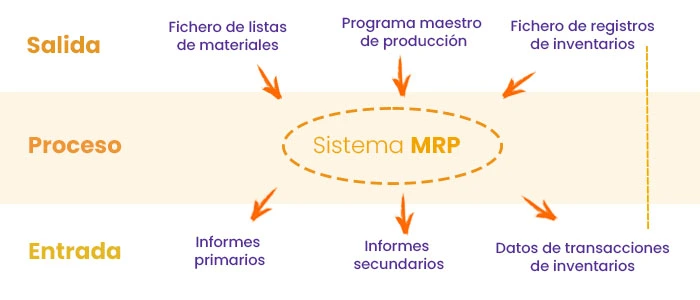
MRP generally follows the following steps
- Data recording
Relevant information is collected, such as the bill of materials (BOM), product demand, inventory levels, and supplier lead times. - Requirements calculation
Based on projected demand and the BOM structure, the quantity of each material required to satisfy pending orders and maintain optimal inventory levels is calculated. - Production schedule determination
Once the material requirements have been calculated, a production schedule is created indicating when and how much of each product should be manufactured to meet delivery deadlines. - Generation of purchase or production orders
Based on the previous calculations, purchase orders are generated to acquire materials from suppliers or production orders are generated to manufacture the products internally. - Tracking and control
The progress of purchase and production orders is monitored to ensure that materials arrive on time and product deliveries are made as scheduled. MRP is especially useful for companies that handle a wide variety of products and need to manage a constant flow of materials to maintain efficient production and meet customer delivery commitments.
By optimizing planning and resource utilization, MRP helps to avoid delays, excess inventory, and loss of sales due to lack of planning in the purchase of materials.
Why is materials requirements planning important?
Materials requirements planning is crucial for the efficient operation of any company or project, as it allows for the timely and adequate supply of the resources necessary to carry out activities and meet market demand.
By anticipating material needs and managing their acquisition in a planned manner, production interruptions are avoided, costs associated with inventory are minimized, and decision-making is improved.
Furthermore, proper planning also helps to optimize the use of resources, reduce the risks of shortages and excess stock, and provide a competitive advantage by allowing faster and more efficient responses to changes in demand or market conditions.
How to have efficient production with the help of an MRP?
To have efficient production with the help of an MRP (Material Requirements Planning or Material Requirements Planning), it is important to follow some key steps to implement and use the system effectively. Here we explain the main points to keep in mind:
Define the appropriate MRP system:
There are different MRP systems on the market, so it is important to select one that fits the needs and size of your company. Some MRP systems are more complete and complex, while others are simpler and specific to certain types of industries.
Accurate and up-to-date data:
The effectiveness of MRP depends largely on the quality and accuracy of the data entered. Ensure that information on inventories, production times, supplier lead times, and other relevant factors is up-to-date and accurate.
BOM (Bill of Materials) or BOM List:
Create a detailed bill of materials for each product you manufacture. The BOM is a complete description of the components, materials, and quantities needed to manufacture a finished product. This list is essential for MRP to accurately calculate material needs.
Production time and lead times:
It is essential to have clear information about production times for each product and the lead times that can be met. This data will allow MRP to plan production orders and material purchases more efficiently.
Demand planning:
Use historical data and sales trends to predict future demand for your products. This will help MRP generate production orders and material purchases according to market needs.
Periodic review:
It is necessary to periodically review and update MRP data to ensure that it accurately reflects the current situation of the company and the market. Changes in demand, lead times, or suppliers can affect planning and require adjustments to the system.
Communication between departments:
Foster communication between the different departments of the company, such as production, purchasing, sales, and logistics. Effective collaboration will help align planning and resolve potential problems more quickly and efficiently.
Staff training:
Ensure that the personnel operating the MRP are properly trained to use the system correctly. A good understanding of MRP will increase efficiency and reduce errors in planning.
Inventory optimization:
MRP can help you maintain an optimal inventory level by calculating the appropriate quantities of materials and finished products. This will avoid unnecessary accumulation of stock and associated costs.
Monitoring and continuous improvement:
Regularly monitor the results obtained with the implementation of MRP and look for opportunities to improve the production process and materials management. Continuous improvement will allow you to optimize your operations and achieve even more efficient production.
A well-implemented and correctly used MRP system can be a powerful tool to improve efficiency in production by ensuring that the right materials are available at the right time and in the right quantities, thus avoiding unnecessary costs and improving customer satisfaction.
Who uses an MRP system?
An MRP system is mainly used by manufacturing and production companies to efficiently manage their inventories and resources. This system is particularly relevant in industries where supply chain planning and control are crucial, allowing organizations to accurately calculate the quantities and timing of material acquisition needed for the production of goods, ensuring that inventory levels are optimal and that products are available at the right time, minimizing costs and maximizing operational efficiency.
Companies that can use an MRP are those involved in the manufacturing or production of goods. This system is especially useful for industries with complex production processes and multiple components, such as manufacturing, electronics, automotive, pharmaceuticals, and other related industries.
MRP helps these companies to efficiently manage inventories, forecast material needs, schedule production, and ensure the timely availability of the components needed to meet product demand, thus optimizing costs and production times and always having a master production plan.
Benefits of an MRP system
As we have seen before, an MRP system is an essential tool for the efficient management of the supply chain and production in a company. However, we want to show you all the key benefits that an MRP system offers:
- Inventory management: MRP helps to maintain precise control of inventory by calculating the optimal quantity of materials and components needed for production. This reduces the risk of having excess inventory, which could incur additional costs, or a shortage of materials, which could affect production and on-time deliveries.
- Production planning and scheduling: The MRP system allows for more effective production planning by identifying the materials needed and the time required to complete orders. Thus, realistic schedules can be established and the ability to meet delivery dates is improved. Reduction of costs: By managing inventory more efficiently and eliminating waste, the MRP system can contribute to reducing operating costs and improving the company's profitability.
- Optimization of time: With effective production scheduling and planning, time lost waiting for lack of materials is avoided and downtime of machinery and personnel is minimized.
- Greater accuracy in decision-making: Having real-time information about the status of inventory and production, managers can make more informed and strategic decisions to improve efficiency and productivity.
- Improved collaboration and communication: An MRP system centralizes information and allows sharing relevant data with all departments involved in the supply chain, which improves collaboration and communication between them.
- More accurate forecasts: By analyzing historical sales and production data, MRP can help predict future demand more accurately. This allows for better preparation to fulfill orders and minimize problems of excess or shortage of inventory.
- Improves product quality: By ensuring that the necessary materials are available on time and that the appropriate production guidelines are followed, the MRP system contributes to improving the consistency and quality of manufactured products.
- Efficiency in supplier management: An efficient MRP system facilitates the identification of key suppliers and helps establish strong relationships with them, which can lead to more favorable negotiations in terms of costs and delivery times.
- Adaptation to change: MRP allows for greater flexibility to adjust production and purchases in response to unexpected changes in demand or in the supply chain, which helps the company to be more agile and competitive in a dynamic business environment.
What happens if there is a production incident?
If a production incident occurs, this can have various consequences depending on the nature and severity of the problem. Production refers to the process by which goods are manufactured or services are provided, so any type of setback can affect the efficiency and quality of the final product or service. Some of the possible consequences include:
- Production delays: The incident could interrupt the normal flow of the production process, which could cause delays in delivering products or services to customers.
- Increased costs: If the incident affects machinery, equipment, or raw materials, it could increase operating and production costs to solve the problem and resume production.
- Decreased quality: If the incident is not resolved properly, the quality of the final product or service could be compromised, which would affect customer satisfaction and the company's reputation.
- Loss of income: Delays in production or delivery of products could lead to loss of sales and, therefore, a decrease in income.
- Impact on the supply chain: If the incident affects suppliers or customers, it could trigger problems in the supply chain and affect other related companies.
- The need for quick solutions: In the event of a production incident, the company must take quick measures to resolve the problem and minimize its impact. This may require additional resources and increased pressure on work teams.
- Risk to safety: Depending on the type of incident, it could pose a risk to the safety of workers, which would require immediate intervention to ensure their well-being.
- Impact on the company's reputation: If the incident affects customers or becomes public, it can have a negative impact on the company's reputation and affect its brand image.
In the event of any production incident, it is crucial that the company has contingency plans and established protocols to handle emergency situations. Rapid identification and resolution of the problem, along with effective communication to customers and stakeholders, are key to minimizing negative effects and protecting the company's image. In addition, it is important to perform a root cause analysis of the incident to prevent its recurrence in the future.
What is MRP II?
MRP II is an integrated system that helps companies plan and coordinate all aspects of their manufacturing process more effectively, from demand planning and production scheduling to purchasing management and quality control.
The main difference between MRP and MRP II lies in their scope: while MRP focuses primarily on inventory and materials management, MRP II focuses on global planning and resource optimization throughout the production chain, making it a more complete and advanced tool for efficient manufacturing management.
Differences between MRP and ERP
MRP (Material Requirements Planning) and ERP (Enterprise Resource Planning) are two planning and business management systems that address different aspects within an organization. The following explains the main differences between MRP and ERP:
-
Purpose
– MRP (Material Requirements Planning): It focuses specifically on the planning and management of the materials and resources needed for the production of goods. Its main objective is to ensure that the right materials are available at the precise time to meet production needs and avoid both shortages and excess inventory.
– ERP (Enterprise Resource Planning): It is a broader system that encompasses all resources and processes within a company. In addition to materials planning, it also integrates and manages other aspects, such as finance, accounting, human resources, sales, purchasing, project management, among others. Its objective is to optimize efficiency and coordination throughout the organization, providing an integral view of business processes. -
Scope
– MRP: It is a planning subsystem within a broader ERP. It focuses on inventory control and production scheduling.
– ERP: It is a more complete and modular software solution that covers various functions and departments of a company. -
Modules:
– MRP: Typically includes modules such as MRP I (for materials planning) and MRP II (which also includes capacity and production resource planning).
– ERP: Includes multiple modules such as finance, accounting, human resources, project management, purchasing, sales, CRM (Customer Relationship Management), SCM (Supply Chain Management), etc. -
Time focus:
– MRP: Focuses on the short- and medium-term management of materials and production.
- ERP: Its focus is more long-term, covering the long-term management of resources, processes, and business operations. -
Application and use:
- MRP: It is commonly used by manufacturing companies to manage their production and logistics operations.
- ERP: It is used in various industries and types of companies to manage a wide range of business processes and activities.
MRP specifically focuses on material and production planning, while ERP is a more comprehensive solution that encompasses multiple aspects and departments of an organization, providing a more holistic and coordinated view of business processes.
What is the MRP module in SAP Business One?
The MRP (Material Requirements Planning) module in SAP Business One is a functionality that helps companies efficiently manage and plan material and resource needs for production and procurement. MRP is an essential part of inventory and production management in SAP Business One and is used to avoid material shortages and minimize inventory costs.
The main features and functions of the MRP module in SAP Business One include:
1. Material needs calculation:
MRP performs calculations and analysis of material demand based on sales orders, production orders, and other relevant documents. With this, it determines which materials are needed and when they should be acquired or produced.
2. Generation of recommendations:
Based on the material needs calculations, the system generates purchase or production recommendations. These recommendations include information on the required quantity, delivery dates, and optimal order quantities.
3. Production scheduling:
MRP can also help in production scheduling, suggesting when production orders should be started and completed to meet demand in a timely and efficient manner.
4. Inventory control:
The MRP module allows for proper control of inventory levels. It helps avoid situations of overstocking or stockouts, thus optimizing costs associated with storage and inventory management.
5. Resource planning:
In addition to material management, MRP also takes into account the available production capacity, which helps plan human and machinery resources to meet demand effectively.
The MRP module in SAP Business One is a powerful tool that allows companies to proactively manage their material and resource needs, ensuring a smooth production flow and avoiding inventory problems. This translates into greater operational efficiency and an overall improvement in business management.
Xamai
At Xamai, we play a crucial role in the successful implementation of the MRP module in SAP Business One in your company. As a SAP Gold Partner, we have extensive experience and specialized knowledge in SAP products, including SAP Business One, which allows us to provide customized and efficient solutions to meet the specific needs of your company.
Do you want to know how we can help you? We explain it below
Requirements Analysis: Our specialized consultants will work hand-in-hand with the key stakeholders and teams of your company to understand the existing requirements and processes related to materials management and production planning. Through interviews and meetings, they will gather detailed information to understand the unique needs of your company in everything related to raw materials, labor, and other needs within the planning of requirements.
Custom Design: Based on the requirements analysis, our SAP consultants will design a customized solution for the implementation of the MRP module in SAP Business One. This solution will be aligned with best practices and will optimize the planning and materials management processes in your company.
System Configuration: We will perform the necessary configuration in SAP Business One to enable and adapt the MRP module according to the specific needs of your company. This will include configuring parameters, inventory policies, forecasting calculation formulas, and other adjustments necessary to ensure that the system functions correctly.
Integration with Existing Processes: Thanks to our 20 years of experience, we can assure you that the implementation of the MRP module will integrate perfectly with the existing business processes in your company. This includes synchronization with other SAP Business One modules, such as sales, purchasing, production, and inventory control, to ensure a harmonious operation.
Training and Education: We provide key employees of your company with comprehensive training so they can use the MRP module effectively and get the most out of the system. This will include teaching the key functionalities, interpreting results, and how to make informed decisions based on the data provided by the MRP and the master program.
Testing and Verification: Before putting the MRP module into production, at Xamai we will perform exhaustive tests to ensure that everything works correctly and that the objectives and requirements established during the initial analysis are met.
Post-Implementation Support: Once the MRP module is up and running, Xamai will provide you with ongoing support to resolve any problems or concerns that may arise. In addition, we will provide you with updates on new features and improvements that may benefit your company.
At Xamai, we can help you facilitate the successful implementation of the MRP module in SAP Business One in your company, ensuring that the solution is customized, integrated, and well aligned with existing processes. This will allow for better planning and materials management, which in turn will optimize production, reduce costs, and improve the overall efficiency of your business. If you have any questions, write to us and we will gladly help you resolve your concerns.
Ready to talk to SAP specialists?
Tell us what your company needs and we'll help you find the best path.
Request information










 English
  Español de México
  Español