
In addition to giving you the recording of this interview, we decided to transcribe the most important points for you, so that you can learn more about everything we talked about point by point. Click on any of these titles and find out the answers to everything you need to know about SAP Success Factors.
- Xamai's experience in implementing Success Factors
- What is SAP Success Factors?
- What is the employee experience and how does Success Factors help you with it?
- How is Success Factors sold? By modules.
- Human Resources as a strategic area. How to align the employee experience with the company's administrative processes?
- The employee experience. We spend most of our time at work.
- How does technology help me retain talent?
- Human Resources operations with Success Factors (Payroll, Taxes, Compensation, etc.)
- Success Factors makes it easier to have a healthier and fairer organizational culture
- Human Capital Metrics, measure talent with Success Factors
- What is the process for implementing Success Factors? How difficult is it to have it in my organization?
- How much does Success Factors cost?
Xamai's experience in implementing Success Factors
- We at Xamai have been marketing SAP solutions since 1999. Specifically in Human Resources, we have been implementing Human Capital Management or HCM for what was then known as R/3 and later as All in One or ECC, SAP's ERP.
- We implemented one of the first Mexican payrolls with the product and Human Resources functionalities with many clients in companies of various industries ranging from 100 to 10,000 employees.
- We have been working with SAP technology when the Human Capital solution was channeled to Success Factors and have performed implementations with this product in several clients.
- Throughout its history Xamai has worked with more than 1300 clients of all industries and sizes hand in hand with SAP solutions.
What is SAP Success Factors?
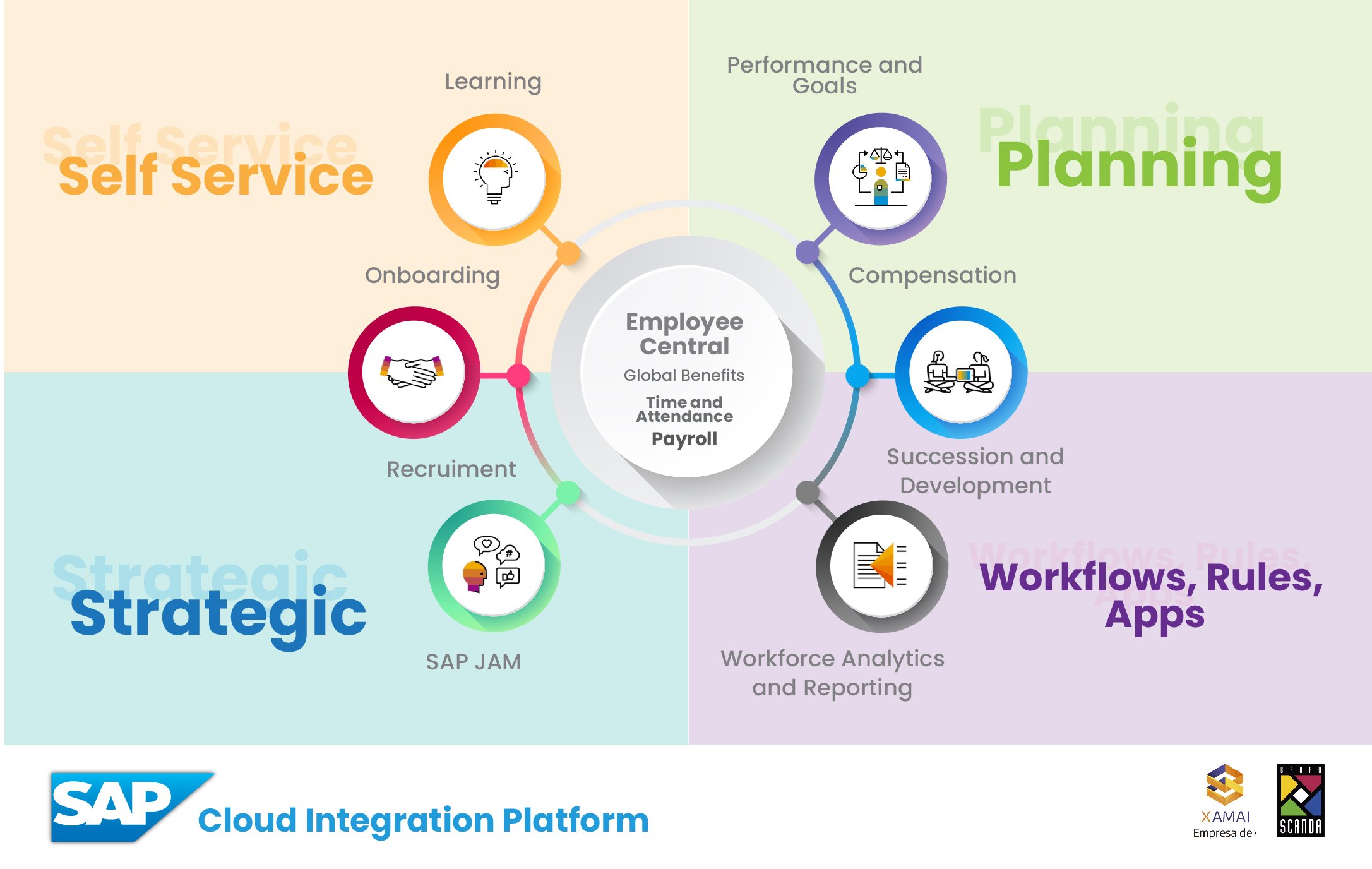
This tool manages the entire employee lifecycle within an organization, from recruitment, selection and onboarding, organizational structure, vacations, benefits administration, performance administration, objective administration, compensation, succession, training, development and analytics. That is to say, practically all activities related to the employee within a company are managed through this solution.
What is the employee experience and how does Success Factors help you with it?
One of the greatest benefits that SAP has Success Factors is that it turns the human factor into a strategic area rather than an administrative or tactical area. For many organizations, the human factor is seen as the administration of a necessary evil when it is actually the most important asset any company has.
The tool itself facilitates all activities related to the administration of this human factor. It has a self-service component that eliminates, in a way, the requests that employees constantly make to human resources, such as: requesting vacation, a letter of recommendation, the management of a training course, and so on, all these activities that should be very simple and take a lot of time, are now done from the convenience of the user's computer.
How is Success Factors sold? By modules.
Success Factors is sold by modules and the scope of the services you can obtain through the tool depends on the module implemented. All defined through best practices to ensure the most efficient processes.
Some clients, due to their volume of operations, contract the entire solution. Others only contract a module. In general, the administration of personnel and the structure is called Employee Central or Employee Central, it is the backbone of Success Factors. However, there are clients who prefer to have only one module without needing to contract Employee Central.
That is to say, this adapts to the needs of the clients.
For talent management there are specific modules such as Performance and Goals which integrates a series of solutions that include performance evaluation, objective administration and calibration.
Modules such as succession and development that integrate perfectly with the compensation and variable pay solution.
And there are functionalities for recruitment and selection, training, onboarding, time management, payroll, analytics, etc.

Human Resources as a strategic area How to align the employee experience with the company's administrative processes?
From initial interviews, we at Xamai realize that candidates are more attracted to companies that facilitate their work experience through technology.
It facilitates employees' lives to have a platform that integrates with their daily work, where they can register their vacations, manage their information, download their receipts, see their goals, and even more so now that remote work has become a work model for many companies.
As organizations, we have moved from needing fewer transactional systems managed by the Human Resources area for payroll and administrative procedures to platforms that facilitate employee integration with the company and improve their experience. And the employee experience translates into a better experience for our customers.
“There's no way we can, as a company, provide a good experience for our customers if our employees are not happy.”
– Andrea Navarrete, SAP Success Factors Consultant
A human resources solution like Success Factors makes the human resources area something strategic within the company.
The employee experience. We spend most of our time at work.
We must consider that we spend a good part of our lives at work, and one would think that simple situations such as not having your vacation requests processed or not having the correct vacation bonus paid due to human error is something insignificant and shouldn't cause much stress for the employee, but it does.
Payroll, benefit payments, and employee development within organizations are very delicate issues that significantly affect people's well-being. There are many studies that refer to the fact that people work better and stay longer when they feel valued, heard, and recognized by their companies.
How does technology help me retain talent?
The most innovative companies are those that have the right talent and are constantly developing. That is also a very important part for organizations to retain talent, meaning there is always a certain level of turnover within an organization, which is healthy, because we want certain resources to be outside the organization, perhaps in an organization that is more suitable for them, and certain resources that are talents, those that contribute to the organization, not to lose them.
Through the tool, you ensure that this lifecycle is more pleasant for the employee and ensure that they want to belong and remain in your organization.
Human Resources operations with Success Factors (Payroll, Taxes, Compensation, etc.)
There is a part in the Human Resources areas that all companies have to do. Administrative activities such as maintaining employee data, paying and withholding taxes, registering the daily integrated salary, calculating IMSS, generating and delivering legal reports, making the annual adjustment, paying vouchers or Christmas bonus. All of this is covered in Success Factors and has been functioning for many years and is a product totally adapted to Mexican laws that are also constantly updated.
Success Factors makes it easier to have a healthier and fairer organizational culture
The tool also facilitates having a healthier and fairer organizational culture. Because if you don't worry about measuring things like:
- How fair is my compensation among my employees?
- Is there a relationship between performance and how I am compensating people, or is it simply based on the subjective criteria of certain people within the organization?
- Am I effectively promoting better positions or better salaries?
- Am I promoting people who have demonstrated and I have a way to verify that they have demonstrated that they are committed to the company and have had extraordinary performance?
You risk your company losing competitiveness and innovation. The solution therefore helps you to have more just and objective organizations.
Human Capital Metrics, measure talent with Success Factors
With 20 years of experience and accumulated clients, Success Factors has had the opportunity to refine analytics or metrics that not all organizations typically have and don't even realize they could have.
And this is very useful because it's really the only and best way to know if your process is working properly.
Having a constant thermometer of how hiring is performing, how inclusive your organization is, how aligned it is with strategic objectives, how well people are responding to their performance evaluations, how developed their competencies are, how many are being trained, in short. modules all have certain analytics as standard, and if that weren't enough, the solution offers a dedicated module for analytics only.
In our experience, there is no measurement that a company requires that Success Factors doesn't already have planned.
{{cta(‘205875ac-2058-4fbc-b9e5-1181cc43a7aa’,’justifycenter’)}}
What is the process for implementing Success Factors? How difficult is it to have it in my organization?
These types of Cloud implementations typically use the ACTIVATE methodology, which is an agile methodology; that is, they are very fast implementation processes. For example, a very standard talent module can be implemented in three months, which marks a significant difference if we consider the implementation times of SAP in the past, we were talking about implementations of six months to a year.
So, the truth is that SAP has so much experience in these implementation processes that it has very well-defined phases and has very proven which activities need to be executed for each one.
In the past with traditional implementations you saw how your system looked after long stages of analysis, design, configuration; that is, several months after the project had started, and by the time you saw the finished product, you didn't like it so much or your expectations changed, it wasn't what you had imagined.
It happened a lot, I remember, in traditional implementations, some client had seen the system at some event, had seen it with a lot of functionality and when you showed them their own system it wasn't exactly like the one at the event and they were a little disappointed.
I find it very interesting that as a company that is implementing, from the beginning you can see how your system is taking shape because you always work with your own installation and you approach the final version through iterations.
In the case of implementations in cloud products, from the beginning of the implementation you are seeing the product and the only thing you are doing is fine-tuning it to how you want it to look at the end. This helps both for training and adoption purposes, I think it is a very easy way to get involved with the system.
How much does Success Factors cost?
The investment should be considered in terms of how much it costs you per employee, but it is much cheaper than many clients imagine and the price has been decreasing. Giving you a number would be very inaccurate because it depends on the number of employees and the functionalities you need.
It is also important to consider that it is a periodic rent so you don't have to disburse the total amount in one go and that at the beginning it may sound higher due to the implementation service, but it is something that only has to be paid once.
Furthermore, the administration of the entire system is handled by SAP, so there is a very important saving in maintenance.
Ready to talk to SAP specialists?
Tell us what your company needs and we'll help you find the best path.
Request information









 English
  Español de México
  Español