

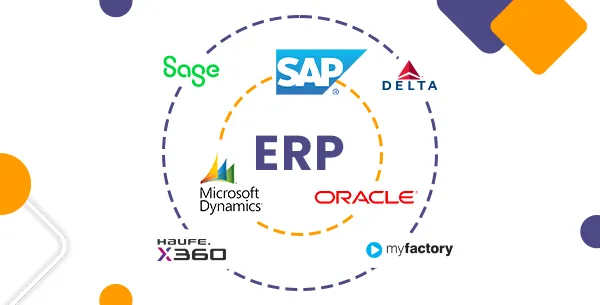
Both the SAP ERP system and the Oracle ERP system have excellent management capabilities for an organization, but both have qualities that may be better suited to certain companies. Let's explore the main characteristics of SAP and Oracle so you can choose the best solution for your business.
On this occasion, we will focus on these two ERP products and set aside Microsoft Dynamics. But in future installments, we will expand the information with said ERP software, which is also one of the most used in Mexico.
What is SAP and Oracle ERP?
From the point of view of what they do, they are enterprise resource planning (ERP) tools. Both facilitate the collection and storage of data and have computing capabilities to optimize planning and resource allocation.
SAP is largely a market giant when it comes to an ERP solution. Capable of transforming any manufacturing industry. Oracle is generally known for its databases, although it also has other products.
SAP depended on Oracle's database until November 2010. By then, SAP had created its own database called HANA. But many customers still prefer to use Oracle because it is cheap and stable. Today the trend is changing, users are beginning to adopt HANA.
Benefits of SAP
SAP ERP is a software enterprise resource planning that is basically intended for various industries. The type of business is not a problem, since SAP is a package designed to integrate almost all functional areas of a business, such as sales and distribution, finance, accounting, human resources, manufacturing, production planning, procurement of goods and services, logistics and storage.
SAP, in its SAP Business One, Business Intelligence, SAP 4 Hana, etc., modalities, consists of several modules designed to handle almost all functional areas of business processes, such as financial accounting, administration, sales and distribution, materials management, human resources management, etc. It collects and consolidates data from separate modules, creating a fusion and planning resources at the enterprise level.
Benefits of Oracle
Oracle is a database management system created based on a multi-model schemeOracle is commonly used for various tasks, such as performing online transactions, executing data storage, etc. Currently, Oracle is sold to its customers as a leader in database technology available for hybrid cloud environments with scalability.
It is extremely reliable. It can handle large database sizes and heavy application loads.Oracle is portable and available on different operating system platforms. Oracle has demonstrated the highest database performance in the world on multiple platforms. That database performance tuning is an interesting concept for many developers worldwide. There are several technologies, such as Oracle RAC and Data Guardthat help you scale your database vertically and horizontally.
Comparing both ERP software products
Next, we will make a comparison of both to know their advantages.
- Sector to which they belong
SAP: focuses on enterprise resource planning.
Oracle: is a database management system.
- Function of each ERP
SAP: real-time management of business processes.
Oracle: data administration in companies.
- Language they use
SAP: works with ABAP language
Oracle: works using SQL
- Meaning within organizations
SAP provides a set of tools to facilitate the flow of information for your business.
Oracle is a multi-model database management system.
- Functional area
SAP: sales, distribution, accounting.
Oracle: data storage, transaction processing, database workloads.
- Price
The cost of implementing SAP is considered higher.
The cost of implementing Oracle is low compared to SAP ERP.
These are the 10 differences between SAP and Oracle
- SAP is a well-known enterprise resource planning solution, it is software that has been well received in the market of large corporations because it integrates artificial intelligence into business processes.
- SAP deals with functional areas such as accounting, sales, distribution, materials management and finance; while Oracle deals with data areas such as the data warehouse and database workloads.
- While SAP is synonymous with large companies like Microsoft, Oracle is available in a simpler version creating a wide network of customers.
- SAP works with traditional information system management. This allows us to consider processes independently, but with Oracle it is possible to work with multiple model designs to simplify the database design process.
- SAP requires more implementation time and costs, as it is software tailored to the company. In that sense, Oracle is a simpler product.
- SAP uses ABAP as the standard language, while Oracle can be accessed through a standard language called SQL.
- SAP is an ERP that operates in real time, while Oracle can sometimes be reduced to personal use outside the company.
- While SAP's domain is in real-time enterprise management systems, Oracle's power lies in database management.
- SAP development can include Oracle as a database system, as it can integrate with multiple databases, but Oracle is one of the key components of enterprise resource planning for operational companies.
- SAP integrates business applications and Oracle is used in enterprise environments for data-level functions.
These are the implementation costs, duration, and risks of SAP and Oracle
While SAP and Oracle solutions tend to be more expensive and take longer to implement than most ERP systems, there are clear differences between the two. Oracle has a slightly greater advantage with the average implementation time because it is faster and even its average cost is 20% lower than SAP.
SAP implementations, on the other hand, are less risky and as long as a consultancy performs a correct analysis of the business environment, success and results are assured.
Benefits and satisfaction of organizations
This is perhaps SAP's greatest strength. Oracle has the highest ERP vendor satisfaction rate, while SAP leads the category of most significant real business benefits worldwide.
Considering that most companies undertake ERP projects with the aim of achieving tangible business benefits, this is enough to recognize SAP as a reliable solution for many companies that want to be leaders in the market.
In conclusion, which is better for your company?
Now that we have a solid understanding of the differences between SAP and Oracle, you can see that the benefits of both are evident. They are highly reliable products with lower risk in their implementation. They have a long lifespan and interesting options for your company with cloud solutions.
SAP ERP provides a business process solution that can include database functionalityOn the other hand, Oracle can provide data solutions, which is one of the components of enterprise resource planning.
It all depends on your planning needs and budget. SAP offers a complete solution for all enterprise-level needs, while Oracle, which runs on multiple operating systems or platforms, offers a solution for all data-related requirements.
The difference between SAP and Oracle is very noticeable, but business requirements alone must match the customer satisfaction and budget you have. Reach out to a consultant who can provide you with more information about the implementation of each.
Don't forget to follow us on our social networks and share this content.
Ready to talk to SAP specialists?
Tell us what your company needs and we'll help you find the best path.
Request information





 English
  Español de México
  Español