

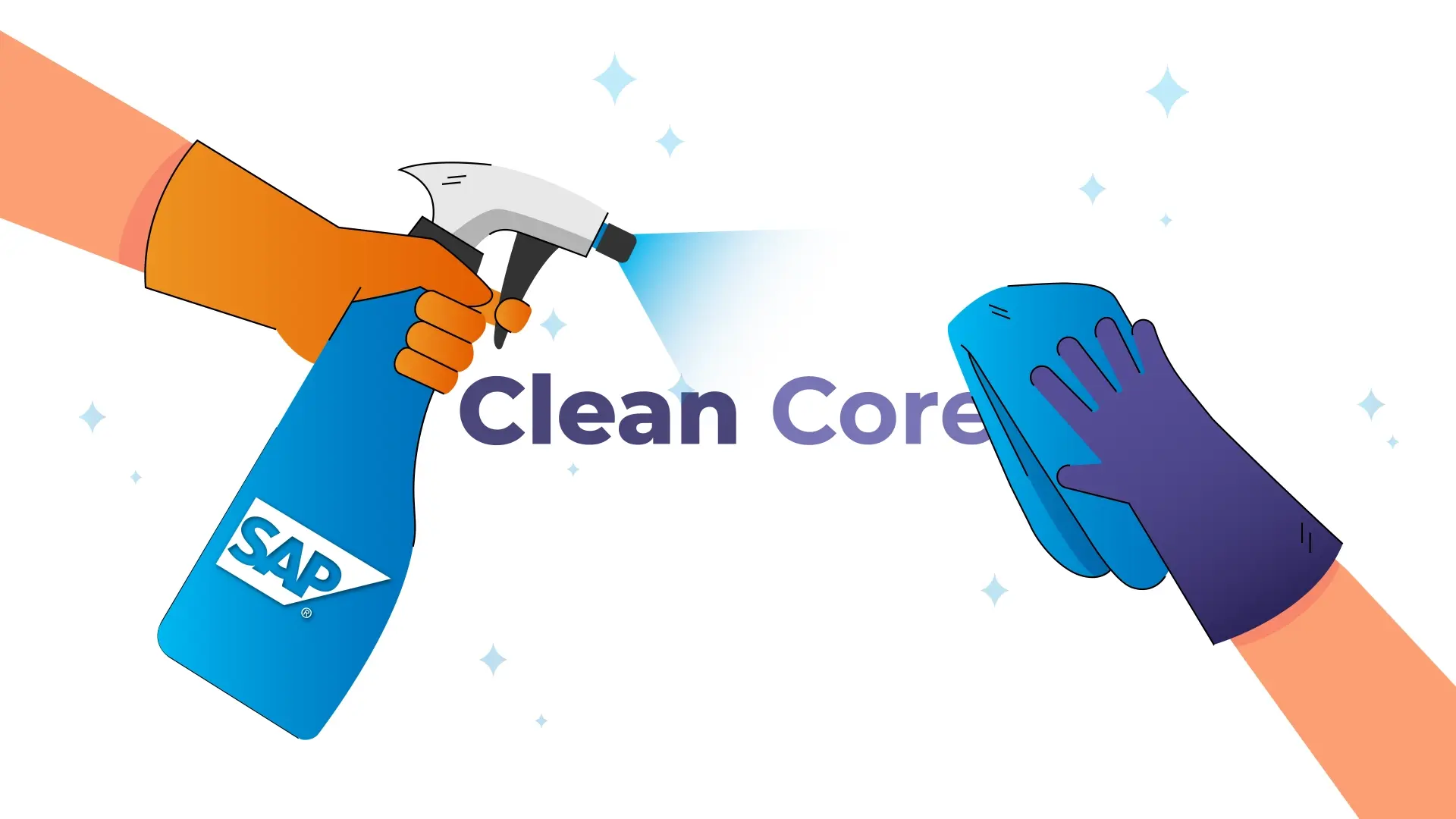
We show you how you can implement clean core in your company
Faced with a customer base that still largely uses on-premise ERP, SAP has made significant efforts to promote migration to S/4HANA Cloud.
The core of this effort is Grow with SAP, launched in 2021, an offering designed to simplify migration to the SaaS environment. One of the keys to the success of a cloud project of these characteristics, according to SAP, is to go through a “clean core” or “clean core”, in which companies transform the customizations of their SAP systems or completely eliminate their specific developments to move to standardized processes.
However, achieving a clean core is complex and is probably one of the reasons why many customers have been reluctant to migrate to the cloud. But let's learn a little more about this SAP Clean Core concept.
What is Clean Core in ERP?
The concept of Clean Core refers to keeping the ERP core as clean and standardized as possible, using the system's native functionalities instead of custom developments. This allows the system to be easier to update, reduce maintenance costs, and improve interoperability with new technologies.
Traditionally, many companies have customized their ERP systems to adapt them to their specific processes. However, this approach entails high maintenance costs and complexity when updating the software. The Clean Core strategy seeks to reverse this, adopting configuration over customization practices and using external solutions for specific needs.
Why is it so important to have a clean core?
Because it significantly reduces the effort companies have to make to perform updates and improvements. SAP is one of the most critical systems in the world that runs systems like supply chains or manufacturing, and any interruption in its operation can have a serious impact.
Maintaining a clean core allows you to make the most of the semi-annual updates that SAP implements in its Cloud systems. These updates bring constant improvements in security, performance, and functionality, but can only be applied without friction if the base system is not overloaded with unnecessary customizations or modifications to the standard.
Not opting for a clean core approach will inevitably lead to problems during ERP version updates... which could later become serious problems for organizations.
To achieve a Clean Core without losing flexibility in customization, it is essential to have tools that allow you to extend the capabilities of the ERP without modifying its core. This is where SAP Business Technology Platform (SAP BTP) comes into play, a cloud platform that allows you to develop and execute applications, automate processes, and manage data in an integrated way with the ERP.
SAP Business Technology Platform
With SAP BTP, companies in Mexico and the rest of the world have a cloud platform on which they can implement their specific code, without modifying the main ERP or their other SAP applications. The APIs offered are robust and stable, which limits testing and adaptation efforts during a SAP software package update.
The Grow with SAP S/4HANA Cloud Public offering provides SAP S/4HANA ERP in a public cloud mode. An ERP that is automatically updated semi-annually, to allow companies to benefit from the latest fixes and innovations from the publisher. This benefit also applies to the private cloud of Rise SAP S/4HANA Cloud Private.
Benefits of a Clean Core Approach
Implementing a Clean Core in ERP offers multiple advantages:
- Greater agility in updates: by reducing customizations, companies can adopt new versions of the ERP without significant interruptions.
- Cost reduction: fewer customizations mean lower development, maintenance, and support costs.
- Better integration with new technologies: facilitates connection with cloud solutions, artificial intelligence, and advanced analytics.
- Greater security and stability: a standardized system minimizes vulnerabilities and errors derived from proprietary developments.
- Easier regulatory compliance: facilitates the adoption of industry regulations and best practices.
Steps to implement a Clean Core in SAP ERP
1. Assessment of the Current ERP State
Before starting, it is essential to perform a detailed analysis of the SAP environment. For this:
- Identify the customizations (Z-Developments, User-Exits, Enhancements, BAdIs, Modifications of Standard Code) that have been implemented.
- Use SAP tools such as Custom Code Analyzer and SAP Readiness Check to evaluate the amount of custom code and its impact.
- Classify the customizations according to their criticality and dependence on key business processes.
2. Customization Classification and Prioritization
Organize the customizations into three groups:
- Critical and necessary: those essential for business operations.
- Replaceable: modifications that can be eliminated or replaced with standard SAP functionalities.
- Obsolete: developments that no longer provide value and can be discarded.
This exercise helps to define which code should be maintained, which can be optimized, and which customizations should be eliminated during the transition to Clean Core.
3. Adopt Standard SAP Functionalities
SAP has improved its ERP with solutions such as SAP S/4HANA Cloud, in both its public and private versions, which include optimized processes and advanced native tools. Some key actions in this step include:
- Review SAP Best Practices and adapt business processes accordingly.
- Use tools such as SAP Fiori Apps Library to replace custom developments with standard applications.
- Configure processes with SAP Business Configuration (BC Sets) instead of custom developments.
4. Use Side-by-Side Extensibility
Instead of modifying the SAP ERP core, use the Side-by-Side extensibility concept with cloud solutions such as:
- SAP Business Technology Platform (BTP) to develop external applications without touching the ERP core.
- SAP Integration Suite to connect the ERP with other applications without direct modifications.
- SAP API Management to access ERP data without the need for custom ABAP code.
This reduces dependence on internal modifications and facilitates future updates.
5. Implementation of a Governance Framework
To ensure that the SAP ERP system remains within the Clean Core approach, it is essential to establish a governance model that:
- Defines clear policies on when and how extensions can be made.
- Establishes periodic reviews of Z code with tools such as SAP Custom Code Management.
- Implements quality controls in development with SAP Code Inspector and ABAP Test Cockpit (ATC).
6. Training and Change Management
The success of Clean Core depends on the acceptance of the teams. To facilitate the transition:
- Train teams in the use of standard SAP processes.
- Involve business areas so they understand the benefits of eliminating unnecessary customizations.
- Use tools like SAP Enable Now to facilitate continuous learning about the system.
7. Monitoring and Continuous Optimization
Once Clean Core is implemented, the system should be constantly monitored to prevent the accumulation of new unnecessary customizations.
- Use SAP Solution Manager to monitor system performance and changes.
- Establish regular audits to ensure Clean Core policies are being met.
- Evaluate new SAP functionalities that could replace any future customizations.
Today it is essential to maintain a clean ERP core and externalize specific aspects, otherwise we will end up with an increasingly important technological debt as the market and versions of the SAP S/4HANA Cloud ERP advance.
Implementing a Clean Core requires strategy, technical discipline, and a clear vision of the company's digital future. However, beyond the steps and tools, there is a critical factor that is often overlooked: the operational reality of the teams carrying out these implementations.
And it is here that the real challenges begin.
The operational challenge of consultants and quality in implementations

While it is true that the Clean Core strategy offers clear benefits, its implementation in practice faces a very important challenge, which is the preparation and availability of consultants trained in the new SAP methodologies.
Many professionals still apply legacy approaches from previous versions such as SAP ECC 6.0, and are not fully familiar with tools like SAP BTP or Side-by-Side extensibility, and since they are mostly independent consultants participating in several projects simultaneously, inconsistencies in quality and adherence to best practices may be found.
At Xamai, we understand that a modern strategy requires a team that is up to the task. That's why our consultants are certified and trained in tools like SAP BTP, Side-by-Side extensibility, and integration with Cloud solutions, ensuring that each project aligns with SAP's best practices.
Having an expert and up-to-date team not only improves the quality of the implementation, but also allows the benefits of the Clean Core to be maintained in the long term.
Ultimately, achieving a Clean Core depends not only on technology, but on having professionals who are truly aligned with current best practices.
Options for migrating to SAP S/4HANA Cloud
Regardless of the migration method chosen: what begins as a transformation project is not a complete project. While the ERP system can be migrated to the cloud within a reasonable timeframe, companies will not achieve a complete clean core. This is because SAP has not yet provided many improvements in all areas.
Therefore, migration is more of a trigger for the continuous development of IT. Successful companies have always dynamically adapted their digital systems to market and technological changes. However, conditions have changed in recent years.
The increasing complexity and accelerated pace of digital innovation have made it more challenging for internal IT teams to manage infrastructure, maintain daily operations, and develop new projects simultaneously. However, optimizing these processes is key to competitiveness and value generation.
This is where Xamai makes the difference. Our team of experts not only guides your company in migrating to SAP S/4HANA, but also provides ongoing strategic support to ensure that your digital infrastructure evolves along with the needs of the business. With our specialized services, your company will be able to:
- Streamline the transition to SAP S/4HANA without affecting daily operations.
- Maintain an optimized digital core aligned with industry best practices.
- Have expert support for the continuous evolution of your ERP system.
- Reduce the workload of the internal IT team, allowing them to focus on innovation.
Migrating to SAP S/4HANA Cloud is just the beginning. With Xamai, your company will have the necessary support to transform your digital infrastructure efficiently and sustainably. Optimize your operation with the best team by your side.
Ready to talk to SAP specialists?
Tell us what your company needs and we'll help you find the best path.
Request information








 English
  Español de México
  Español