

Updated: June 2025
Enterprise management software is software developed to make the progress of each company's project more efficient, learn more here.
We often hear the words 'business efficiency improvement' and 'business improvement'. But what exactly does it mean? Many companies are taking various measures to achieve it, but the easiest way to see the effects of improving work efficiency and improving work is to introduce a system.
For large corporations, this is not usually a problem, but for growing companies, it can be difficult to know what type of management software to implement, so in this article we will look at enterprise management systems and their most important tasks.
Types of enterprise management systems.
There are several enterprise management systems that allow different processes to be carried out, let's learn about them.
Accounting management system
A system for recording transactions in daily accounting books for the production of financial statements.
Tax declaration system
A system that prepares documents for tax declarations requires accounting data. It is often integrated with the accounting management system.
Sales management system
A system that manages after an order is placed, administering a series of sales activities from order receipt to shipping and invoicing.
SFA (Sales Force Automation)
A sales support tool and primarily manages sales activities before an order is received.
CRM (Customer Relationship Management)
Regarding customer management, it has classifications and customer information for each customer. There are functions such as email delivery and scoring.
Procurement management system
Software that records the results of purchases and outsourcing requests.
MRP (Material Needs Planning)
Software that automatically calculates the type and quantity of parts needed for production and automatically places orders, etc., along with the parts invoice.
Production management system
A system that manages the quality, cost, and delivery date of items produced in the factory.
Human resources management system
A system that manages employee information, enabling payroll and social security related calculations.
SCM (Supply Chain Management)
A system that shares information such as the amount of inventory required between companies such as suppliers and customers.
ERP (Enterprise Resource Planning)
Central commercial management system, a system that centrally administers all main commercial activities, such as accounting, sales, purchasing, and production. We will talk about this software in more detail a little later.
Attendance management system
As it is, it is a system that manages attendance. Some systems include security measures.
What are the types of industry-specific enterprise management systems?
Industry-specific management systems are narrowed down to certain industries in particular, so they have specific operations and functions according to the solutions they require. However, compared to general-purpose business systems, the number of functions tends to be small. This is because it is easier to use if there are no unnecessary functions for the industry.
When choosing a general-purpose type or an industry type, it is a good idea to decide whether your company's products and services are in one industry or multiple industries. If you specialize in one industry, it is easier to use a specialized system for enterprise management systems.
Conversely, if you are doing multiple products and services, a general-purpose business management system will be able to collectively manage the products and services you are currently doing.
Management software for growing companies
Even growing companies can no longer do without business software. Legal regulations, customer management, order processing, and much more are significantly met and supported by software, leaving behind outdated tools like spreadsheets.
ERP software helps growing, medium, and large companies to fully manage their activities and have a properly established management program. But how does an ERP system work?
Whether it's accounting, human resources, commercial administration, or document management, everything is taken into account in a single tool. They automate their operational activities while at the same time simplifying processes within the company.
How does the software act in your company? Let's imagine a possible scenario:
Example of how business management software works in an SME:
Let's imagine a bakery called “El Pan de la Abuela” (Grandma’s Bread), which has grown to such an extent that it now has 50 employees, several branches, several suppliers, and a growing base of wholesale and retail customers.
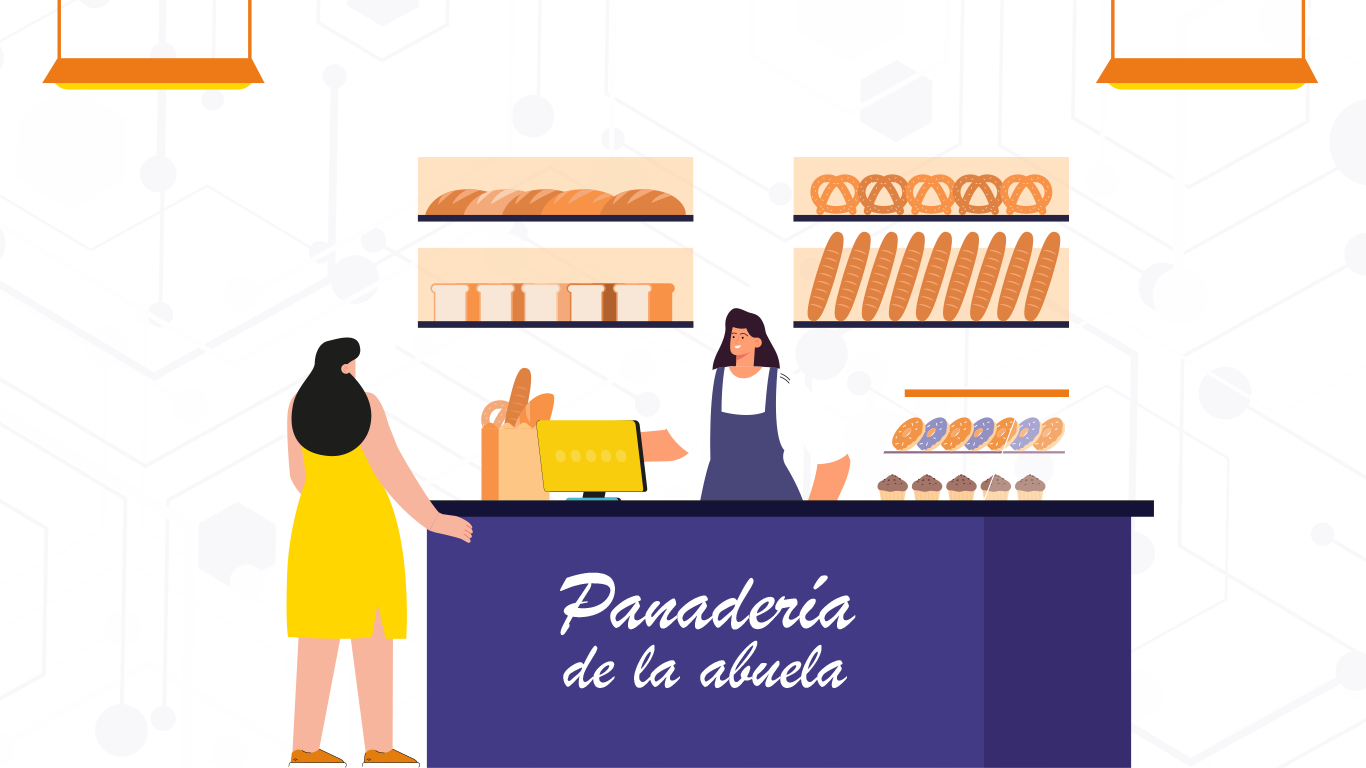
Although their product remains artisanal, operations and administration have become more complex.
Problem:
The owner of “El Pan de la Abuela” can no longer handle all tasks manually or with basic systems. They are having difficulty coordinating inventory between branches, controlling sales, and generating reliable financial reports. In addition, controlling the entire payroll and purchases is beginning to be a challenge to maintain efficiency and growth.
Implementing an ERP as a solution
To resolve these difficulties, they decide to invest in an ERP, something that requires a serious commitment: for a company of this size, the minimum budget is around $30,000 to $35,000. This covers licenses, configuration, training, and specialized consulting.
The ERP they choose includes modules for:
- Inventory and purchasing management, with control of ingredients and supplies.
- Sales and distribution, which allows you to manage and control orders in real time and electronic invoicing.
- Accounting and finance, to provide reports and comply with all tax requirements.
- Human resources and payroll, facilitating the correct calculation of salaries and benefits.
- Analysis and reporting, with updated data to make quick and accurate decisions.
Tangible benefits
With the ERP running, “El Pan de la Abuela” achieves:
- Greater efficiency by automating processes that were previously manual.
- Complete visibility of their operations, from inventory to sales.
- Reduction of errors in invoicing, inventory control, and payroll.
- Better coordination between branches and work areas.
- Sustainable growth thanks to a platform prepared to adapt and scale.
This is just one example of how an enterprise management software can work in a growing company that requires something more in line with its needs.
Advantages of enterprise management software
Once analyzing the previous case, we must say that enterprise management software reduces the cost of operations and simplifies processes. It is a flexible solution according to the changing requirements of your business, allowing you to review critical business information in real time.
What are the elements of a good enterprise management program?
Enterprise management software helps the company to facilitate tasks to gain efficiency and productivity and have a competitive advantage; that means it must guarantee the company that uses it:
- Security with the information it handles: The management software must ensure that your information is secure and that you have backups.
- Ease of offering reports: A good business management program will offer users all kinds of financial reports that are required to efficiently monitor business tracking.
What is an ERP system?
ERP software is software to manage all activities of an organization. ERP stands for “Enterprise Resource Planning” and is defined as software to manage all business processes that support a company's operations. The ERP system is a specific software package that implements an ERP strategy.
How does an ERP system work?
In general, an integrated ERP is a unified response to a large number of business questions. In the form of independent modules, the basis of an ERP allows the consolidation of different computer applications.
All modules of the application share a single database, so standardized data can circulate easily and it is never necessary to duplicate or re-enter it.
Functions of the ERP program
As mentioned earlier, an ERP software package consists of a series of modules that can be customized according to the company's needs. Each module corresponds to an area of activity and includes a set of associated functionalities.
Budgeting and invoicing
These are the functionalities that allow you to record purchase invoices according to the type of expense. In the sales area, ERP software helps to study customer budgets and invoices: personalized invoices, overdue payment reminders, simulation of discount effects or price adjustments, etc.
Customer Relationship Management (CRM)
CRM allows all companies to be more efficient in all areas. It offers better customer tracking, guaranteeing the profitability of stores, which allows for better and greater sales.
Accounting
As for accounting, accounting transactions are automated with multi-currency management and this is known as multinational accounting. Accounting tasks that are usually laborious are completed faster: time is saved, fewer errors are made, and focus is placed on high-value-added tasks.
Inventory management
In order to manage stocks, the use of supplier documents is essential. Therefore, inventory accounting is replaced by automated management or accounting is carried out in a simplified and guided manner.
The ERP system consists of a simple tracking of inventory and warehouse movements. With the ERP information system, the status of the stock can be easily consulted in real time with the cloud platform.
Production
Production management guarantees the regularization of input inventories. This ERP module guarantees the management of customer requirements from orders to production programs.
Acquisition
Allows the company to manage purchases from purchase orders to production.
Schedules
The functions related to the workforce consist of managing schedules and controlling employee attendance times. Human resources management also includes working hours and productivity.
PPM or project management
From project management to the PPM (Project Portfolio Management) tool for the strategic management of a project portfolio, this module is one of the essential IT tools for teamwork.
Schedule management allows not only task scheduling and management, but also project tracking in real time.
Advantages of an ERP system
Despite its apparent complexity, management software packages have many advantages:
- Gain in productivity: saves time by automating time-consuming tasks, avoids accounting errors, and has access to relevant and up-to-date data in real time. So you can focus on the essentials and work better.
- A single work environment: now uses a single software to manage all aspects of your business. The uniform user interface and single sign-on make your life easier.
- Simplified processes: An ERP allows you to structure and streamline your work processes. The entire company benefits from optimal management of activities, which gives you more time to focus on strategic tasks and efficiency.
- Reduced operating costs: a single software package replaces your existing tools, which also means reduced software training costs. In the long term, this leads to cost control.
- A response to your needs: The modular aspect of an ERP gives you the possibility of building software that adapts to your activities and responds to your specific problems.
- Security of your data: your data is protected in a cloud solution when you use SaaS software. So you don't risk losing it and you benefit from high security standards.
- A decision-making tool: An integrated management software package is an unprecedented decision-making tool: information unity, scheduling, optimization of process management, dashboard with accurate information.
- A return on investment: The implementation of several modules working together results in economies of scale in the long term in your ERP project's return on investment. This saves time, increases productivity, and responsiveness compared to using inappropriate tools that hinder collaboration between your departments.
Business management software is useful for companies that require planning the management of processes within an organization and, with that, prevent that, according to the increase in their financial and accounting operations, it becomes a difficult issue to manage.
And what role does SAP ERP play in all of this?
SAP ERP is one of the most recognized enterprise management systems worldwide. Its robustness, scalability, and ability to adapt to companies of all sizes have made it a benchmark in the sector.
Thanks to its modular approach, companies can integrate exactly the processes they need, from accounting to supply chain. Furthermore, being a solution backed by years of experience and constant innovation, it offers a level of reliability that few platforms can match.
Having an enterprise management solution not only improves operational efficiency, but also facilitates the identification of opportunities, optimizes processes, and enhances decision-making with business intelligence tools. Whether your company seeks to reduce costs, increase profits, or compete at the level of large organizations, an ERP can make the difference.
At Xamai, we help you perform an assessment of what is the best option for your business, in SAP products. Our goal is to offer you a customized solution, regardless of the size or industry of your company.
Approach Xamai and take the next step towards intelligent, strategic, and profitable business management. Are you ready to transform your business?
Ready to talk to SAP specialists?
Tell us what your company needs and we'll help you find the best path.
Request information






 English
  Español de México
  Español