

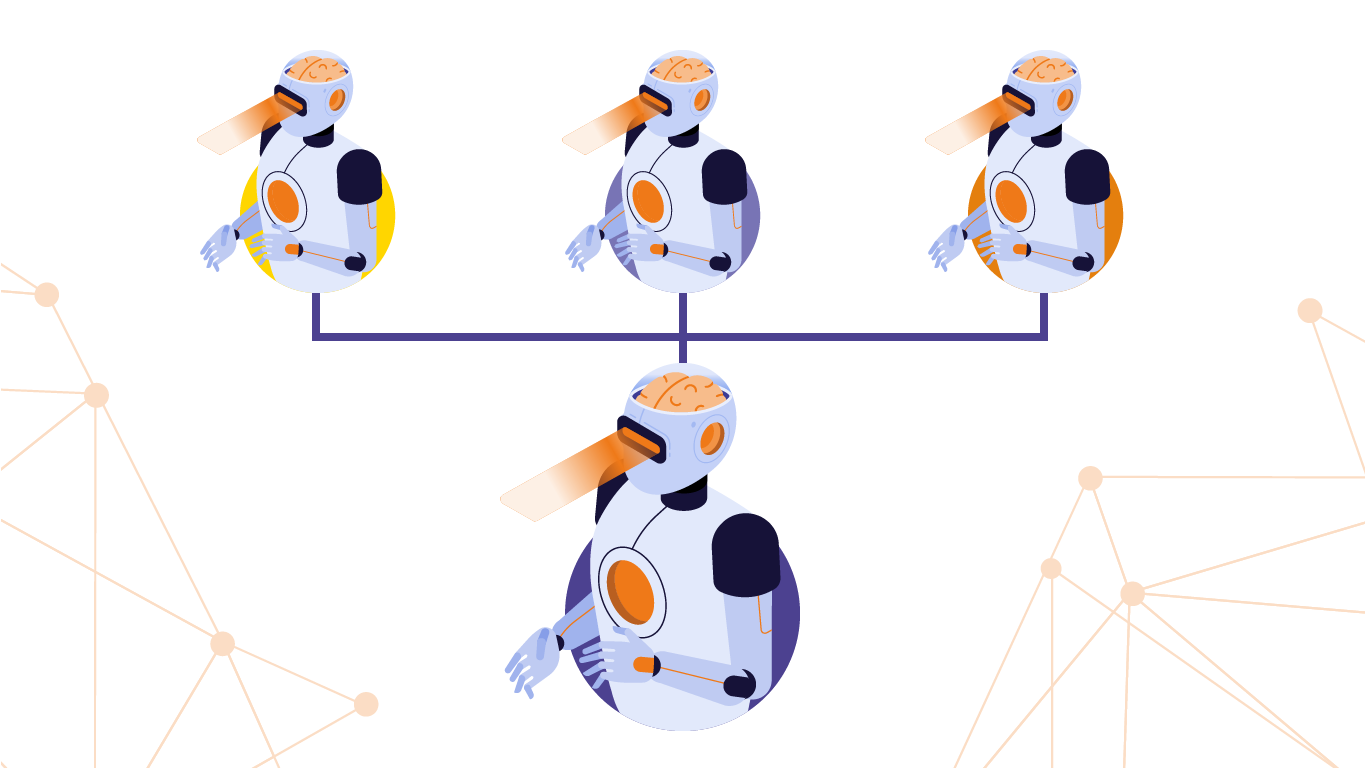
Do you know the levels of AI? From reactive machines to deep learning. Explore the classifications and techniques that are transforming businesses.
Artificial intelligence (AI) is defined as the ability of machines and systems to emulate human cognitive functions such as learning and decision-making, and what seemed unthinkable decades ago is now a reality beyond a science fiction movie.
In the full 21st century, AI has evolved so much that it is now part of the daily lives of companies, organizations, and society in general; we see it in recommendations on social networks or medical diagnoses and advanced data analysis. However, not all artificial intelligence works the same or has the same ability to perform tasks or make decisions.
It is necessary to understand the types of artificial intelligence, their classifications, and their operation in order to dimension their real current impact.
Classification of AI by capabilities
Narrow or Weak Artificial Intelligence (ANI).
This type of AI specializes in performing very specific tasks and does so very efficiently, it is worth noting that there is no broad understanding and much less consciousness.
Machines with narrow artificial intelligence can execute complex algorithms and programs in order to recognize patterns or classify data.
For example, search engines use machine learning and artificial neural networks to process large volumes of data and thus offer consultants precise results. However, their ability is only limited to the task for which they were designed; that is, they do not have the ability to transfer knowledge to different domains.
Most current applications in companies and organizations correspond to narrow AI, which helps perform routine tasks and process customer, sales, or inventory information, supporting the efficiency of a business or organization's operations.
General or Strong Artificial Intelligence (AGI).
This level of AI is theoretical because it seeks to create machines with intelligence comparable to that of a human being. In theory, an AGI would be capable of learning and performing various tasks in different contexts, adapting and transferring knowledge from one domain to another; that is, it could reason and understand the world as the human brain does.
While this is an area of research, achieving an AGI would involve developing algorithms and models inspired by the complexity of the central nervous system of us as human beings. Without a doubt, this type of AI would have autonomy to plan, solve complex problems, and develop strategies without specific programming for each case.
Superartificial Intelligence (ASI).
At an even more advanced level, superintelligence refers to machines whose performance completely surpasses human capacity in all areas, including creativity and decision-making. An ASI system could analyze large amounts of data and find patterns or solutions to high-complexity problems much faster than any person, and even create innovative strategies in different fields.
This hypothetical future is highly questionable ethically and in terms of security. It would be a moment when AI could drive profound transformations in society, to the point of completely changing the way we work and live.
Classification by functionality
The more detailed vision of AI by its operation comes from the classification of Arend Hintze. Arend Hintze is a researcher at the University of Michigan who has proposed four levels based on the complexity and the ability of machines to process information:
1.- Reactive Machines
These are the simplest systems. A reactive machine responds immediately to stimuli from the environment without storing memories of past experiences or learning from them, which means that each decision is made at the moment and without considering previous situations.
These machines work well in specific tasks (for example, a fraud detection system that analyzes transactions one by one), but do not improve over time, they have no memory or ability to plan beyond the immediate stimulus.
2.-Limited Memory
Here are systems that do retain temporary information to use it in future decisions. Limited memory AIs can review recent data and learn from it, but to a certain extent. For example, autonomous vehicles that use sensors and continuous learning to improve their navigation based on the traffic conditions they have just experienced. This is how systems adjust their behavior and make decisions in similar situations that may occur.
3.-Theory of Mind
At this level, machines would be capable of interpreting and understanding the needs, intentions, and internal states of the people they interact with. Although it is still a research goal, this level would imply that an intelligent system recognizes human emotions or behavior patterns to respond more naturally; the idea is to provide the AI with a deeper understanding of the social context to be able to create better responses.
4.-Self-Awareness
This is the highest level of intelligence according to this classification. A self-aware machine would have consciousness of itself, that is, it would understand its own existence, goals, and its place in the environment. This state has not yet been achieved even in the laboratory; it is more of a long-term aspiration, but artificial self-awareness raises questions about ethics and rights towards that new consciousness as its autonomy would challenge traditional limits of human intervention.
Enfoques según Stuart Russell
Another way to classify AI was proposed by experts Stuart Russell and Peter Norvig, with a focus on goals and how systems relate to human intelligence or rationality. There are four main categories:
Systems that think like humans.
Here the goal is to replicate human mental processes and is inspired by the way people think, striving for algorithms to reason or learn in a similar way to how our brain does.
Systems that act like humans.
In this category, the focus is on the AI being able to behave like a person. Machines or robots are designed whose external interaction simulates that of a human being. For example, a humanoid robot that walks or speaks convincingly. Success is measured by how indistinguishable the machine is from a human being in social or physical tasks.
Systems that think rationally.
These systems focus on emulating ideal rational mental processes. They use inference algorithms, mathematical models, and knowledge bases to perceive data, reason about it, and make optimal decisions. An example is systems that encode logical rules to solve specialized problems.
Systems that act rationally.
Finally, this approach seeks for the AI to produce the best possible result in each situation (the “rational” one), regardless of imitating human behavior. These are intelligent agents that make decisions following criteria of efficiency and optimization. They simulate rationality in action, focused on the most effective results.
Principales técnicas de IA
Artificial intelligence possesses various development techniques and methodologies that are worth mentioning and we have the following:
Machine Learning
In this model, instead of following fixed instructions, machine learning models analyze large volumes of data and extract patterns. This allows it to “learn” and improve its accuracy when making decisions based on accumulated information each time it receives more data.
Companies leverage machine learning in data analysis, fraud detection, customer segmentation, and many other applications, from marketing to internal operations.
Deep Learning.
It is a subfield of machine learning that uses deep neural networks with multiple processing layers. These networks somewhat simulate the structure of a human brain, with several layers that refine information at each step. Deep learning is effective in handling large amounts of unstructured data, such as images, voice, or text. Thanks to this, it has driven advances in speech recognition, machine translation, computer vision, and text generation.
Artificial neural networks.
Inspired by the neurons and synapses of the brain, these networks process information through interconnected nodes organized in layers. This approach allows for the recognition of complex patterns in language, images, or sensory signals. For example, neural networks can identify faces in photos, translate voice to text, or analyze the emotional tone of a message. They are very powerful tools for analyzing massive amounts of information and extracting relationships that are difficult to program with traditional rules.
Natural Language Processing (NLP).
NLP is the technology that allows computers to interpret, manipulate, and understand human language. It integrates machine learning techniques, linguistics, and statistics to process text or voice. Thanks to this, AI systems can answer questions, summarize documents, or translate languages automatically.
In companies, NLP is applied in chatbots and virtual assistants that automate customer service.
Enabling Technologies
The development of AI is based on advanced computing technologies. Training deep learning models requires powerful processors (GPUs or supercomputers) that accelerate the calculation of complex algorithms.
Big Data platforms and cloud computing allow storing and processing the enormous databases that AI needs. There are also dedicated programming tools and frameworks that facilitate the creation and deployment of AI models.
Companies integrate these technologies into their platforms (including SAP solutions) to create data analysis and automation systems. Thanks to these infrastructures and the use of efficient algorithms, AI can process and extract knowledge from huge amounts of information, making possible innovation in sectors such as healthcare, manufacturing, finance, or e-commerce.
Ethical Considerations
The massive use of AI poses important ethical and social challenges. The first major aspect is privacy: AI often requires processing sensitive data from people (such as medical records or financial information), so that information must be protected and regulations must be complied with.
There is also the risk of bias in the data, so it is essential to design transparent and fair AI systems, where those responsible supervise how information is extracted and used.
Another challenge is the automation of work: AI is increasingly replacing human tasks, which can affect jobs in traditional sectors. In addition, the growing autonomy of intelligent systems generates debates about to what extent AI should act without human intervention.
In this context, AI regulation and ethics are aimed at creating standards of responsibility, transparency, and security. Organizations and governments are working on guidelines to ensure that AI development is professional and benefits society as a whole, minimizing negative impacts.
Understanding the different types of artificial intelligence helps to understand the current potential and limitations of AI. And knowing that techniques such as machine learning, deep learning, neural networks, and natural language processing are the basis of these capabilities allows professionals and companies to make better use of them.
Currently, companies are already contributing to transform the processing of large amounts of data using AI, and with it control their decision-making, but there must always be a look towards a future where there is a responsible approach to achieve a sustainable and human development of technology.
Ready to talk to SAP specialists?
Tell us what your company needs and we'll help you find the best path.
Request information








 English
  Español de México
  Español