

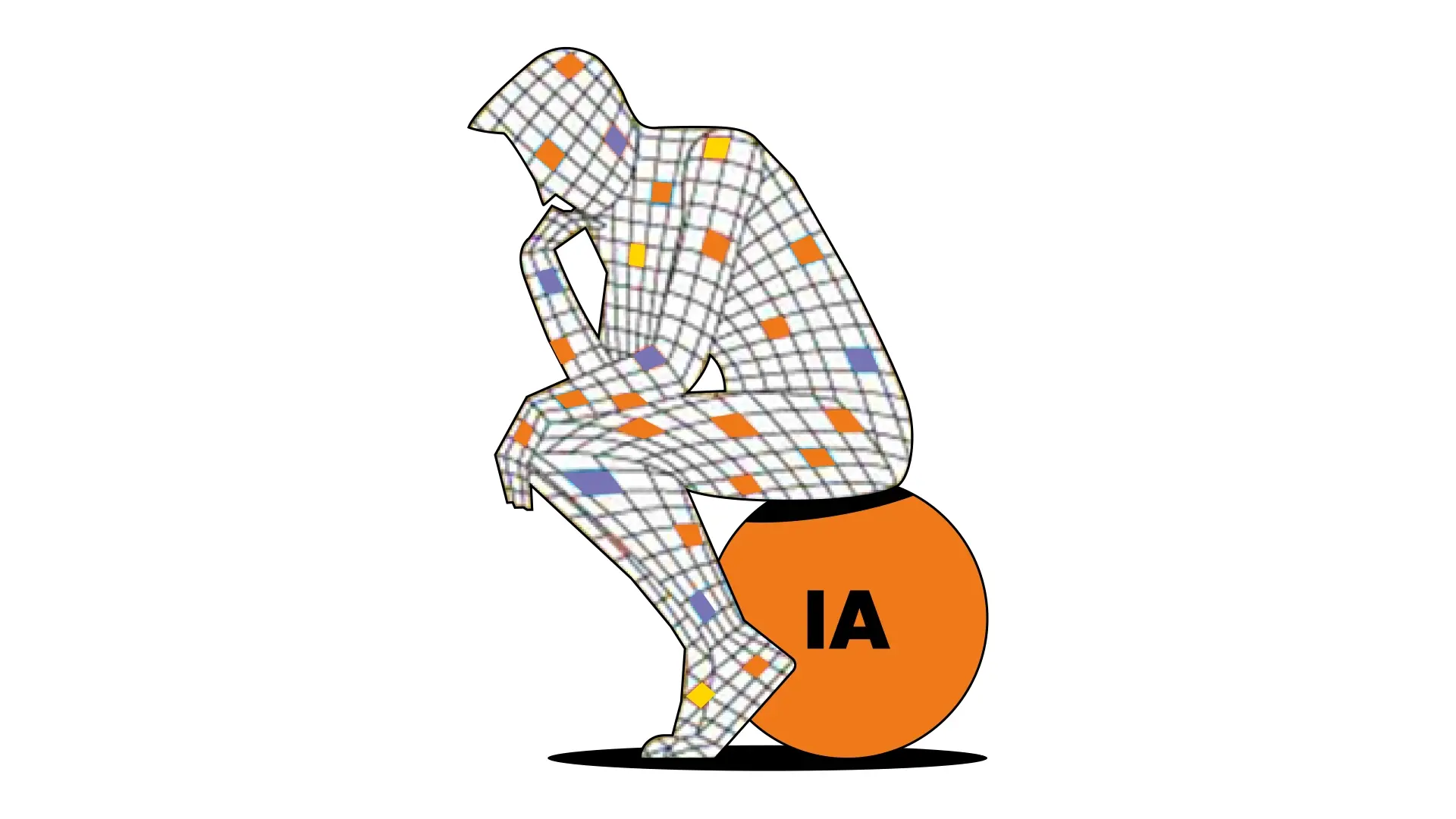
Have you heard about general artificial intelligence? Here we explain what it is and what its main characteristics are.
General Artificial Intelligence, or GAI, refers to a machine capable of learning, reasoning, and adapting as a person would, something that seemed like a topic of science fiction movies but is now a reality being developed as part of technological evolution.
It is a topic that has generated debate because it is not about a machine that simply answers questions or executes defined tasks, but about its ability to understand different contexts, face new problems, and make decisions based on logic similar to that of a human being.
To better visualize its scope, it's as if a person memorizes, learns, and truly understands how things work from a manual.
A GAI would not be limited to repeating patterns or following trained instructions; it would have the ability to relate ideas, identify alternative solutions, and transfer what it has learned from one scenario to another. The door is opening to a type of intelligence that could accompany us in a much more intuitive and natural way.
How does it differ from the “AI we use every day”
Current AI is also called narrow or specialized artificial intelligence because it does not understand the world in general; it is simple and fulfills clear tasks and objectives such as predicting, suggesting, ordering, and comparing. And when you take it out of that framework, it simply doesn't know what to do.
GAI, on the other hand, aspires to have a broader understanding and does not require being trained from scratch for each activity, but could apply its knowledge to different situations, even those it has not seen before.
The comparison also makes it clear why it generates so much expectation, since while current AI automates processes, a GAI could become a companion of rational processes.
The main characteristics of general artificial intelligence
High understanding of problems
Talking about artificial general intelligence (or AGI, or AGI… they all refer to the same thing) is thinking about a type of intelligence that is not limited to a specific task, but moves freely between different problems, much like a human would.
It is a machine capable of having a broad understanding based on AI models, neural networks, deep learning, and other techniques to create connections between ideas, just as a human brain would relate one experience to another.
Adaptability
AGI could adapt easily and learn something in one context to be able to apply it in a completely different one, from analyzing business statistics to autonomous navigation, from a conversation to a complex simulation. This type of flexibility is not achieved solely with traditional machine learning; it implies a level of reasoning that we are only just beginning to explore.
Autonomy
There is also a high level of autonomy, which is much greater than that of current AI systems; however, it is not a complete replacement of human intervention, but it is possible to work together to sustain natural and environmentally related interactions. It is a superintelligence that can work in service of humanity.
This vision connects with developments like SAP Business AI, which seeks to have models and systems work more intelligently within platforms like SAP S/4HANA or BTP. It is not artificial general intelligence, but it marks the path towards more flexible tools with greater contextual knowledge, something that companies are already beginning to value.
Are we close to achieving it, or does it remain a distant concept?
This is one of the favorite debates regarding the topic: is artificial general intelligence (AGI) just around the corner or is it an objective that we will take decades to see? The short answer is that… it depends on who you ask.
While it is true that the pace of development in technologies such as generative AI, automated learning and training, and new multimodal models makes it clear that machines have capabilities that a few years ago seemed like science fiction. The technology is advancing at a level that surprises even those who work full-time on these systems.
But on the other hand, we are still far from a system with consciousness and that has a deep understanding or skills comparable to humans in all their complexity. AGI not only requires more powerful algorithms, but a kind of artificial 'common sense' that we have not yet finished deciphering.
It is important to mention that ethical, economic, and even social factors also influence, because there are issues of global relevance that influence priorities and the speed of advancement; we know that work is being done on the subject, but we could not specify when an event of that kind will occur.
What does exist is a clear movement towards more autonomous, integrated, and capable models, something that is already reflected in enterprise platforms like SAP, where automation and performance improve year after year.
Opportunities and risks
Like any transformative technology, artificial general intelligence opens up a range of possibilities. On the positive side, a well-implemented AGI could boost company productivity, support complex decision-making, improve customer service quality, and free up operational work time thanks to advanced automation. It could also help in critical areas such as data analysis, scenario simulation, or early detection of global problems.
But it is not all promise. Risks exist, and it is important to see them calmly, there are complicated situations that would affect people such as technological dependence: if a machine has too much control in a process, human supervision could weaken, it looks like a Robocop movie scenario but there are latent risks; even in misinterpretations of information; incorrect decision-making if the data is incomplete or biased and many points that can always happen.
In addition, there is the debate about jobs: some will change, others will disappear, and many new ones will emerge. It is not about replacing humans, but about reorganizing their functions around smarter tools.
That is why it is so relevant that companies like SAP promote responsible AI frameworks, ensuring that each model, algorithm, or technology is used with transparency, traceability, and ethical criteria. It is not about stopping progress, but about accompanying it with clear criteria.
What changes could it bring to companies and professionals
If artificial general intelligence were to consolidate, its impact on companies would be profound. Imagine a system capable of understanding complete processes and reacting in real time to changes, unexpected events, or customer needs. We would no longer be talking only about automating tasks, but about a type of interaction and reasoning that would allow organizations to anticipate problems and improve their daily operations.
For professionals, AGI would mean working shoulder to shoulder with machines that understand context and provide useful knowledge, from statistical analysis to programming proposals or business strategies. Work would become more creative and less routine, because many operations would be resolved with the help of AI models integrated into their tools.
At this point, it's worth remembering the role of SAP, which already integrates intelligent technologies to improve decision-making and connect complex systems within the same company. We're not talking about AGI yet, but about firm steps towards ecosystems where data, processes, and models work together to drive performance.
In the long run, the key will be implementation: not just adopting technology, but preparing people, adjusting workflows, and creating cultures open to change. A general artificial intelligence could transform how companies operate, but its true value will depend on how we integrate it into our daily lives.
FAQ's
Could an AGI make decisions on its own?
It could, but that doesn't mean it should work without supervision. The idea is to support, not replace, human intervention. Supervision will continue to be key to ensuring ethical and responsible decisions.
How would an AGI be trained if a complete model doesn't yet exist?
Today, experiments are being conducted with neural networks, machine learning, and simulations that replicate parts of human reasoning. But there is still no system that integrates all those skills into a single machine.
What implications would AGI have for privacy?
They would be enormous. An artificial intelligence with such capabilities would need to handle sensitive data and millions of interactions. This will require stricter governance rules, something that providers like SAP are already working on to protect the knowledge and operation of companies.
How would AGI affect the handling of sensitive information, including something as simple as cookies?
The impact would be enormous. Even everyday elements like cookies would require new control and transparency frameworks. An AGI would handle deeper and more complex information, so data governance would have to be much stricter. Here, providers like SAP are already working on responsible and traceable usage models.
How would AGI impact platforms like SAP within a company?
It would completely change the way systems are operated. It could understand processes, anticipate problems, and execute tasks without relying so much on programming. Although this doesn't exist yet, we are already seeing signs in SAP services that integrate more intelligent technologies to improve productivity and decision-making.
Ready to talk to SAP specialists?
Tell us what your company needs and we'll help you find the best path.
Request information






 English
  Español de México
  Español