

The business world has become increasingly dependent on efficient management systems to remain competitive in the digital age. In this context, SAP R/3 was, at the time, a key tool for many organizations worldwide. At Xamai, we want to explain how SAP R/3 laid the foundation for the development of new SAP products and technologies and its role within companies.
What was SAP R3?
SAP R/3 is defined as an ERP (Enterprise Resource Planning – Business Resource Planning). An ERP is a comprehensive tool for managing companies, offering instruments to plan, analyze, and supervise the company's resources.
The SAP R/3 system was developed by the German company SAP SE. Its name, R/3, is derived from 'Real-time Data Processing' and '3-tier Architecture'.
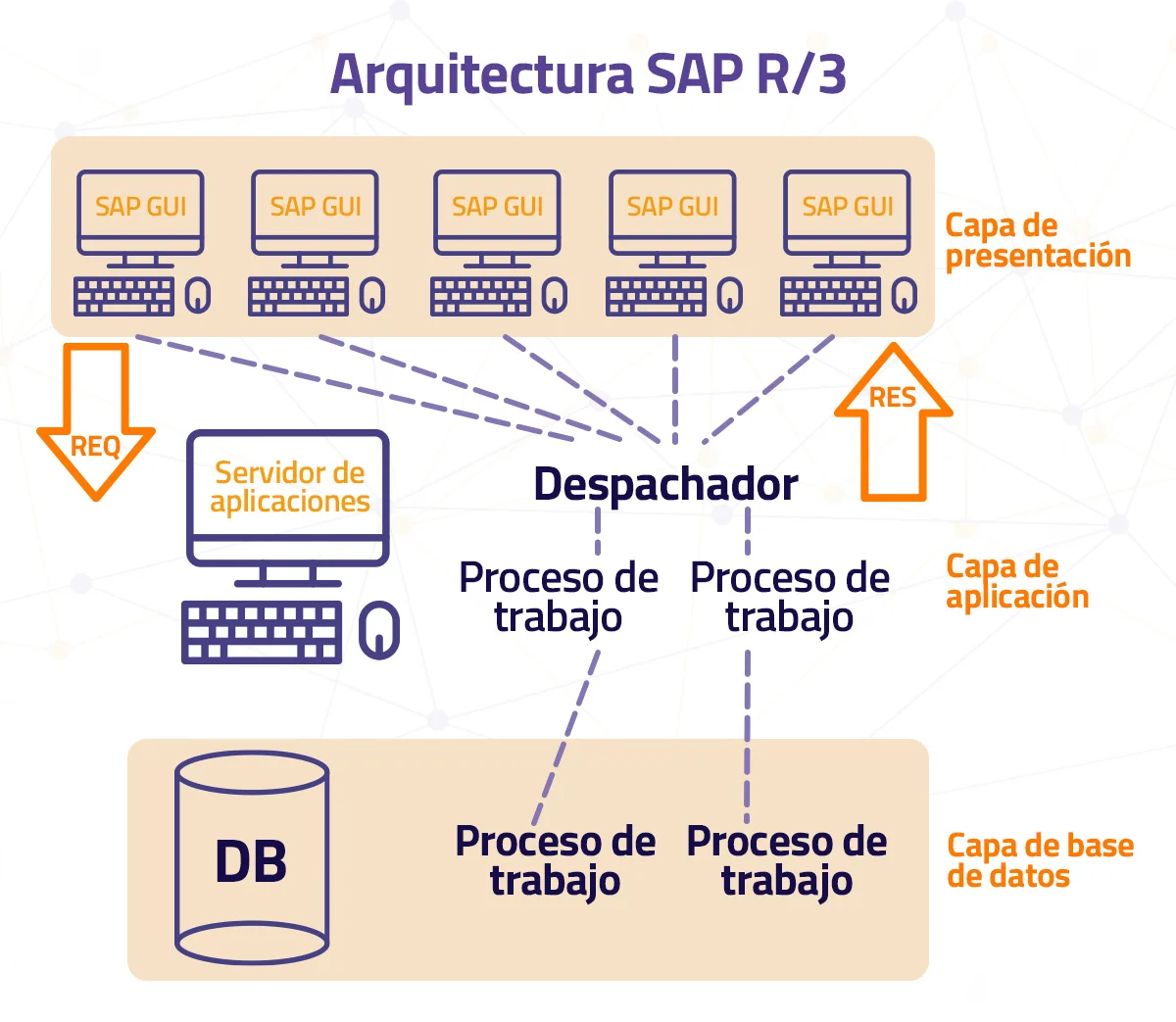
The 'R' in SAP R/3 indicates real-time data processing, while the number 3 refers to its three-tier architecture: the client (known as SAP GUI), the application server, and the database.
SAP R/3 is organized into modules, each related to a specific area of the company. The interconnection between these modules and the server allows for agile and effective operation, as well as facilitating the management of large volumes of data.
Why is it called SAP R3?
The name 'SAP R/3' originated when SAP AG, the German company behind this system, launched the third version of its software in 1992. Since then, SAP has evolved its offering and launched new business solutions, such as SAP ECC (SAP ERP Central Component) and SAP S/4HANA, but the R/3 name is still sometimes used to refer to the older version of the system.
Here's a more detailed explanation:
- Three-Tier SystemThe 'R' in SAP R/3 refers to the three-tier structure of the system. These layers are:
– Presentation Layer: User interface through which users interact with the system.
– Application Layer: Where business applications are executed and transactions are processed.
– Database Layer: Where the data necessary for the applications is stored and retrieved. - Business Applications: The '3' in R/3 indicates that the system is designed to cover a wide variety of business applications, including functions such as finance, human resources, production, inventory management, and sales, among others. This makes it suitable for many companies and organizations in different industries.
- Real-time Data Processing: The “R” also refers to the real-time processing offered by SAP R/3. This means that transactions and data are processed instantaneously, allowing companies to make faster decisions based on updated data.
How did SAP R3 work?
The following briefly explains how the R 3 system worked and which set a precedent for future SAP products:
-
Three-Tier Architecture:
Presentation Layer: This was the user interface through which users interacted with the system. It could be a desktop application or a web interface. Users had access to different modules and performed tasks according to their roles in the organization.
Application Layer: This layer contained the SAP R/3 business logic. Here, programs for specific business processes were executed, such as inventory management, finance, human resources, and more. The application layer processed user requests, and business logic was executed on application servers.
Data Layer: The data layer held the storage of all information used by the system. SAP R/3 used a relational database to store critical company data, such as customer records, suppliers, purchase orders, invoices, etc.
-
SAP Modules:
SAP R/3 consisted of various modules, each designed to manage a specific business function. Some of the modules include:
SAP FI (Finance): For financial and accounting management.
SAP CO (Controlling): For cost control.
SAP MM (Materials Management): For inventory and procurement management.
SAP SD (Sales and Distribution): For sales and distribution management.
SAP HR (Human Resources): For human resources and payroll management.
-
Business Processes:
SAP R/3 at the time allowed organizations to automate and optimize their business processes. Users could perform transactions in the system to carry out tasks such as creating sales orders, processing invoices, managing inventories, and generating financial reports. These business processes were executed consistently and efficiently throughout the organization.
-
Integration:
One of the key features of SAP R/3 was its integration capability. Data flowed seamlessly between the different modules and was stored in a centralized database. This allowed organizations to gain a complete view of their business operations and make informed decisions.
-
Security and Control:
SAP R/3 provided a robust set of security controls to protect critical business information. User roles and profiles could be configured to ensure that users only have access to the information and functions necessary to perform their tasks.
Additionally, it had an environment called ABAP (Advanced Business Application Programming) that allowed it to develop and install additional software independently.
SAP R/3 is an ERP system that helped organizations manage their business operations efficiently by automating processes, integrating data, and providing a platform for data-driven decision-making.
Its three-tier architecture and suite of modules made it a versatile solution for a wide variety of industries and sectors.
SAP R3: What benefits did it offer organizations?
This software was used in organizations around the world to manage a wide range of business functions, from finance and human resources to logistics and inventory management. Here are some benefits that SAP R/3 used to bring to companies.
Process Integration: SAP R/3 integrated various business functions into a single system. This meant that data flowed consistently between departments, which reduced duplication of effort and errors.
Process automation: The system automated many routine tasks, which increased efficiency and reduced the time and resources needed to carry out these tasks.
Improved Decision-Making: SAP R/3 provided real-time access to updated data, which allowed managers to make more informed and faster decisions.
End-to-End Visibility: It provided a complete view of business processes, from the acquisition of raw materials to the delivery of finished products, making it easier to track and manage the entire product lifecycle.
Accurate Financial Management: It helped with financial accounting, cost tracking, and budget planning, ensuring accurate and transparent financial management.
Inventory Optimization: It helped organizations maintain an appropriate balance in their inventory levels, which could reduce costs and improve operational efficiency.
Human Resources Management: It facilitated human resources management, from hiring to payroll and employee development.
Regulatory Compliance: It helped comply with business regulations and standards, as it facilitated the generation of accurate reports and the management of audits.
Scalability: SAP R/3 was scalable, which meant that it could adapt to the changing needs of your organization as it grew.
Improved productivity: By reducing manual workload and providing efficient tools, SAP R/3 was able to increase employee productivity.
Improved customer satisfaction: By providing a complete view of customer interactions and product availability, it helped improve customer satisfaction by providing better service.
Advanced data analysis: SAP R/3 offered advanced analytics capabilities, allowing organizations to perform data analysis to identify trends and improvement opportunities.
However, it is important to note that implementing and effectively using SAP R/3 was also costly and challenging. It required careful planning and management to ensure that the benefits were realized and outweighed the costs and efforts associated with implementing and maintaining the system.
Why implement SAP?
Implementing SAP, a leading market Enterprise Resource Planning (ERP) system, offers numerous benefits for organizations. First, SAP centralizes the management of data and business processes, which improves operational efficiency by eliminating data duplication and simplifying decision-making. Furthermore, SAP provides a comprehensive view of the company, making it easier to identify areas for improvement and optimization.
The process automation that SAP offers reduces errors and cycle times, which translates into increased productivity and lower operating costs. In addition, SAP facilitates compliance with regulations and standards, minimizing legal and financial risks.
Another key advantage is SAP's ability to adapt to the changing needs of the company through customization and integration of additional modules. This ensures that the system can evolve with the organization as it grows and expands.
SAP promotes data-driven decision-making by providing advanced analytics and real-time reporting, which helps companies anticipate trends and make informed strategic decisions.
While SAP R3 was once a functional and widely used solution, the constant evolution of enterprise technology has led to this platform showing certain limitations in terms of scalability and adaptation to the changing needs of modern companies.
At Xamai, we are committed to offering cutting-edge and customized solutions for your business. We can help you take the leap into the future with the implementation of SAP Business One or SAP S/4HANA, always adapting to your specific needs and ensuring efficient business management aligned with current industry standards. Contact us to explore how we can take your company towards a more competitive and efficient future in Industry 4.0.
Ready to talk to SAP specialists?
Tell us what your company needs and we'll help you find the best path.
Request information






 English
  Español de México
  Español