
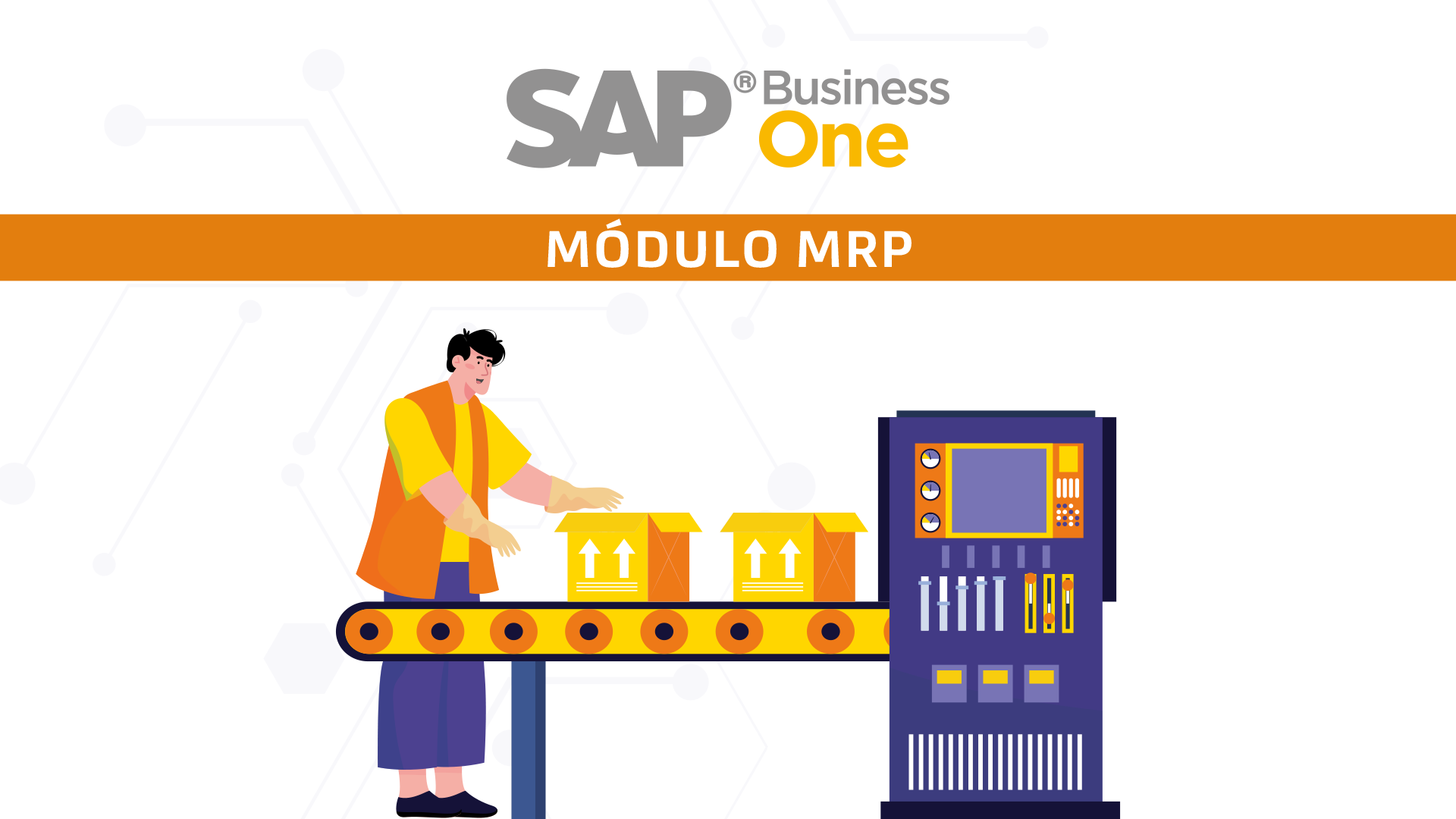
Meet this powerful tool designed to optimize the planning and management of materials within small and medium-sized companies.
MRP is Material Requirement Planning, its acronym in English. This module of SAP Business One allows you to determine how much needs to be purchased and produced at a given time, in order to create automatic purchase orders and production orders based on the recommendation report that the system provides you.
The MRP module of SAP Business One helps you plan and manage your inventory in order to have control over it. The purpose of this module is to have the required material at the right time to meet the demands of your customers.
The objectives of MRP in SAP Business One for a company are:
- Ensure that materials and products are available for production and delivery to customers.
- Maintain adequate inventory levels for the operation.
- Plan manufacturing activities, delivery schedules, and purchasing activities.
Advantages of the MRP module in SAP Business One
- Automate processes that previously required complex manual calculations and allows for time savings.
- Avoid excessive inventory storage and reduce associated costs.
- Helps companies meet delivery deadlines by keeping materials available at the right time.
MRP process flow
With MRP, inventory can be optimized through needs-based receipt planning to avoid excess products. Sales and distribution respond to the specific needs of market customers.
In demand management, sales are planned in advance through a sales forecast. The sales forecast is entered into demand management as an independent planned requirement (PIR), i.e., the need for finished product.
To cover these needs, MRP calculates net requirements and plans supply quantities and the dates on which the material should be purchased or produced.
If an item is produced internally, the system breaks down the bill of materials and calculates dependent requirements, i.e., the quantity of components needed to produce the finished product.
What happens if there is a material shortage?
In the event of a material shortage, planned orders are created at each level of the bill of materials to meet requirements and purchase requisitions are generated for externally purchased raw materials. You can also create planned orders for externally purchased items that can be converted into a purchase requisition.
Delivery deadlines
MRP plans delivery deadlines and calculates planned order dates based on the delivery lead times of the routes. Basically, it performs backward planning from the date of the least requirement (GR processing time, internal production time, pre-production float time) and calculates the duration of planned orders through the obtained data.
Production orders or purchase orders are created after converting planned orders and purchase requisitions, respectively.
The MRP type “PD” in MRP master data 1 is essential for executing MRP for materials. If you do not want to execute MRP on the item, the MRP type “ND” can be managed in the item master record.
Importance of SAP Business One MRP
MRP is important because making a bad decision regarding warehouse stock can result in insufficient material to meet demand, if you buy too much material it can spoil, evaporate, or deteriorate without obtaining profit, and finally, starting production at an inappropriate time can cause it to not be finished on time.
What can be done in the MRP module?
What can be done in the MRP module in SAP Business One is:
- Purchase and sales orders.
- Global purchase and sales agreements.
- Advance invoices.
- Recurring sales orders.
- Sales forecast.
- Production orders.
- Inventory level reports.
- Stock transfer requests.
- To have up-to-date information on our production, at all times.
- Improve the relationship with customers and suppliers, by meeting their needs on time and in full.
- To successfully complete all work orders thanks to the planner.
- Reduce or even eliminate overtime.
- Reduce temporary hires for production work.
- Maintain inventory at optimal levels.
- Reduce inventory costs.
- Increase productivity.
- Better manage supplier deliveries.
The MRP module of SAP Business One is essential for SMEs looking to improve their production operations and maintain efficient inventory control. It is a solution that transforms materials planning into an agile and reliable process.
Are you ready to unlock the potential of MRP in your company? With SAP Business One, planning has never been so easy!
To learn more about the tool, see our MRP Webinar
Ready to talk to SAP specialists?
Tell us what your company needs and we'll help you find the best path.
Request information








 English
  Español de México
  Español