

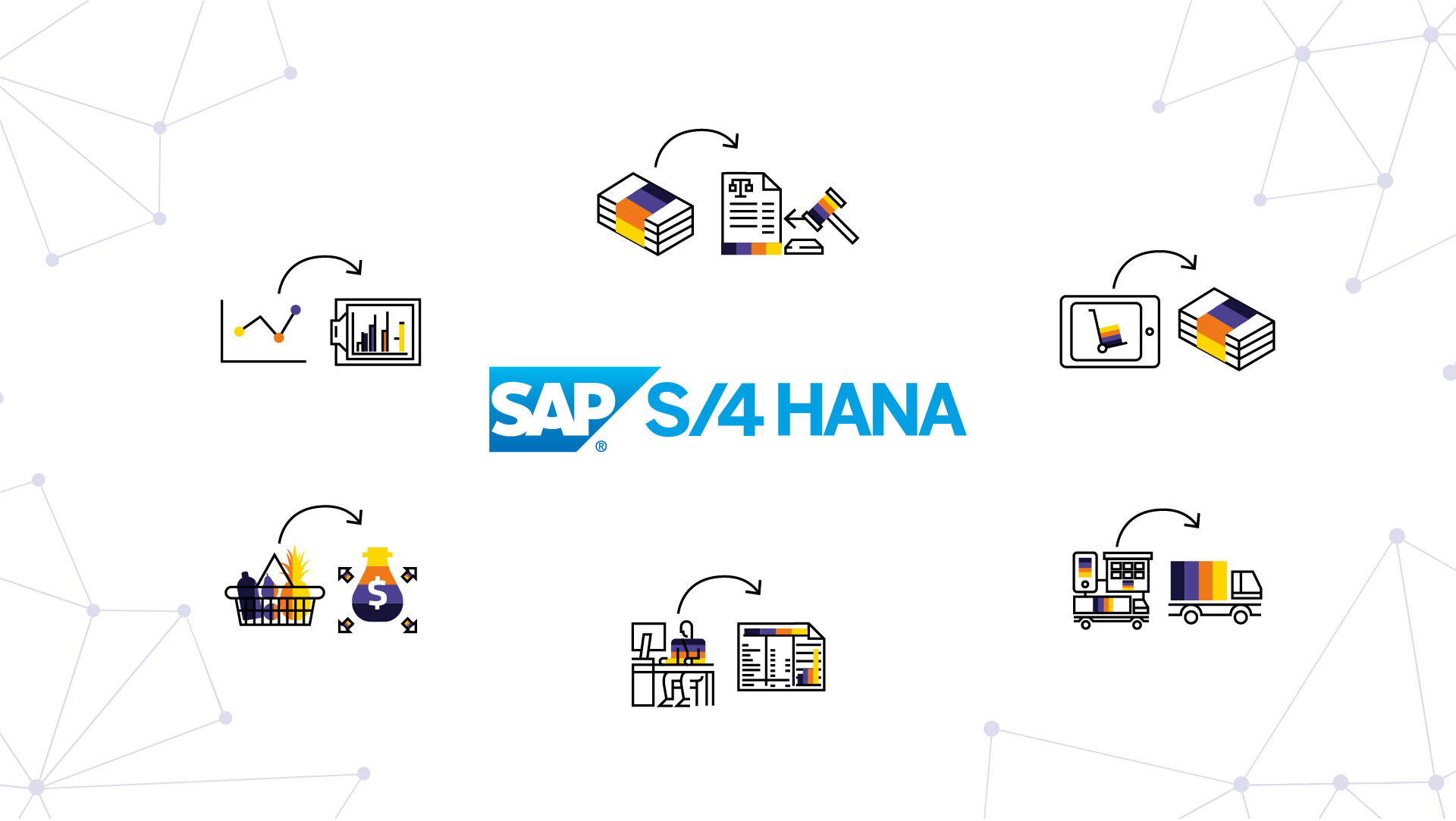
Learn how traditional SAP ERP modules have evolved into SAP S/4HANA Cloud, giving way to more efficient and integrated macroprocesses.
SAP has developed a cloud-based system where organizations can adapt comprehensive processes, tracking them in each phase.
In a 'Cloud' system, where innovation is key, the modules that make up an OnPremise scheme are discarded to give way to 'Macroprocesses'.
Macroprocesses have cross-functional features that intertwine with each other for greater information coverage, measuring everything with indicators to achieve maximum efficiency.
SAP S/4HANA Cloud in its Public (Grow) or Private (Rise) version adopts a macroprocess analysis approach aligned with industry best practices.
What are the Macroprocesses that replace SAP modules in the Cloud schemes of S/4HANA?
As we mentioned earlier, macroprocesses are like the 'threads' that connect the different areas of a company, from the acquisition of materials to the generation of financial reports.
The macroprocesses of SAP S4 HANA Cloud are:
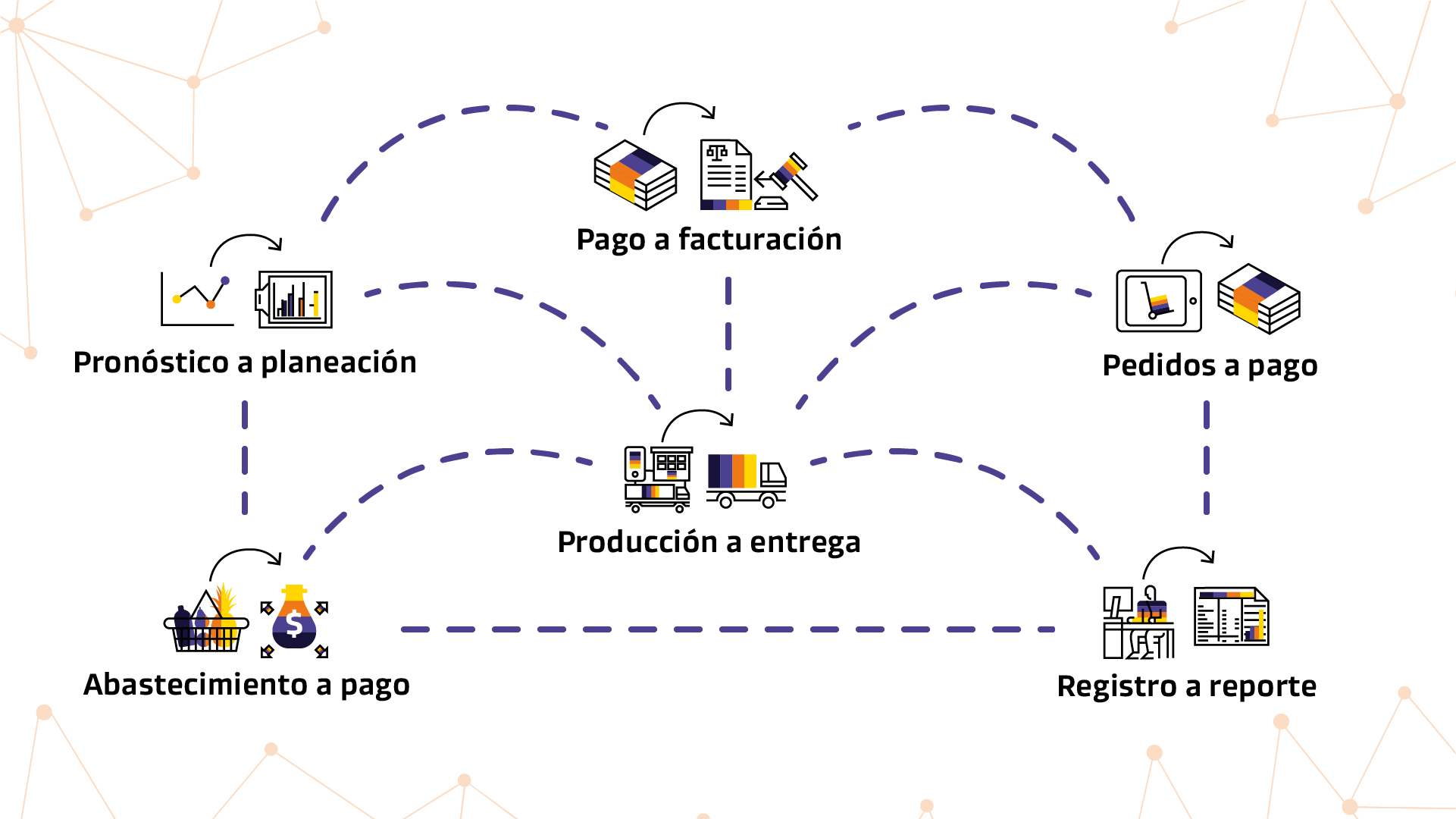
Source-to-Pay (Procure-to-Pay) / Abastecimiento a Pago:
This process encompasses all activities related to the acquisition of goods and services, from the identification of the need to payment to the supplier. It includes tasks such as creating purchase requests, selecting suppliers, receiving goods, and managing invoices.
Record-to-Report / Registro a Reporte:
It refers to the company's accounting and financial processes, from the recording of transactions to the generation of financial reports. It includes tasks such as recording income and expenses, closing the books, and preparing financial statements.
Make-to-Deliver / Producción a Entrega:
It focuses on the company's production and logistics processes, from production planning to product delivery to the customer. It includes tasks such as production scheduling, quality control, and inventory management.
Order-to-Cash / Pedidos a Pago:
This process covers all activities related to the management of customer orders, from order receipt to invoice collection. It includes tasks such as creating sales orders, managing inventory, and issuing invoices.
Cash-to-Tax / Pago a Facturas:
This macroprocess focuses on the management of the company's cash flow and compliance with tax obligations. It includes tasks such as managing accounts receivable and payable, bank reconciliation, and tax filing.
Forecast-to-Plan / pronóstico a planeación:
This process focuses on the company's long-term financial planning. It includes tasks such as preparing budgets, planning investments, and managing risks.
How do Macroprocesses work in SAP S/4HANA Cloud ERPs?
Macroprocesses: The Panoramic View
Macroprocesses in SAP S/4HANA Cloud represent a holistic view of an organization's business processes. They are like large 'umbrellas' that group a series of interrelated and essential activities for the operation of the company.
Some examples of macroprocesses are:
- Source-to-Pay: Manages the entire lifecycle of a purchase, from request to payment.
- Order-to-Cash: It covers the complete sales process, from order receipt to payment collection.
How did the SAP ERP modules evolve into Macroprocesses in S/4HANA Cloud?
In previous versions of SAP, such as SAP ECC (ERP Central Component), the system was structured into specific modules that represented different functional areas within a company.
Some of the most important modules were:
- FI (Financial Accounting) – Financial accounting
- CO (Controlling) – Cost and profitability control
- MM (Materials Management) – Materials and purchasing management
- SD (Sales and Distribution) – Sales and distribution
- PP (Production Planning) – Production planning
- QM (Quality Management) – Quality management
- HR (Human Resources) – Human resources
- PM (Plant Maintenance) – Plant maintenance
In SAP S/4HANA Cloud, instead of these individual modules, they have been grouped into macroprocesses that reflect a more integrated view of the business.
For example:
- The module MM (Materials Management) and part of the module FI are integrated within the Source-to-Pay (Procure-to-Pay).
- The modules FI and CO are consolidated into Record-to-Report, optimizing financial management with advanced analytics.
- The module PP (Production Planning) is part of Make-to-Deliver, uniting production, logistics, and inventory in a single flow.
What advantages does this evolution offer?
- Less customization and more standardization: In SAP S/4HANA Cloud Public Edition, industry best practices are preconfigured, which reduces implementation times.
- Greater integration between processes: Macroprocesses allow companies to manage their operations more smoothly, without relying on functional silos.
- Advanced analytics and automation: SAP S/4HANA Cloud uses artificial intelligence and machine learning to optimize processes and facilitate decision-making.
What does this mean for companies that already use SAP ECC?
For companies migrating from SAP ECC to SAP S/4HANA Cloud, it is important to understand how their processes will be transformed.
In general, functions that were previously in separate modules are now available within macroprocesses and are configured in a more integrated way.
Lines of Business: Specialization
Within each macroprocess, we find the lines of business. These are more specific areas that focus on particular activities related to the macroprocess.
For example, within the “Source-to-Pay” macroprocess, we could have the following lines of business:
- Direct Procurement: Acquisition of raw materials and components for production.
- Indirect Procurement: Acquisition of goods and services that are not directly related to production, such as office supplies or consulting services.
Lines of business allow companies to adapt macroprocesses to their specific needs and the characteristics of each industrial sector.
Business Processes: Detailed Execution
Business processes are the individual activities that make up the lines of business and, ultimately, the macroprocesses. They are the specific tasks performed to achieve a specific objective. For example, within the “Direct Procurement” line of business, we could have the following business processes:
- Creation of a purchase request: The user requests a specific product or service.
- Selection of a supplier: Different suppliers are evaluated and the most suitable one is selected.
- Creation of a purchase order: The purchase request is formalized with the selected supplier.
Business processes are the foundation upon which enterprise management systems like SAP S/4HANA Cloud are built. By modeling and automating these processes, companies like yours can improve efficiency, reduce costs, and make more informed decisions.
.
Important: Business processes are key criteria that will help determine if your company could implement:

S/4HANA Cloud Public: If your company can adapt to the system's preconfigured processes, as these cannot be modified.

S/4HANA Cloud Private: If your company needs specific details where customization is required, this ERP software has the flexibility to build or adapt processes according to your needs.
How are the Macroprocesses, Business Lines, and Business Processes that my company needs determined?
Implementing SAP S/4HANA Cloud is a strategic decision that will transform your business. At Xamai, we accompany you on this journey to ensure you make the most of this technology.
In our pre-sales process (which has no cost), we have discovery sessions that allow us to know and understand:
- Your current processes: We identify your strengths, areas for improvement, and innovation opportunities.
- Design a custom solution: We define the macroprocesses, business lines, and business processes that best adapt to your specific needs.
Through intensive sessions, we map your processes and create a detailed DDA (Discovery Digital Assessment), which will serve as a roadmap for your implementation. With this document, you can visualize how SAP S/4HANA Cloud will transform your company and allow you to achieve your business objectives.
If you want us to accompany you on this innovation journey for your company, contact us and it will be a pleasure to help you.
Ready to talk to SAP specialists?
Tell us what your company needs and we'll help you find the best path.
Request information






 English
  Español de México
  Español