

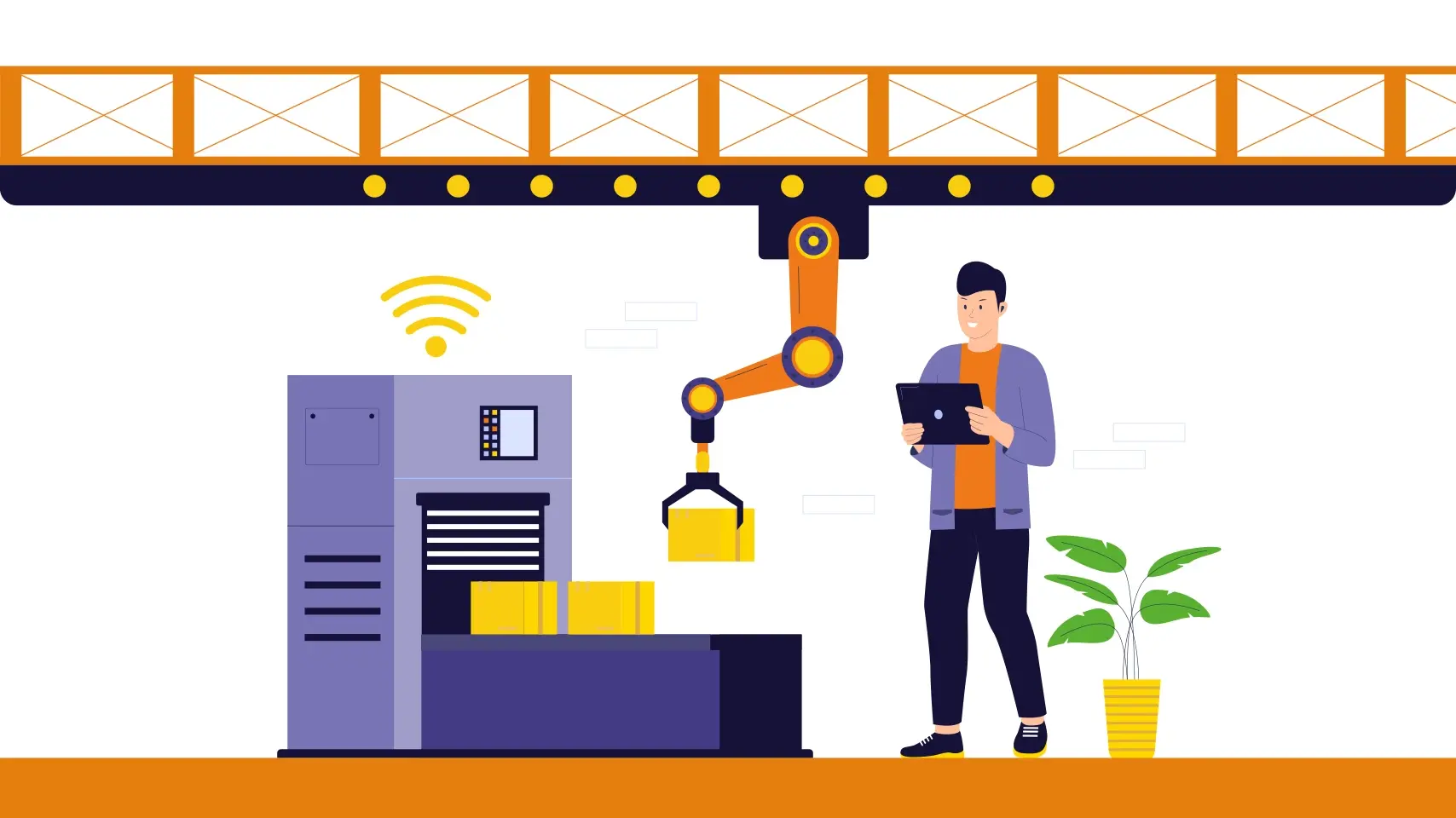
What are the benefits of industrial automation and the keys to implementing it successfully in your company.
Modern production plants need industrial automation because this is no longer a concept of the future, it is a daily reality that must transform every sector. Today, industrial automation systems allow for a transformation of work and, consequently, an improvement in results for a company regardless of its size. But how does industrial automation really work in practice? How can it be successfully implemented?
We will explain this system in detail below.
The concept of industrial automation
Let's start with the basics, the concept of industrial automation: this refers to the use of technologies, systems, and devices to operate industrial processes with minimal human intervention, as its name suggests, everything is automated.
Its objective is to increase efficiency, reduce errors, greatly improve the quality of products, and also the safety of workers.
Proper automation integrates elements such as sensors, actuators, industrial robots, control systems, computers, controllers, and specialized machinery into its processes.
Types of industrial automation
As with everything, there are several types of industrial automation that have very particular functions. Let's look at each of them:
- Fixed automation: used in repetitive processes such as the assembly of products in series, its characteristic is that it has an established configuration and little flexibility.
- Programmable automation: its function is to modify the sequences of operations by reprogramming automata or controllers and is generally common in production batches.
- Flexible automation: combines the best of both worlds, allowing for quick changes without the need for major adjustments.
Practical operation of an industrial automation system
To understand the operation, it is necessary to visualize a kind of interconnected chain of components that perform specific tasks within the automation system.
It all starts with sensors that detect variables including temperature, pressure, movement, or resistance. Any type of change is sent to a control system, such as a PLC (programmable logic controller), which decides based on the defined parameters.
Generally, the system sends orders to actuators, machines, or industrial robots, which execute the required actions at the moment, such as cutting, assembling, moving goods, or adjusting the speed of a production line.
This process occurs instantaneously, allowing for constant monitoring and the collection of valuable data to optimize processes and detect failures.
Components in automation processes
These elements make automation and machine control possible:
- Sensors: capture information from the environment (temperature, light, humidity, movement).
- Actuators: transform orders into physical actions (motors, valves, pneumatic cylinders).
- Control systems: make automatic decisions (PLC, SCADA, DCS).
- Computers and software: manage data, optimizing processes and programming what is required for continuous improvement.
- Human-machine interfaces (HMI): facilitate communication between operators and systems.
Applications of industrial automation
Now, you are probably wondering where this automation is applied? Can my company be automated? The answer is simple: any company, regardless of sector and size, can have industrial process automation.
For example, in the automotive industry, it is used in the assembly of vehicles with robots that perform welding or painting. In the food industry, it allows controlling temperature, times, and product quality. In the pharmaceutical sector, it facilitates precise dosage control and traceability.
Automation systems are also common in the electronics, textile, chemical, and construction industries, improving task distribution, energy efficiency, and the quality of the final result.
Benefits of industrial automation
Now that you know your company can be automated, we show you the benefits you can obtain from the industrial automation process:
- Increased productivity: automated systems work without interruptions, at a higher speed and with fewer errors.
- Quality improvement: automation guarantees consistent results and reduces defects in products.
- Reduced costs: by optimizing resources, times and labor, the company increases its profitability.
- Greater safety: reduces workers' exposure to dangerous or repetitive tasks.
- Data collection and processing: allows for real-time analysis to make informed decisions.
- Maintenance optimization: digitalization helps to detect failures before they become major problems.
How to achieve a successful implementation
For the automation process to be successful, it is very important to consider the following factors:
Evaluate specific needs:
Each industry and each company has particular characteristics. There is no one-size-fits-all solution.
Design a clear strategy:
Define objectives, priority processes and implementation stages.
Select reliable suppliers:
Have technology partners who offer customized solutions, support and training.
Engage employees:
Their knowledge of the plant's internal operations is essential to adapt systems and processes.
Train the team:
Update skills in programming, maintenance, and use of new tools.
Monitor results:
Use data to adjust, optimize, and scale automation.
Transformation and future of industrial automation
Industrial automation will continue to grow over the years and with the use of new technologies. Thanks to artificial intelligence and machine learning, systems learn from collected information and continuously improve.
This opens the door to automation with greater autonomy that also allows for close collaboration with human labor. It is an imminent evolution that is transforming traditional functions and also the organization of work. New jobs appear and, although some activities disappear, others are created, especially in programming, system maintenance, data analysis, and project management.
Industrial automation helps every growing business to face the challenges of globalization, competitiveness, and the demand for customized products, as well as being a tool to increase performance and guarantee quality from the first piece.
The role of SAP and Xamai in industrial automation
In the automation process, companies that have become established know the importance of having a robust digital infrastructure that benefits them in the short, medium, and long term. In this context, solutions like SAP S/4HANA allow integrating and administering all production, maintenance, logistics, and distribution processes centrally, providing a real-time overview of their competitive and production development.
At Xamai, as a specialized partner in the implementation of SAP, we accompany companies in their digital transformation and help them adapt systems to business needs and integrate advanced tools that facilitate industrial automation.
We create a synergy so that organizations that work with us can achieve smarter management, reduce operating costs, and increase their competitiveness.
Automation as a business driver
Today more than ever, industrial automation represents a strategic advantage. It's not just about installing machines, but about rethinking industrial processes with an integral and connected vision. From the receipt of raw materials to the distribution of finished products, automation systems can transform each stage of the production cycle.
With good planning, the right tools, and the commitment of the entire organization, automation can be the lever that takes companies to a new era of efficiency, competitiveness, and sustainability.
Ready to talk to SAP specialists?
Tell us what your company needs and we'll help you find the best path.
Request information









 English
  Español de México
  Español