
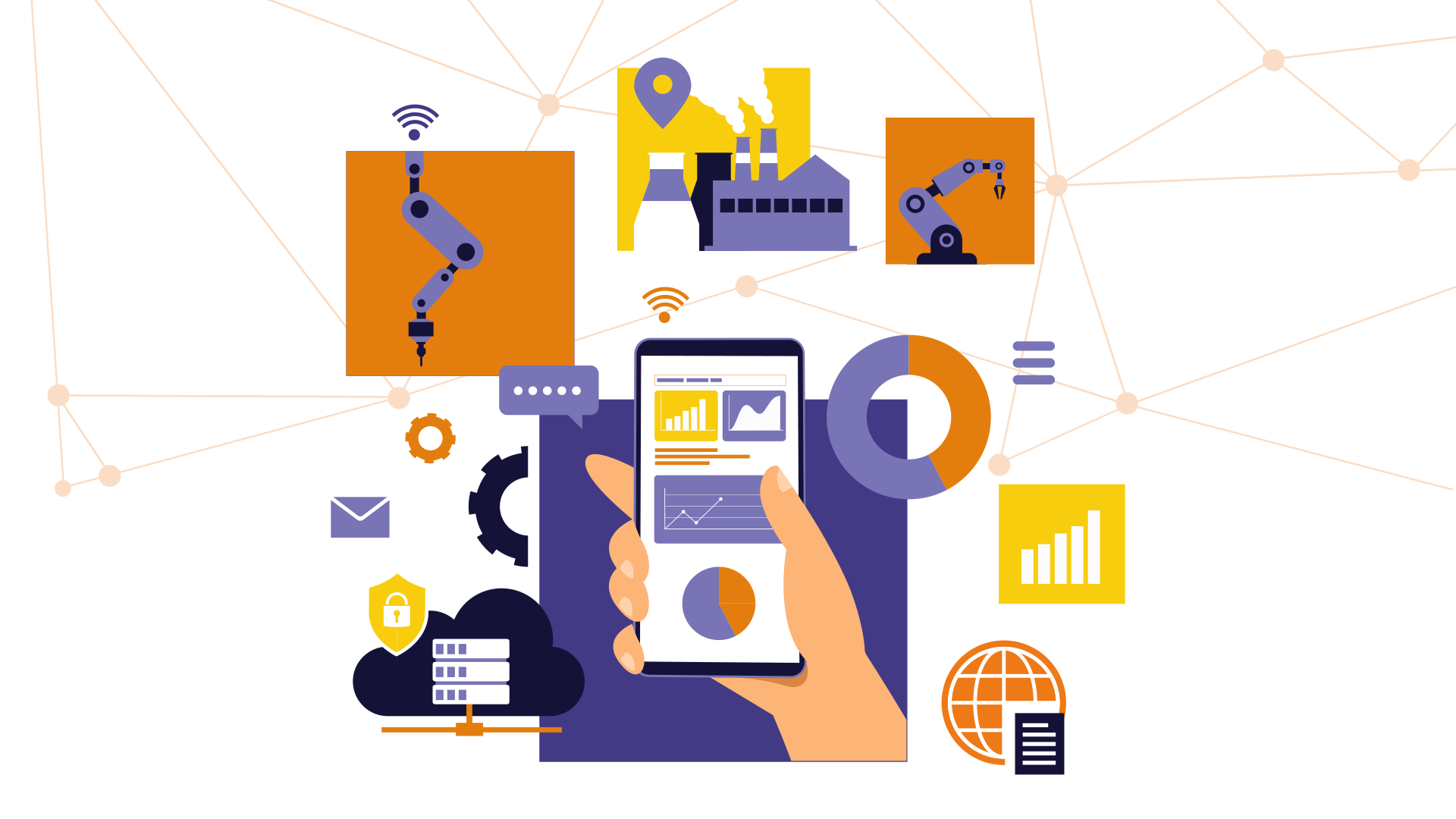
Discover what the Industrial Internet of Things (IIoT) is and how it transforms your business. Connect machines, optimize processes, and achieve the efficiency of Industry 4.0 with Xamai.
The Industrial Internet of Things (IIoT) is a concept that has marked a trend in factories and businesses that have many processes, use machines and real-time data, but be careful, it is not the same as the general Internet of Things (IoT). The central idea of this is very simple: to be able to connect machines, sensors and equipment to the internet in order to collect data, send it to the cloud and process it with artificial intelligence (AI) and advanced analytics.
All of this serves to make faster and better decisions about how the business works. At Xamai, we will help you understand how all this world of industrial internet of things works and why it has become key for companies to be more efficient, safe and productive.
IIoT explained from scratch
To fully understand IIoT technology, you need to start with something simple: it is an evolution of the IoT that we all use every day. Traditional IoT connects smartwatches, lights, voice assistants, or appliances. It is technology designed for consumers, home comfort, and basic automation.
The Industrial Internet of Things is another world apart; here we talk about connecting machines, sensors, systems, production lines, robots, power equipment, industrial vehicles, and all the infrastructure that supports companies and productive sectors.
The Key to IIoT
Because a failure is critical, IIoT requires greater security, precision, and availability than the Internet of Things, and all of this because its main objective is:
- To move data in real time very quickly.
- To analyze this information with advanced systems (cloud, edge computing).
- To use that analysis to prevent failures, improve performance, and optimize processes (such as energy consumption).
Why did the industry need something like IIoT? IIoT for large-scale businesses
Because machines generate tons of data, but before that information was lost. There was no system to organize it, send it to a database, pass it through intelligent processing, and transform it into something useful. IIoT came to solve that: to convert data into quick, concrete decisions capable of improving the performance, productivity, and efficiency of the industry.
Connectivity and communication as the foundation of everything
The true strength of IIoT is not only in the machines, but in how they communicate with each other because it must be emphasized that without reliable connectivity, IIoT does not work.
All equipment must communicate and be united in the same direction.
Constant data exchange
Machines, sensors, and industrial systems must share important data continuously and be aware of elements such as temperature, vibration, pressure, energy consumption, among others. It is very important that this communication is fluid, stable, and secure.
The technologies that achieve all this connectivity
To achieve this, different layers of technology are used:
Industrial networks as a first bridge, are specialized networks (such as industrial Ethernet or advanced Wi-Fi) designed for harsh environments.
Data processing systems and two main approaches are used. For better understanding, we have created this comparative table:
|
Focus |
Description |
Main Purpose |
|
Cloud Computing |
Remote servers (the cloud). |
Store and analyze large volumes of data. |
|
Edge Computing |
Small servers close to the machine (on the "edge"). |
Process data instantly for quick decisions.milliseconds). |
The role of protocols
Standardized protocols are used so that, regardless of the brand or generation, it is possible to understand and connect, thus guaranteeing the integrity, availability, and security of information, since an interruption can stop all production and bring about serious economic losses.
How it benefits companies
IIoT has become a very important tool for any organization that wants to operate better and compete seriously within Industry 4.0.
The benefits are felt directly in the day-to-day operations of companies. For example, it allows reducing costs by identifying inefficient processes, detecting failures before they occur, and avoiding unnecessary purchases of spare parts or emergency shutdowns.
Machines work with more stable parameters, receive timely maintenance, and operate better, all of which results in excellent business productivity.
It allows anticipating peak demand, scheduling shifts, adjusting inventories, and coordinating production lines in a more orderly manner, which makes your business highly competitive in the market.
IIoT helps companies work with more order, fewer unforeseen events, and with decisions based on data, not assumptions.
Sustainability and consumption reduction
One of the strongest pillars of IIoT is its role in sustainability. Factories and industrial facilities that have IIoT systems monitoring each piece of equipment can identify leaks, overconsumption, downtime, motors operating outside of range, poorly adjusted cycles, and behaviors that are difficult to notice at a glance.
In addition, the collected information helps to design savings strategies: turning off equipment during periods of low demand, adjusting production according to electricity rates, or even detecting areas of the plant where there are heat losses or insulation failures.
All of the above results in a more intelligent use of energy and materials, which reduces costs and reduces the environmental impact of operations without sacrificing performance.
Platforms and developers behind IIoT
Although sometimes we only see the final result behind IIoT, there is an entire system of people and platforms that make this technology possible. Developers create the applications that connect the equipment; programming engineers are responsible for protocols, configuration, and integration; systems specialists install industrial networks; and data processing experts ensure that the information arrives in the correct format and with the necessary precision.
In addition to this, there is the work of field implementation teams, who install sensors, calibrate devices, and validate that each machine sends the correct data.
This entire set forms the foundation upon which IIoT solutions operate, and without them, it would not be possible to connect so many different technologies within a single industrial ecosystem.
IIoT Applications by Sector
|
Sector or Industry |
Use of IIoT |
Main Objective |
|
Oil and Gas |
Detection of pressure changes and operating conditions. |
Prevent incidents and failures. |
|
Food and Beverage |
Monitoring of temperature, humidity, and sanitary conditions. |
Ensure product quality and safety. |
|
Logistics and Transportation |
Tracking of vehicles and optimization of routes and fleets. |
Improve efficiency and delivery times. |
|
Infrastructure (Services) |
Management and control of electrical grids, water, and energy distribution. |
Ensure continuity and optimize consumption. |
|
Pharmaceutical |
Control of critical parameters (temperature, vibration) in production. |
Maintain precision and strict regulation. |
|
Mining |
Measurement of vibrations, wear, and consumption of heavy equipment. |
Evaluate performance and schedule predictive maintenance. |
Step-by-step implementation
Adopting the IIoT is a process that requires a complete strategy and is not just about buying and connecting equipment. We will explain it step by step.
1. Planning and Devices
Sensor selection: Choose the appropriate devices and sensors according to the specific needs of your project (temperature, pressure, vibration, etc.).
Installation and Calibration: Physically install the sensors and ensure they are properly calibrated to begin collecting accurate data.
2. Connectivity and Integration
Network configuration: Adjust industrial networks (Wi-Fi, Ethernet, etc.) and infrastructure to ensure stable communication.
Definition of protocols: Establish communication protocols so that all equipment can exchange data without interruptions.
Integration with platforms: Connect the devices to management platforms (cloud or edge computing) where data will be stored, analyzed, and visualized.
3. Testing and Optimization
Initial Monitoring: Perform thorough testing of the entire system to ensure data flows correctly.
Detection and Adjustment: Identify any errors or inconsistencies in data collection or analysis and adjust system parameters.
4. Training and Maintenance
Personnel Training: Train the human team to understand how the new system works, how to leverage analysis tools, and how to keep the operation alive and efficient.
How IIoT implementation connects with SAP
When a company decides to move towards Industry 4.0, IIoT implementation is necessary to transform processes, make better decisions, and operate with real-time data.
This is where SAP comes in as the great coordinator that organizes all the information generated by the devices, machines, and sensors distributed in the different facilities.
The connection between sensors, machines, and SAP
In a modern factory, sensors measure temperature, operating cycles, vibration, energy consumption, or any parameter that affects the operation of the machinery.
That constant collection travels through industrial networks and communication protocols to a database connected with SAP, whether in the cloud, local servers, or hybrid schemes that combine cloud computing with edge computing to accelerate real-time processing.
Thanks to that integration, SAP can interpret data from the industrial internet of things and align it with key modules such as:
- SAP PM for maintenance and predictive maintenance strategies.
- SAP PP to adjust live production.
- SAP WM/EWM to move inventories according to the actual movement within warehouses.
- SAP MM to supply materials without relying on manual reports.
This is how the industrial internet of things becomes functional for manufacturing, not just a beautiful technology project.
Data flowing in real time and processes that optimize themselves.
One of the great advantages of using IIoT with SAP is that companies stop depending on hand-filled spreadsheets or delayed reports. Now, the equipment, products, and production lines themselves send data in real time that feeds the system.
This is achieved:
- Automatic optimization of resources.
- Greater efficiency in operations and supply chain.
- Less manual intervention.
- Greater productivity and competitiveness for organizations.
- More precise planning thanks to the analysis and treatment of information.
Furthermore, when unusual behavior appears in machinery, such as a different vibration or an increase in electrical consumption, SAP can activate alerts and generate work orders without waiting for an operator to detect the problem.
Automation, intelligence, and fewer errors.
The IIoT–SAP combination allows many routine tasks to be automated. Applications that connect the industrial internet with the SAP ecosystem leverage machine learning, automated learning, artificial intelligence, and other IIoT technology to find patterns, anticipate failures, or recommend actions.
This level of automation does not mean replacing workers, but giving them tools to execute tasks with less friction, less risk, and more clarity. It is a digitalization that impacts both daily operations and strategic levels throughout the entire company.
Security, data integrity, and reliable architecture.
IIoT–SAP integration also involves taking care of security, data integrity, and connectivity between hundreds of distributed devices. This includes topics such as:
- Control of industrial communication protocols.
- Correct configuration of IIoT devices.
- Good design of the physical and digital infrastructure.
- Continuous monitoring of network status.
- Secure access to the cloud and SAP platforms.
All of this ensures that any IIoT implementation maintains the quality of information, without errors or manipulation, an indispensable point for SAP to execute its processes well.
How companies in various sectors are leveraging it
This integration is no longer exclusive to manufacturing; different sectors are adopting IIoT as a subcategory of the Internet of Things to improve their business strategies:
- Factories that automatically adjust production.
- Logistics companies that improve their supply chain.
- Mass consumption operations that better understand their consumers.
- Organizations seeking sustainability and reducing energy consumption.
The flexibility of IIoT makes it possible to customize platforms, create new applications, and allow developers to design integrations that combine sensors, SAP, and specialized services.
SAP orders; IIoT reveals reality
The best way to understand this relationship is as follows:
- IIoT observes, measures, and sends data from the physical world.
- SAP interprets, organizes, and transforms that information into business actions.
Without that interconnectivity, IIoT projects remain isolated. Without the analysis offered by SAP, the data would be underutilized. The union of both technologies is the key to a modern, connected company capable of making decisions based entirely on facts and not on assumptions.
Xamai accompanies you on your IIoT journey
If, after understanding everything that IIoT and SAP can achieve, you realize your company needs to take this step, we at Xamai can help you make it a reality.
We guide you from planning, sensor selection, and integration with your SAP systems, to the complete launch of your project.
Our team connects your machines, your data, and your operations in the same direction so you can work with more efficiency, less risk, and much smarter decision-making.
Reach out to us and discover how to transform your production, maintenance, and supply chain with solutions designed specifically for your industry.
Ready to talk to SAP specialists?
Tell us what your company needs and we'll help you find the best path.
Request information






 English
  Español de México
  Español