

We explain everything about the SAP FI universe and the reason why its role is vital in business financial management.
SAP Finance, known as SAP FI, is one of the most important SAP Modules for a company, and is seen as a fundamental tool for organizations seeking to streamline their business finance processes.
But what exactly is SAP FI and what is its purpose? In this article, we want to show you how SAP FI helps the financial and accounting processes of a business and the multiple ways it is used to drive financial excellence and fund management in the business world.
SAP FI Module: What is it?
The FI module, or Finance in SAP S 4HANA, is the financial engine that drives the heart of business management. It is an integral part of the SAP system and is designed specifically to handle financial operations effectively and in real time within a business, regardless of its size or complexity in its structure.
It is one of the most important modules because it focuses on general accounting and encompasses various key functions that guarantee the financial health of an organization: from recording transactions to generating detailed financial reports.
The fundamental purpose of the SAP FI module is to provide a comprehensive platform for financial and bank account administration through internal and external applications.
Imagine SAP FI as the director of an orchestra, coordinating each note to create a harmonious symphony of financial data in the general ledger. So, in practical terms, the SAP FI module is used to record all relevant financial transactions of a company, including aspects such as accounts payable, accounts receivable, asset accounts, and more.
Furthermore, it facilitates the generation of accurate reports that offer a clear and detailed view of the organization's financial situation.
SAP ERP in its FI module is the foundation upon which business financial management is built. Its main function is to provide a solid and consistent structure for managing finances, ensuring that companies can make informed and strategic decisions on their path to success.
What is the SAP FI module used for?
The SAP FI module serves as the financial core of business management, playing an essential role in various key areas.
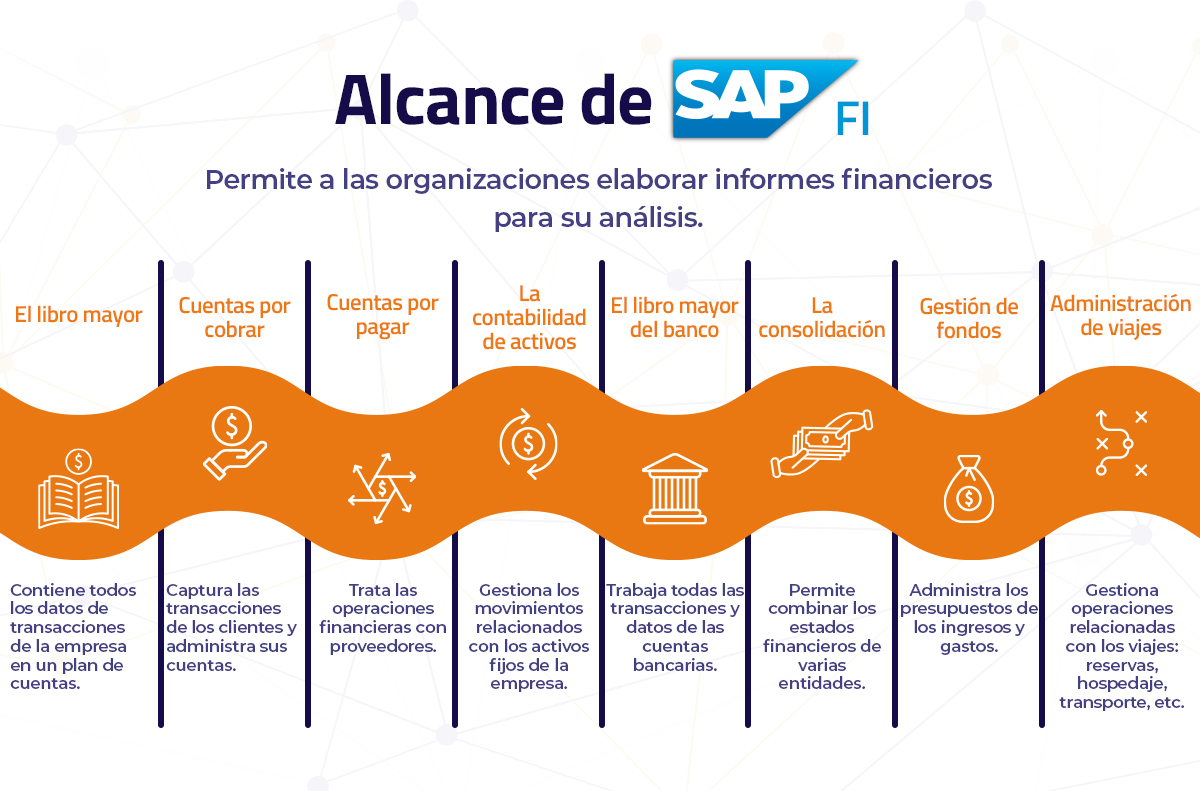
As we mentioned earlier, its usefulness ranges from the detailed recording of transactions to the generation of accurate financial reports. We detail some of the fundamental functions of SAP FI below:
General Ledger
SAP FI facilitates general ledger accounting, recording all financial transactions of a company. This includes the management of accounts payable, accounts receivable, and the accounting for assets and liabilities.
Fixed Asset Management
It allows for the tracking and efficient management of a company's fixed assets, such as buildings, equipment, and vehicles. This helps to maintain precise control of resources and their depreciation.
Treasury
It facilitates treasury management, supervising cash transactions, banks, and other financial instruments. This contributes to optimal cash flow and strategic financial planning.
Accounts Payable and Receivable Management:
It helps to control and record payments to suppliers and outstanding customer accounts, providing a clear view of liquidity and financial health.
Financial Reporting Generation:
SAP FI offers powerful reporting tools that allow for detailed analysis of the company's financial situation. This is vital for informed and strategic decision-making.
Auditing and Compliance:
It contributes to maintaining the integrity and transparency of financial data, complying with auditing standards and legal regulations.
SAP FI is used to centralize and optimize the financial operations of an organization, providing a comprehensive platform for informed and efficient financial decision-making.
Let's talk about SAP FI submodules
Within the SAP FI module, there are several specialized submodules that focus on specific aspects of a company's financial management. It is important to know them because they show us how FI helps the company in its internal management.
General Ledger (FI-GL):
It functions as the accounting core, capturing data from all business areas. It allows for the creation of accounting accounts, tracking balances, and generating financial reports. It also facilitates integration with other SAP modules, ensuring data consistency.
With FI-GL, organizations can efficiently track their financial activities, comply with legal requirements, and generate accurate reports for decision-making.
Accounts Payable (FI-AP):
It is essential for managing and supervising a company's financial obligations. It works by integrating with other modules, such as Purchasing and General Ledger.
When an invoice is received, it is recorded in the system and associated with the corresponding purchase order. The submodule automatically performs verifications, such as price and quantity reconciliation. It facilitates the payment process to suppliers, generating accounting documents and maintaining a precise tracking of outstanding debts.
Accounts Receivable (FI-AR):
Similar to the accounts payable submodule, FI-AR deals with the management of accounts receivable from customers. When a company makes a sale, a record is automatically generated in accounts receivable.
This module tracks amounts pending payment by customers, providing key information about balances and due dates. It facilitates the creation of invoices, tracking of payments, and automated reminders.
Fixed Assets Management (FI-AA):
This submodule focuses on the management and accounting of a company's fixed assets, such as buildings, machinery, and vehicles. It allows for tracking depreciation and generating related reports.
It works by assigning asset numbers to the corresponding objects, facilitating the tracking of the useful life, depreciation, and residual value of each asset. It allows for efficient recording of acquisitions, transfers, and disposals of assets.
Treasury (FI-TR):
The Treasury submodule (FI-TR) in SAP is responsible for managing and supervising financial activities related to a company's liquidity and funds. It controls cash transactions, payments, and collections, ensuring efficient management of financial resources.
It allows for liquidity position planning and monitoring, facilitating decision-making. Similarly, it integrates banking operations, automating processes such as reconciliations and transfers.
Travel Management (FI-TV):
It allows for the planning, booking, and settlement of travel expenses in an integrated manner. Employees can create travel requests, record expenses, and receive reimbursements, all within the system.
In addition, FI-TV links with other SAP modules, such as Finance (FI) and Human Resources (HR), to ensure accurate accounting and efficient management of costs associated with corporate travel.
Credit Management (FI-SD Integration)
Integrated with the SAP SD (Sales and Distribution) module, this submodule is responsible for credit limit management and the accounting of documents related to sales. When a customer places a sales order, the system verifies their credit limit. If it is exceeded, alerts or blocks are generated.
Credit data is updated in real time, allowing for informed decision-making. FI-SD integration improves efficiency by synchronizing financial and sales information, ensuring effective credit management and avoiding financial risks for the company.
These submodules work together to provide comprehensive and efficient financial management, covering various aspects ranging from general accounting to asset administration and treasury planning.
And what are the main advantages of SAP FI?
SAP FI offers various advantages that make it a popular choice for financial management in companies. At Xamai, we want to explain some of the main advantages of SAP FI that make it a leading product in the market.
- . Complete Integration: SAP FI integrates efficiently with other SAP modules and business systems, allowing for a unified and coherent view of financial information in master data that can be used to benefit the entire organization.
- Process Automation: Automates numerous accounting and financial tasks,
reducing manual time and effort. This improves efficiency and minimizes human errors. - Precise Report Generation: Provides powerful report generation tools that allow for detailed and accurate analysis of the financial situation. Facilitates informed decision-making.
- Cost Control: With the integrated SAP CO module (which we will talk about a little later), effective cost control is achieved, allowing companies to manage and optimize their resources strategically.
- Regulatory Compliance: Helps companies comply with audit standards and legal regulations. Provides detailed transaction tracking to ensure transparency and compliance.
- Effective Fixed Asset Management: The Fixed Asset Management submodule (FI-AA) facilitates precise tracking of assets, their depreciation, and related reporting.
- Treasury Optimization: Through the Treasury submodule (FI-TR), SAP FI contributes to efficient treasury management, improving financial planning and liquidity.
- Adaptability: It can adapt to the specific needs of various industries and companies, offering flexibility in configuration and customization.
These combined advantages make SAP FI a valuable tool for organizations seeking comprehensive, automated, and efficient financial management.
What is SAP FI CO?
Within SAP ERP, we find that SAP FI CO appears to help improve the data management of a business, but what is it?
SAP FI CO refers to the combination of two essential modules of SAP ERP: Finance (FI) and Controlling (CO). This combination creates an integrated system that addresses both the financial and control aspects of an organization. Let's analyze each one a little to understand better:
SAP FI (Finance):
This module focuses on financial accounting and covers areas such as general ledger, fixed asset management, treasury, and accounts payable and receivable management. SAP FI provides a comprehensive view of the company's financial situation.
SAP CO (Controlling):
On the other hand, the Controlling module is dedicated to the planning, monitoring, and optimization of internal processes. It includes aspects such as cost center accounting, internal order accounting, and analytical accounting. SAP CO helps companies control and manage their costs efficiently.
Together, SAP FI CO allows for seamless integration between financial accounting and cost control. This means that companies can have a complete view of their finances, from the detailed recording of transactions to the strategic planning and control of costs.
The combination of these two modules provides a powerful tool for informed financial decision-making and effective resource management. Essentially, SAP FI CO acts as a strategic partner for the company's financial success.
How does hiring an SAP FI consultant benefit you?
An SAP FI consultant plays a key role in the implementation, configuration, and optimization of the Finance (FI) module of SAP in an organization. Their responsibilities vary throughout the project lifecycle.
By hiring an SAP FI consultant, you get an ally who will help you improve your financial processes. We show you some of the benefits you can expect when working with a specialized consultancy like Xamai.
- Customized Analysis:
The Xamai consultant will work closely with you to understand your specific needs in accounting and finance, ensuring that solutions are designed that adapt to your company. - Efficient Implementation:
With the experience we have gained over time, the implementation of the SAP FI module will be carried out effectively, guaranteeing perfect integration and correct operation from the beginning. - Comprehensive Training:
Your employees will receive comprehensive training to use all system functionalities efficiently, allowing them to maximize the investment in SAP FI. - Continuous Support:
After implementation, our consultants will be available to provide support and make adjustments as needed, ensuring that your system runs smoothly over time. - Process Optimization:
The Xamai consultant accompanying you will not only implement the system, but will also collaborate in identifying areas for improvement in your financial processes and propose solutions to increase efficiency and performance. - Seamless Integration:
Working together with consultants from other SAP modules, a coherent integration of all systems will be ensured, which will improve efficiency and communication between departments.
By hiring expert consulting like we are at Xamai, you will be ensuring that your financial management system is perfectly adapted to your business needs, which will help you achieve your financial goals more efficiently and effectively.
If you are interested in any SAP services we offer, do not hesitate to contact us.
Ready to talk to SAP specialists?
Tell us what your company needs and we'll help you find the best path.
Request information









 English
  Español de México
  Español