
Improve the efficiency of your business processes with a cloud ERP solution: learn about its benefits and how it can boost your business.
Cloud ERP, also known as cloud-based enterprise resource planning software, is a technological solution that offers companies the possibility of managing their business processes in an integrated manner through the internet.
Instead of hosting and maintaining software on local servers, cloud ERP runs on remote servers and is accessed via the internet.
Cloud ERP vs. On-Premise ERP
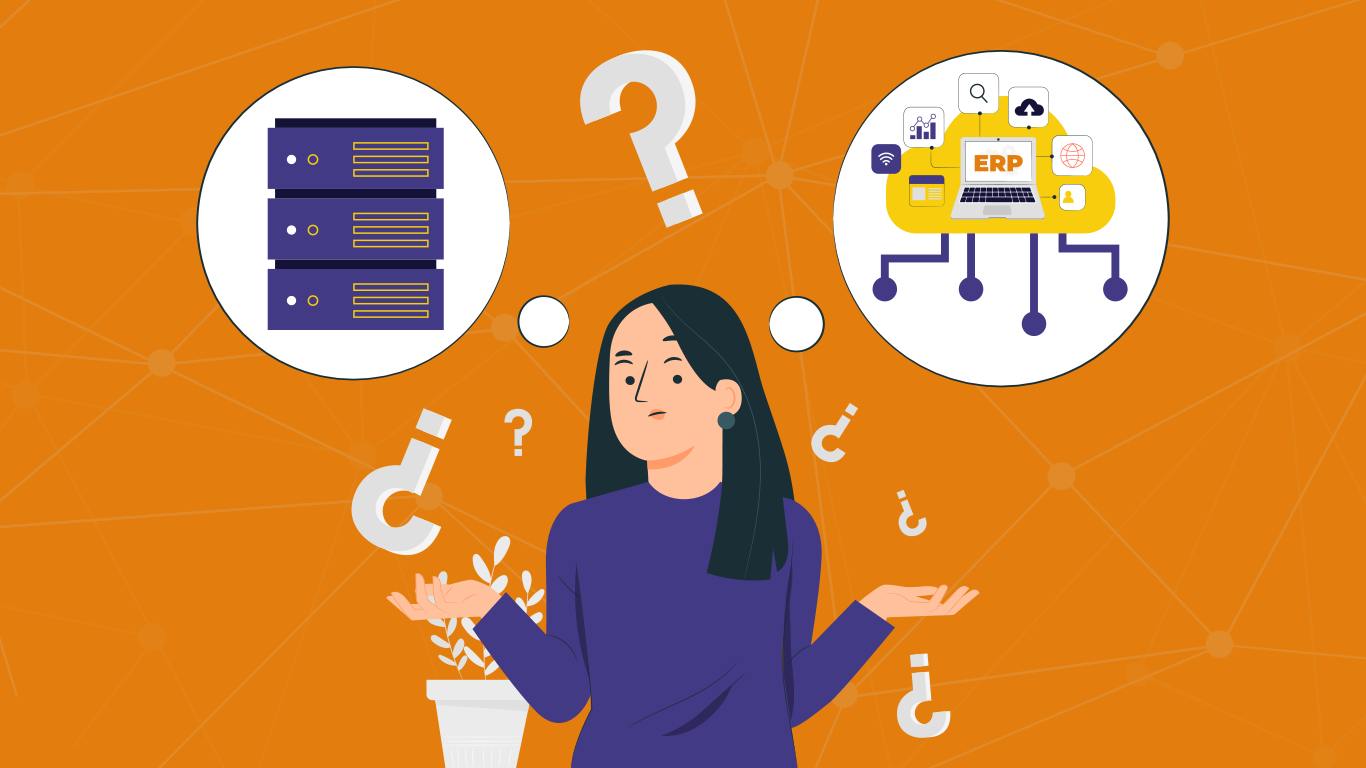
When choosing an ERP (Enterprise Resource Planning) system, companies must consider between two main options: cloud ERP and on-premise ERP.
Both have advantages and disadvantages that must be evaluated based on the needs and resources of each company. Below, we will detail a comparison between the two systems:
1. Infrastructure:
- Cloud ERP: In this model, software and data are hosted on remote servers and accessed via the internet. The company does not need to invest in its own server infrastructure, which reduces initial costs and eliminates the need to maintain and update hardware.
- On-Premise ERP: In this case, the company installs and maintains the software and data on local servers within its own IT infrastructure. It requires a significant initial investment in hardware and software, as well as internal resources to administer and maintain the system.
2. Costs:
- Cloud ERP: Cloud ERP typically operates under a monthly or annual subscription model, allowing companies to pay only for the resources they use. This can result in lower initial costs and long-term cost predictability.
- On-Premise ERP: Implementing an on-premise ERP involves significant upfront costs, including the purchase of software licenses, hardware, installation, and system customization. In addition, there are ongoing costs associated with maintenance, updates, and technical support.
3. Accessibility and Scalability:
- Cloud ERP: Being hosted on remote servers, cloud ERP offers access from anywhere with an internet connection. It is also easily scalable, as companies can adjust their resources according to their changing needs, such as company growth or reduction.
- On-Premise ERP: Accessibility may be limited to the company's internal network or via VPN connections, which can make it difficult to access outside the office. Scalability can be more complex and costly, as it requires the acquisition of additional hardware and adjustments to the existing infrastructure.
4. Security:
- Cloud ERP: Cloud ERP providers typically implement advanced security measures, such as data encryption, firewalls, and continuous monitoring, to protect customer information. However, some companies may have concerns about the security of their data when relying on external providers.
- On-Premise ERP: Security largely depends on the measures taken by the company and its IT team. If implemented correctly, on-premise systems can be highly secure, but require additional investment in security technologies and staff training.
The choice between a cloud ERP and an on-premise ERP depends on various factors, including financial resources, existing IT infrastructure, accessibility, scalability, and security concerns.
Both models have their own advantages and disadvantages, and it is important for each company to carefully evaluate its needs and business objectives before making a decision.
Why choose a cloud ERP system?
Choosing a cloud-based ERP software offers a number of significant benefits for companies. Firstly, accessibility is a key advantage, as it allows users to access the system from anywhere with an internet connection, facilitating collaboration and remote work.
Furthermore, cloud ERP systems are often highly scalable, meaning companies can increase or decrease capacity as needed without incurring significant additional costs. Additionally, cloud ERP providers handle IT infrastructure, including software updates and security, freeing companies from the burden of maintaining and managing local servers.
Choosing a cloud-based ERP system provides flexibility, scalability, and simplified IT infrastructure management, allowing companies to focus on their core operations and long-term growth.
Importance of Cloud ERP for Medium-Sized Businesses
Implementing a cloud ERP is important for companies for several key reasons. First, it offers greater flexibility and accessibility, as it allows employees to access the system from anywhere with an internet connection, facilitating remote work and collaboration between geographically distributed teams.
Furthermore, implementing a cloud ERP provides scalability, meaning companies can easily adjust their resources to meet changing needs, whether increasing capacity to meet business growth or reducing it during periods of lower activity. This allows them to adapt quickly to market demands and remain agile in a competitive business environment.
Another important aspect is the reduction of costs and simplification of IT management. By eliminating the need to maintain and update local servers, companies can reduce infrastructure costs and free up resources to invest in other areas of the business.
Furthermore, by relying on providers specialized in IT infrastructure management, companies can benefit from automatic updates, technical support, and advanced security measures, allowing them to focus on their core operations and improve their efficiency and competitiveness in the market.
Implementing a cloud ERP is important for companies because it provides them with flexibility, scalability, cost reduction, and simplified IT management, allowing them to adapt quickly to market demands and remain competitive in a constantly changing business environment.
Is SaaS ERP Secure?
The security of SaaS ERP is a common concern for users, but cloud ERP providers are dedicated to ensuring the protection of their clients' data.
SaaS ERP providers, such as us at Xamai, implement advanced security measures to protect our clients' data. This may include data encryption, firewalls, continuous network monitoring, and two-factor authentication, among other measures.
However, as with any cloud system, there are potential security risks that should be considered. These may include hacker attacks, security vulnerabilities in the software, and human errors, among others. Therefore, it is important for companies to choose a reliable and stable SaaS ERP provider and establish strong security policies, such as secure passwords, restricted access to sensitive data, and regular training of personnel in cybersecurity practices.
SAP as a Cloud ERP
SAP, a leading provider of ERP software, offers cloud solutions that allow companies to efficiently manage their resources and business processes. An example of SAP as a cloud ERP is SAP S/4HANA Cloud.
This solution provides a comprehensive platform for managing finance, sales, purchasing, inventory, production, and more, all hosted in the cloud and accessible via the internet with various functionalities similar or even superior to an on-premise ERP.
A practical example of how SAP S/4HANA Cloud can benefit a company is in the area of inventory management. Imagine a retail company that operates in multiple locations and needs to have precise control of its inventory to meet customer demand and optimize its operations.
With SAP S/4HANA Cloud, the company can manage its inventory centrally in the cloud, allowing it to monitor stock in real-time, forecast demand, and place replenishment orders efficiently.
Furthermore, SAP S/4HANA Cloud offers advanced analytics and reporting capabilities, allowing the company to gain valuable insights into inventory performance, identify sales trends, and make informed decisions to optimize its supply chain.
SAP as a cloud ERP, such as SAP S/4HANA Cloud, provides companies and users with a comprehensive and scalable platform to manage their operations efficiently and competitively in today's market.
Xamai, your reliable solution for companies that want to implement a SAP ERP in the cloud
At Xamai, we are a reliable solution for companies that want to implement a cloud-based SAP ERP due to our experience and expertise in integrating business systems.
We offer personalized consulting, implementation, and support services to ensure a smooth and successful transition to the cloud. In addition, at Xamai, we provide innovative solutions tailored to the specific needs of each company.
Ready to talk to SAP specialists?
Tell us what your company needs and we'll help you find the best path.
Request information




 English
  Español de México
  Español