
Cloud technology has revolutionized the way companies manage their operations and business resources, and one of the leading systems in this transformation is SAP.
In this article, we want to explain to you how SAP in the cloud is redefining the way organizations approach business management and the numerous advantages this migration to a cloud environment offers.
From scalability and flexibility to operational efficiency and cost reduction, we will discover how this technological evolution is driving business productivity and competitiveness in the digital age.
SAP in the cloud has become a key element in the strategy of many modern companies, and Xamai will tell you why.
What is cloud ERP?
A cloud ERP, or Enterprise Resource Planning system in the cloud, is a software tool that allows companies to efficiently and centrally manage their business processes and data online.
Instead of installing and maintaining management software on local servers, a cloud ERP runs on remote servers accessible via the Internet. This means companies can access their ERP systems from anywhere with an Internet connection, providing flexibility and mobility for employees.
Additionally, the cloud allows companies to reduce infrastructure costs, as they do not need to invest in expensive servers and equipment, and it provides them with the ability to easily scale their resources as needed.
In broader terms, a cloud ERP represents a change in the way companies manage their operations and resources. It means a transition to a more agile, cost-effective, and scalable approach to business management.
The cloud allows organizations to stay up-to-date with the latest features and updates without worrying about costly implementation processes, and it also facilitates collaboration and informed decision-making by providing real-time access to crucial business data.
Cloud ERP vs. On-Premise ERP
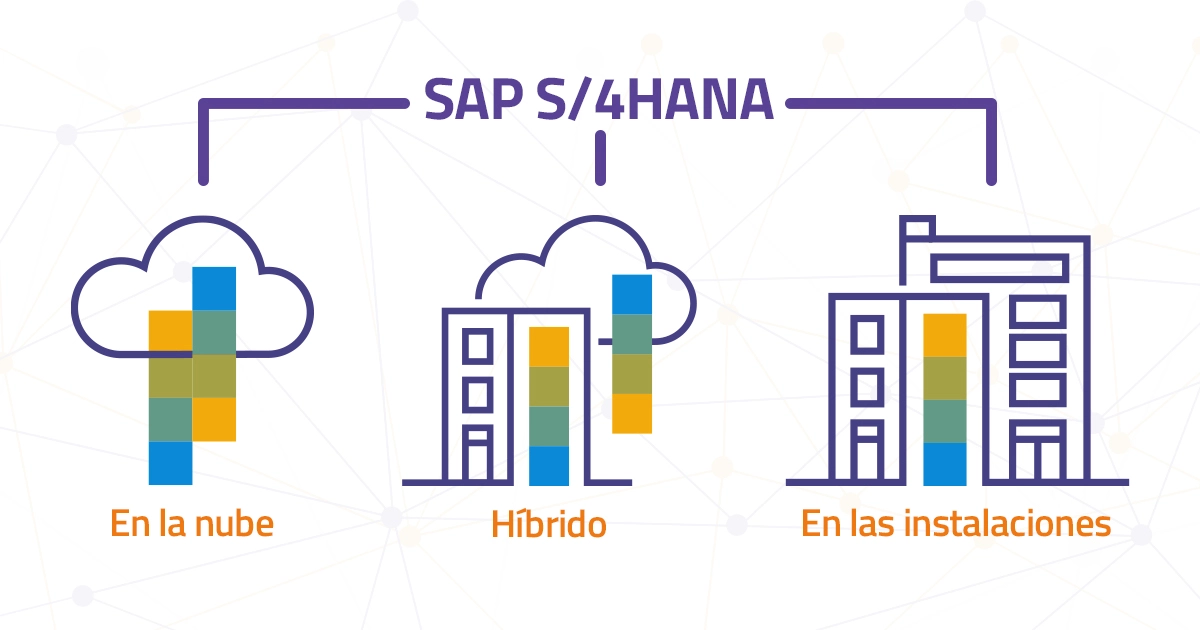
There are two main approaches to implementing an ERP: in the cloud (cloud) and on-premise (on the company's premises). The following is a brief comparison between the two:
Cloud ERP:
- Accessibility: Cloud ERPs are accessible from anywhere with an internet connection. This facilitates collaboration and remote access, which is especially useful in distributed work environments or with mobile employees.
- Initial Costs: : Initial costs are generally lower, as no significant investment in hardware or infrastructure is required. The company pays a periodic subscription fee.
- Scalability: Scalability is easier, as you can increase or decrease resources according to your company's needs with relative ease.
- Maintenance: The responsibility for maintenance and updates lies with the cloud service provider, freeing the company from these tasks.
- Security: Data security largely depends on the cloud service provider. Although many providers offer high security standards, some companies may have concerns about the protection of their data.
On-Premise ERP:
- Total Control: : On-premise solutions offer greater control over infrastructure and data, as everything is located within the company's premises.
- Long-Term Costs: : Although initial costs are usually higher due to investment in hardware and software, in the long run, the total cost of ownership may be lower than that of a cloud ERP.
- Customization: You can customize the ERP according to your specific needs, which can be more difficult in a standardized cloud environment.
- Security: Security is the company's responsibility, which provides greater control but also implies greater responsibility for keeping it up to date and protected.
- Limited Scalability: Scaling an on-premise system can be more complex and costly, as it requires additional investments in hardware and resources.
The choice between a cloud ERP and an on-premise ERP will depend on the specific needs and resources of your company.
Smaller companies with limited budgets may find that the cloud is a more affordable and flexible option, while larger companies with customization and control needs may opt for on-premise implementations.
In some cases, a hybrid solution that combines both options may also be a valid choice.
Evolution of SAP to a cloud solution
The evolution of SAP to cloud implementation has been a significant process in the transformation of the company and enterprise management technology. SAP, as one of the leading providers of enterprise software, has experienced this transition over the years. The following describes the key stages in SAP's evolution to cloud implementation:
-
SAP On-Premises (Local)
In its early years, SAP was primarily delivered as on-premises software or at the customer's site. This meant that companies had to manage their own servers, infrastructure, and perform manual updates.
-
SAP Hosted
The next stage was the offering of hosted SAP, where customers still had their own SAP instances, but they ran on servers hosted by third parties, such as hosting service providers.
-
SAP Cloud Offerings
SAP began to offer specific cloud solutions, such as SAP Business ByDesign and SAP Business One Cloud. These solutions allowed companies to access SAP functionality through the cloud without worrying about infrastructure management.
-
SAP HANA Cloud Platform
SAP launched HANA Cloud Platform (now known as SAP Cloud Platform), which is a cloud-based development and application platform that allows companies to create custom applications and extend existing SAP solutions in the cloud.
-
SAP S/4HANA Cloud
SAP S/4HANA is SAP’s next-generation suite of business applications. SAP offers a cloud version of this suite, known as SAP S/4HANA Cloud. It provides advanced business management capabilities and runs on SAP’s cloud infrastructure.
-
SAP Business Technology Platform (BTP)
The SAP Business Technology Platform is a comprehensive platform that integrates data and analytics, application development, and cloud technology. It offers advanced capabilities to develop, deploy, and manage business applications in the cloud.
-
SAP Cloud Infrastructure
SAP has also developed its own cloud infrastructure, known as SAP Cloud Infrastructure. This allows customers to run their SAP applications on SAP cloud servers, providing greater control and security.
-
Collaboration with SAP Cloud Providers:
SAP has established strategic collaborations with public cloud providers such as AWS, Huawei, Microsoft Azure, and Google Cloud. This allows customers to deploy SAP solutions in the cloud of their choice and take advantage of the benefits of the public cloud.
-
Cloud-Specific Solutions:
SAP has continued to develop cloud-specific solutions for areas such as human resources (SAP SuccessFactors), expense management (SAP Concur), travel management (SAP Travel and Expense Management), among others.
The evolution of SAP towards cloud implementation has been a gradual process that has allowed companies to take advantage of the benefits of the cloud, such as scalability, flexibility, and cost reduction, while continuing to use SAP's powerful enterprise solutions. SAP's strategy has included both public cloud offerings and its own private cloud infrastructure to give customers options to migrate to the cloud according to their needs and preferences.
Why choose SAP in the cloud?
Choosing SAP in the cloud is a strategic decision that offers numerous benefits for companies in the digital age. First, the cloud provides flexibility and scalability, meaning that organizations can adapt their SAP resources to their changing needs without investing in expensive infrastructure. In addition, the cloud ensures the constant availability of SAP systems, minimizing downtime and improving business continuity.
Security
Another key factor is security. SAP cloud solutions typically feature state-of-the-art security, including protection against cyber threats and automatic updates. This alleviates the security burden on companies and allows them to focus on their core business. Furthermore, the cloud enables collaboration and remote access, which is essential in a globalized business environment and in the current context of remote work.
Cost reduction
Adopting SAP in the cloud also reduces operating costs by eliminating the need to manage and maintain local servers with a large database. In addition, advanced analytics and artificial intelligence capabilities offered by the cloud can be leveraged to gain greater visibility and make informed decisions.
Efficiency
Choosing SAP in the cloud is a logical choice for companies looking to increase the efficiency, agility, and security of their operations, while positioning themselves for the future in an increasingly digital and competitive world, and at Xamai we can help you achieve the most suitable implementation for your business. Learn more about our service and contact us.
For more general information about SAP, we recommend reviewing the article What is SAP? What is it used for?
Ready to talk to SAP specialists?
Tell us what your company needs and we'll help you find the best path.
Request information


 English
  Español de México
  Español