
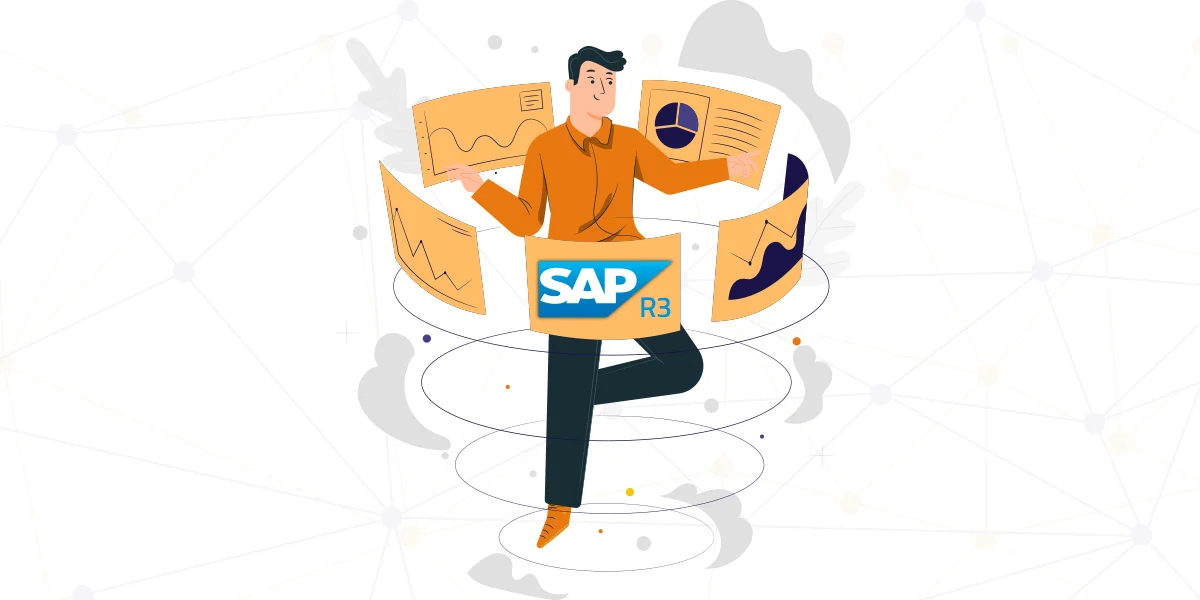
¿Qué era SAP R/3 y por qué fue descontinuado? Conoce su funcionamiento, arquitectura y evolución hacia SAP HANA y SAP S/4HANA.
SAP R/3 fue en su momento, una herramienta importante para muchas organizaciones en todo el mundo. Pero como pasa en la tecnología, lo que en su momento fue un estándar global, hoy ya es considerado una versión descontinuada. El futuro apunta hacia SAP HANA y SAP S/4HANA, que representan no solo una migración técnica, sino también un cambio radical en la manera en que las organizaciones gestionan sus procesos, sus datos y su negocio.
En Xamai, queremos explicarte cómo SAP R/3 sentó las bases para el desarrollo de nuevos productos y tecnologías SAP y la función que tenía dentro de las empresas.
What was SAP R3?
SAP R/3 se define como un ERP (Enterprise Resource Planning – Planificación de Recursos Empresariales). Un ERP es una herramienta integral para administrar empresas, ofreciendo instrumentos para planificar, analizar y supervisar los recursos de la empresa.
El sistema SAP R/3 fue desarrollado por la empresa alemana SAP SE. Su nombre, R/3, se deriva de “Real-time Data Processing” (Procesamiento de Datos en Tiempo Real) y “3-tier Architecture” (Arquitectura de Tres Capas).
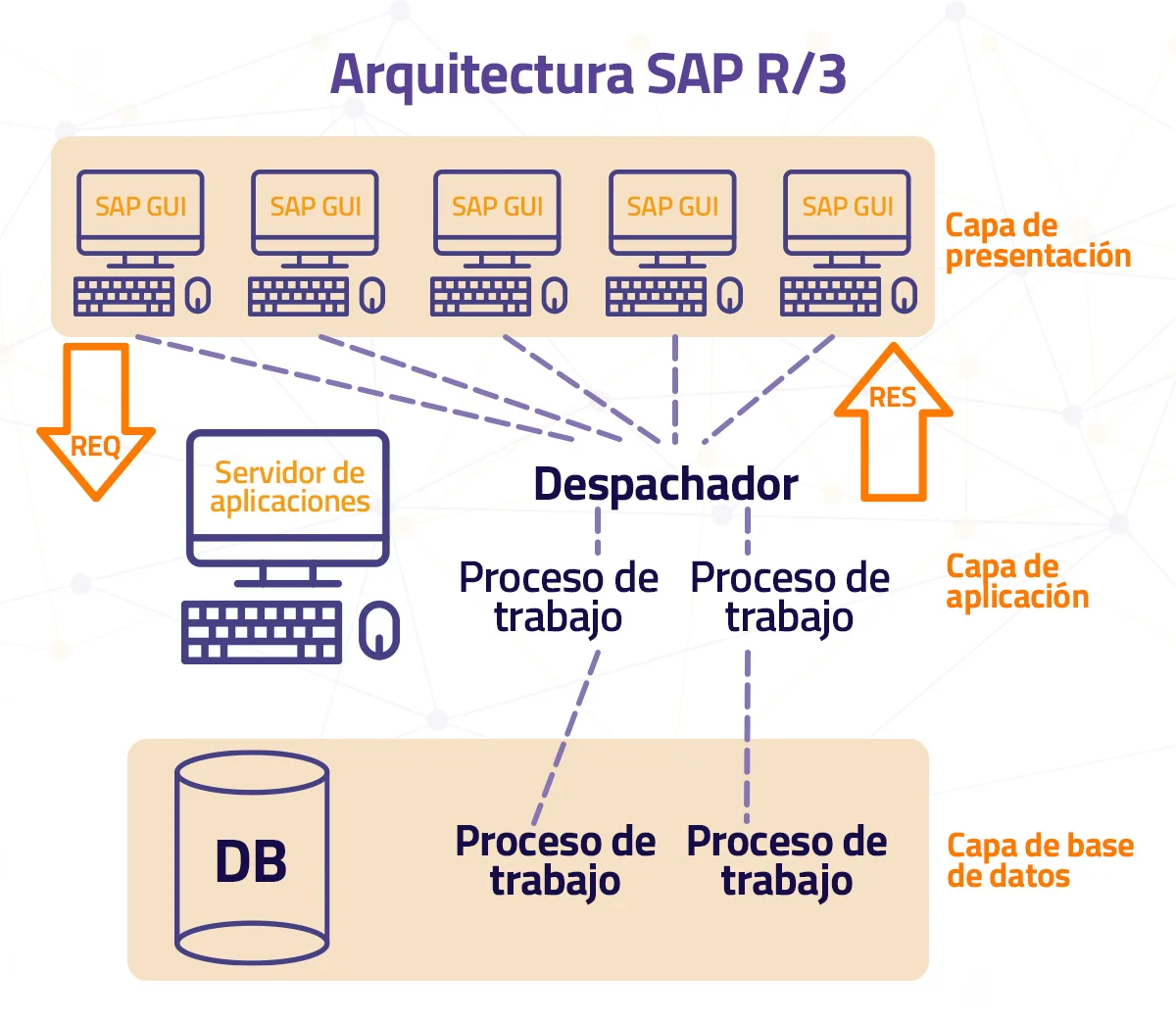
La “R” en SAP R/3 indica procesamiento de datos en tiempo real, mientras que el número 3 hace referencia a su arquitectura de tres capas: el cliente (conocido como SAP GUI), el servidor de aplicaciones y la base de datos.
SAP R/3 is organized into modules, each related to a specific area of the company. The interconnection between these modules and the server allows for agile and effective operation, as well as facilitating the management of large volumes of data.
¿Por qué se le dio el nombre de SAP R3?
El nombre “SAP R/3” se originó cuando SAP AG, la empresa alemana detrás de este sistema, lanzó la tercera versión de su software en 1992. Desde entonces, SAP ha evolucionado su oferta y ha lanzado nuevas soluciones empresariales, como SAP ECC (SAP ERP Central Component) y SAP S/4HANA, pero el nombre R/3 todavía se utiliza a veces para referirse a la versión antigua del sistema.
¿Tu empresa aún opera sobre arquitecturas heredadas como SAP R3?
Dejar atrás una versión descontinuada es vital para no perder competitividad. Prepara tu migración a la era en tiempo real junto a Xamai.
Evolucionar mi ERP con Xamai
How did SAP R3 work?
Su arquitectura cliente-servidor de tres capas marcó tendencia:
- Presentation layer: the user interface.
- Application layer: where transactions and business logic were processed.
- Database layer: with options such as Oracle or SQL Server.
Este modelo permite integrar módulos como personal administration, payroll calculation (nómina), organizational management, production planning o logística. En su momento, fue una verdadera revolución para los departamentos de administración y gestión de recursos de las empresas.
The problem is that, over the years, R/3 fell short in terms of data processing, performance, and adaptation to new demands: large volumes of data, real-time, artificial intelligence, or machine learning. That's why SAP decided to make a clean break.
Evolution with SAP HANA
In 2010, SAP HANA arrived, not as an ERP itself, but as an in-memory database that changed the game. Instead of storing information on disk, it handles it directly in RAM, multiplying real-time processing capacity.
This opened the door to instant analytical reports, advanced analytics, and supporting applications that previously seemed impossible due to the amount of data. HANA became the technological heart of SAP's evolution, the piece upon which the next big bet would be built: S/4HANA.
The foundations left by SAP R3
When SAP R/3 was released in 1992, it introduced several innovations that at the time marked a before and after in enterprise resource planning (ERP). Those same foundations were the 'fertile ground' on which S/4HANA was developed.
1. Client-server architecture
R/3 pioneered abandoning mainframe systems and opting for a three-tier architecture: presentation, application, and database. This allowed companies to have more flexibility, scalability, and a clearer model of process management. Today, that same concept is reinterpreted in S/4HANA, but with in-memory computing and cloud deployment.
2. Integration of modules
With R/3, SAP consolidated the idea of an all-in-one ERP: a single software that connected finance, sales, logistics, production, human resources, and even payroll calculation. That vision of total integration was the basis for what S/4HANA now does, only with modern interfaces and real-time analytics.
3. Standardized processes
R/3 helped formalize business processes under a common language and with modules such as production planning, material requirement planning (MRP), or organizational management. That standardization gave SAP the strength to be considered a global standard, and allowed it to evolve into a system that now incorporates artificial intelligence, machine learning, and greater personalization.
4. ABAP language and business logic
R/3 brought with it ABAP (Advanced Business Application Programming), which allowed thousands of consultants and programmers to customize and create applications on the system. That development ecosystem expanded over time and now in S/4HANA coexists with new technologies such as SAP Fiori, APIs, and cloud extensions.
5. Culture of ERP as the brain of the company
Perhaps the most important thing is that R/3 positioned SAP as the 'brain' of business operations. It turned information into a central asset and showed the value of having a single system that supports all areas. That philosophy is taken to the next level in S/4HANA, where data is not only stored, but processed and transformed into intelligent decisions.
SAP S/4HANA: the present and future of ERP
SAP S/4HANA is the ERP suite designed specifically to run on HANA. Its goal is clear: to simplify, accelerate, and integrate.
With S/4HANA, companies can work with real-time information, have a much more intuitive user interface (thanks to Fiori), and take advantage of in-memory computing for complex processes such as material requirement planning, sales and distribution, e-recruiting, or even training event management.
In addition, it adapts to different scenarios: it can function on-premise, in the cloud, or in hybrid models. And most importantly: it facilitates integration with other SAP applications, such as SAP Business One for growing companies, or human resources solutions like SuccessFactors.
Why implement SAP?
While SAP R3 was once a functional and widely used solution, the constant evolution of enterprise technology has led to this platform showing certain limitations in terms of scalability and adaptation to the changing needs of modern companies.
En Xamai, estamos comprometidos a ofrecer soluciones de vanguardia y personalizadas para tu negocio. Podemos ayudarte a dar el salto hacia el futuro con la implementación de SAP Business One o SAP S/4HANA, siempre adaptándonos a tus necesidades específicas y asegurando una gestión empresarial eficiente y alineada con los estándares actuales de la industria. Contáctanos para explorar cómo podemos llevar tu empresa hacia un futuro más competitivo y eficiente en la Industria 4.0 y modernizar todos tus procesos.
We can support you with implementations, consulting, maintenance, support, and more. We are SAP Gold Partners.
Evoluciona el antiguo cerebro de tu empresa hacia el futuro digital.
Da el salto de SAP R3 hacia SAP S/4HANA o SAP Business One con la asesoría experta de Xamai.
Agendar diagnóstico




 English
 Español de México
 Español