
Compare SAP and Microsoft Dynamics to discover which best suits the needs of your business.
For any company that wants to grow within Industry 4.0, it is necessary to have an effective CRM that allows you to strengthen the relationship with your customers, help you personalize the user experience, and make data-driven decisions. SAP and Microsoft Dynamics 365 are two of the most widely accepted platforms in the market in terms of CRM. But which one offers better results?
Today at Xamai we will analyze its scope, functionalities, flexibility, and integration capabilities.
Let's explore the CRM approach of both systems
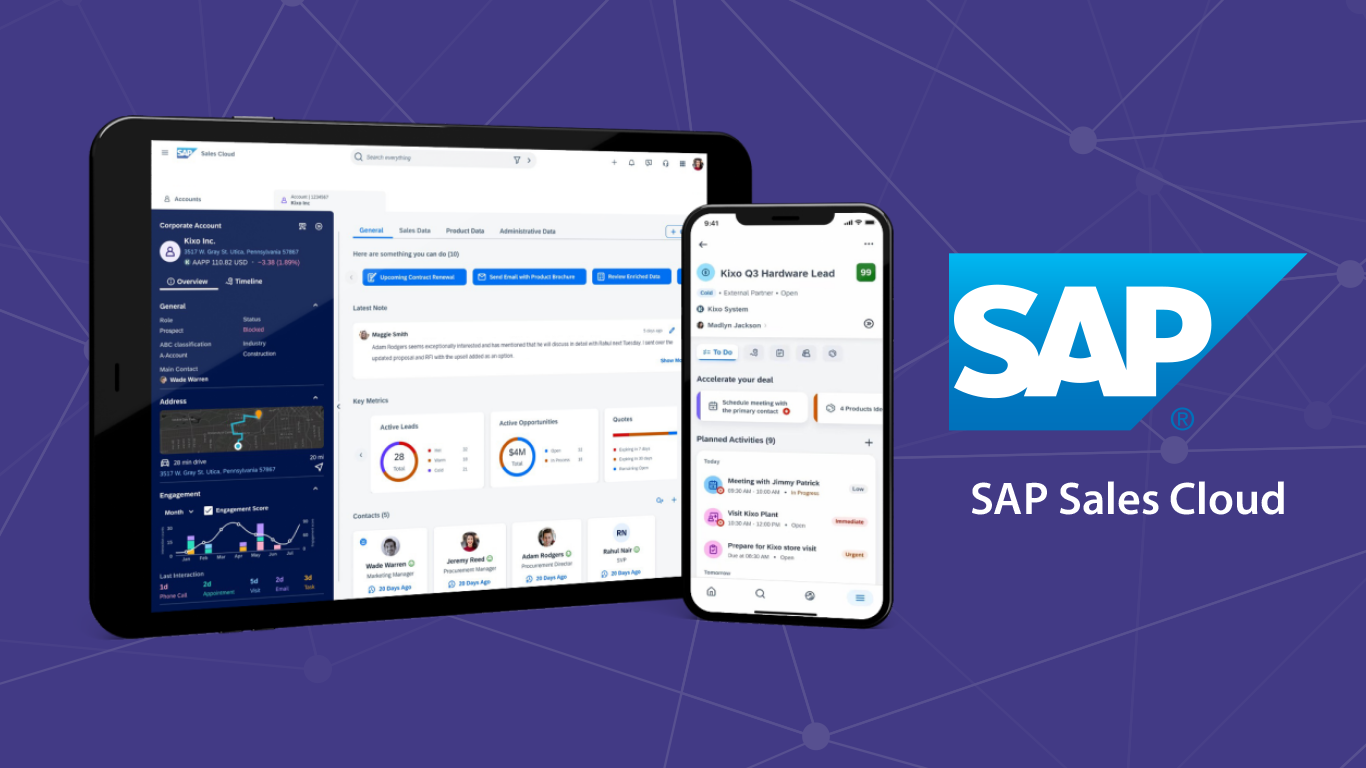
Both SAP and Microsoft Dynamics are ERP software that offer CRM solutions where they play a fundamental role in modern business management. SAP has developed a platform that is oriented to meet the specific needs of each industry, with close integration between SAP S/4HANA, SAP Business One and its cloud CRM solutions.
Microsoft, on the other hand, makes a strong bet on scalability and user experience in Dynamics 365 Business Central and the Microsoft Dynamics 365 CRM module.
These two platforms go far beyond simple customer databases; they offer automation, opportunity tracking, predictive analytics and AI-based workflows to anticipate customer needs.
Comparing the functions and features of each
When it comes to features, Microsoft Dynamics is highly visual with an intuitive user interface, integration with productivity tools like Excel, Outlook and Power BI, and a simple learning curve.
It has a modular design that facilitates the adoption of components such as sales, customer service or marketing and that is very attractive to small and medium-sized companies.
SAP, on the other hand, has a set of advanced tools that focus on data, customer analytics and automation processes. Its CRM is part of an environment that allows for the efficient coordination of areas such as finance, human resources, production and supply chain, all from a single platform. We can also say that it has a high capacity to handle large volumes of information thanks to the SAP HANA engine.
Adaptation and integration with other platforms
The ability to integrate is a key point in any management software. In this aspect, SAP Business One and SAP S/4HANA were designed to connect natively with other business applications through fully standardized APIs and the use of the SAP BTP platform, which allows streamlining processes without sacrificing control or security.
Microsoft Dynamics leverages familiarity with the entire Microsoft environment, such as Teams, SharePoint and Azure, and can thus offer a unified experience. This proximity to everyday work tools can facilitate implementation and reduce training costs. Furthermore, its focus on technologies such as SQL and Azure facilitates the deployment of customized solutions for each client.
Personalization, flexibility and scalability
One of the most decisive factors in choosing a CRM is its level of personalization, and in this aspect SAP takes a step forward since it has a great capacity to adapt to companies with complex processes and specific needs, positioning it as the most robust option on the market. Thanks to its high degree of configuration, the variety of specialized modules and an architecture that allows developing completely customized solutions, SAP has become the preferred CRM in demanding sectors such as automotive, manufacturing, logistics and healthcare.
Microsoft Dynamics 365, on the other hand, has gained ground among companies that prioritize rapid and simple implementation, especially in sectors such as retail, financial services or technology. Although its agile approach is attractive to many SMEs, its scope is often more limited when it comes to scaling or facing complex business processes.
Data analysis and business intelligence
As for business intelligence and advanced analytics, SAP S/4HANA has an in-memory architecture, which allows processing large volumes of data in real time and obtaining precise insights into customer behavior. This capability allows designing solid and information-based business strategies, even in high-complexity business environments.
Microsoft Dynamics vs SAP in this aspect is somewhat at a disadvantage because while it has Power BI as an analysis tool, it largely depends on external solutions to achieve a similar level of depth.
Although its reports are visual and easy to access, its analytical capabilities may be limited when dealing with complex data or working at scale, which puts Dynamics at a disadvantage compared to SAP's comprehensive approach.
User experience and maintenance
User experience is very important to ensure a successful CRM adoption and although Microsoft Dynamics has been valued for its modern interface and familiar navigation for those who already use Office tools, this simplicity often translates into less functional depth, which can limit growth in companies with more sophisticated processes.
SAP offers a more robust platform that, while it may require an initial learning curve, allows for much more comprehensive customer management with a view to scaling and adapting to complex scenarios and offering seamless integration with other ERP and CRM systems, making it the ideal option for organizations seeking a solid and future-proof technological infrastructure.
Security, compliance, and availability
Both SAP and Microsoft Dynamics comply with international security and regulatory compliance standards, including ISO, GDPR, and other data governance frameworks. However, SAP is often the preferred choice for large corporations that prioritize confidentiality, traceability, and high availability in their production environments.
Costs and return on investment
In terms of cost, Microsoft Dynamics generally offers more accessible pricing for mid-sized companies, especially if they already use other Microsoft programs. However, SAP presents a more solid return on investment in the long term for organizations with multiple business lines, the need for complex reporting, and multinational operations.
The value of SAP is not only in its software, but in the business model it proposes: an integrated platform that accompanies the evolution of the company.
Conclusions: Which is better for customer management?
Both SAP and Microsoft Dynamics offer excellent CRM solutions. The final decision will depend on the specific needs of each organization. If your company requires a lightweight, intuitive CRM that is well integrated with other office applications, Microsoft Dynamics 365 is a solid option. But if you are looking for a tool that is deeply integrated into your resource planning processes, with the ability to adapt to different sectors and complex business processes, SAP represents a more robust and strategic option.
Ultimately, it's not just about comparing SAP vs Microsoft Dynamics, but about understanding how well each ERP system aligns with your business vision, your growth plans, and your financial and commercial management strategy.
The solution is in your hands
Both systems have extraordinary capabilities to automate processes, connect work teams, and centralize information. However, if we are talking about a CRM solution with a long-term vision, SAP appears as a more complete platform, with deep integration between all levels of the organization and a first-class technological infrastructure.
If you are evaluating options to improve your customer relationship management, from SAP Business One to S/4HANA, we invite you to approach specialists who can help you define a strategy based on your processes, users, requirements, and innovation plans. Choosing the right CRM will not only impact your sales area, but will completely transform the way your company interacts with the market.
Ready to talk to SAP specialists?
Tell us what your company needs and we'll help you find the best path.
Request information







 English
  Español de México
  Español