
Updated: June 2025
Learn about the main types of SAP to choose the one that best suits your business and achieve your company's goals.
SAP is the most used software globally by large and small companies. It is a business and planning management system to facilitate the daily tasks of each department.
The SAP system is a custom-made system for each client, as it offers products, sub-products, and applications with different features for each type of business.
Today at Xamai we offer you a list of the types of SAP that exist so that your company knows more about the version in which it is operating. Learn about them!
SAP R/3: The classic version that laid the foundations
SAP R/3 was SAP's flagship ERP system during the 90s and early 2000s. Its name refers to a three-tier architecture: database, application logic, and presentation (user interface).
This structure marked a before and after in the way companies managed their operations.
At the time, SAP R/3 revolutionized the market with its modular approach: each area of the business (such as finance, sales, or logistics) was managed from an interconnected module, all within the same system. This level of integration was almost unprecedented at the time.
Although R/3 was very robust, it eventually gave way to SAP ECC, which offered a more flexible architecture and superior performance. SAP R/3 is now officially discontinued, but many of its conceptual foundations still live on in current systems, such as ECC and S/4HANA.
Fun fact: The term “R/3” is still colloquially used by veteran consultants when referring to the classic versions of SAP.
SAP ECC
SAP ECC (ERP Central Component) was for years the heart of business management in many organizations. It is built on a client-server architecture and segmented into specialized modules that interconnect to share data in real time.
The modules of SAP (FI for finance, CO for controlling, sales and distribution SD for sales and distribution, MM for purchasing, SAP PP for production planning, HCM for human resources management, among others) can be implemented gradually or according to business needs.
The modules help adapt the system and its components to large and complex companies, with hierarchical structures or presence in several countries.
One of its greatest advantages is its level of customization: it can be adapted to practically any workflow, industry, or specific need. However, that flexibility also requires greater maintenance, regular technical updates, and support from specialized consultants.
With the announcement of its support until 2027 (extended to 2030 at a cost), many companies are migrating to S/4HANA Cloud in its private or public version.
Advantages:
- High degree of integration between areas.
- Allows for custom developments (Z-programs).
- Functional maturity and proven stability.
Ideal for:
Helps large companies with complex processes in all areas and supply chain, or that are not yet ready to migrate to S/4HANA.
SAP S/4HANA
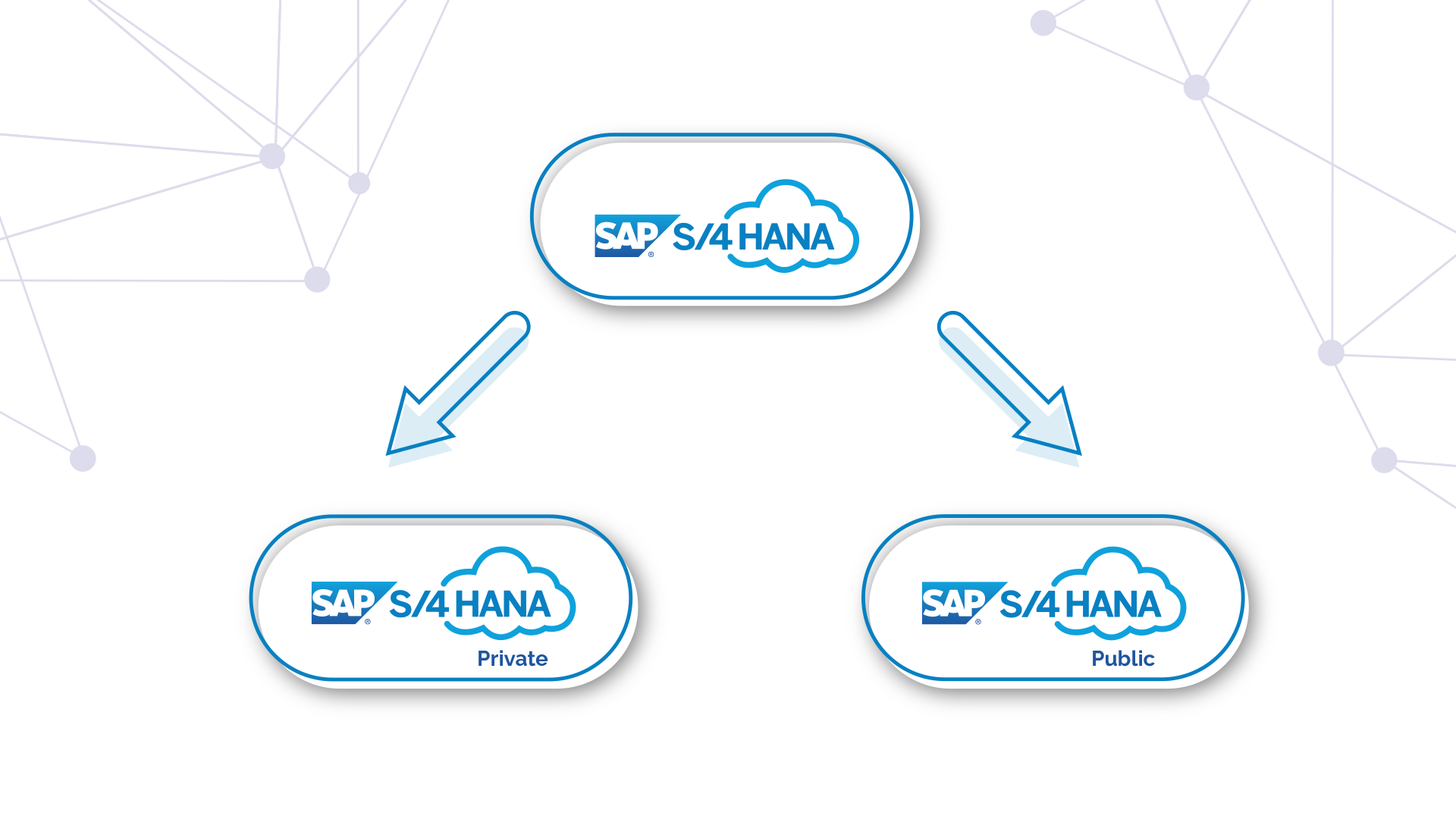
SAP S/4HANA (High Performance Analytic Appliance) is the natural evolution of ECC, but it is not just an update: it is a complete reconstruction of the ERP, designed for modern challenges. It runs on HANA, an in-memory database that allows querying, analyzing, and processing large volumes of data in seconds.
The system integrates operational, analytical, and logistics data, and prioritizes simplification: fewer tables, more automated processes, and a modern interface based on SAP Fiori. This translates into fewer manual tasks, fewer errors, and much faster decision-making.
Furthermore, by centralizing everything in a single database, it eliminates redundancies and improves the performance of key processes. It can be implemented locally, in the public or private cloud, or even under the RISE with SAP model, which offers a comprehensive solution with managed support and maintenance.
Advantages:
- Real-time speed and efficiency.
- Modern and customizable user interface.
- Ready for AI, automation, and advanced analytics.
Ideal for:
Growing companies that want to digitalize or large companies seeking efficiency and modernization of processes.
SAP Business ByDesign

ByDesign is a 100% cloud ERP solution designed for medium-sized companies that need to professionalize their management without assuming the costs of a complex system. It is scalable, meaning it can accompany the growth of the business without requiring a new implementation.
It includes integrated functionalities for finance, projects, human resources, purchasing, logistics, CRM, and more. All these processes are connected and automated, allowing for a global and updated view of the business without relying on multiple tools.
One of its main strengths is that it does not require an internal IT team for its maintenance. Being in the cloud, SAP takes care of updates, security patches, and data backups.
It also allows connection with other existing SAP systems (such as S/4HANA in the headquarters), which is useful for business groups with multiple subsidiaries.
Advantages:
- Low total cost of ownership.
- Rapid implementation (in weeks).
- Ready-to-use reports and access from anywhere.
Ideal for:
Growing medium-sized companies, technology startups, or subsidiaries of global corporations. It is crucial to consider that SAP Business ByDesign is nearing end-of-life, making it a less recommended option for new implementations today. While it has been a solution that has provided very good options, SAP is currently moving towards other offerings.
SAP Business One

SAP Business One (or SAP B1) is specifically designed for small and medium-sized companies looking to digitize their processes without a specialized ERP team. Although it is lighter than other versions, its scope is broad: sales, purchasing, accounting, inventory, light production, CRM, reports, and more.
One of its key advantages is its flexibility. It can adapt to both a retail business and a manufacturing company, thanks to its open architecture and its ecosystem of AddOns (plugins) developed by partners.
Some of these AddOns allow, for example, the issuance of electronic invoices in accordance with tax regulations, fleet management, or e-commerce solution integration.
Regarding its implementation, SAP B1 offers versatility: it can be installed on your own servers or used from the cloud. The latter option is an ideal way for companies that want to work remotely and take advantage of the accessibility provided by the cloud environment.
Advantages:
- Affordable cost.
- Integration with Excel and Outlook.
- Extensive network of partners and complementary solutions.
Ideal for:
Companies that need more operational control and real-time visibility of their numbers.
MiniSAP
MiniSAP, also known as SAP NetWeaver Developer Edition, is not a business tool, but a test environment designed for programmers, students, and consultants in training.
This software allows you to develop in ABAP (SAP's main language), test integrations, practice configurations, and learn how real SAP environments work without risking production systems.
It does not have complete business modules or official support, but it is a valuable tool in internal training processes or in educational institutions.
Many companies use it to train their technical team or prepare proof of concepts before developing definitive tools in production environments.
Advantages:
- Free and accessible for developers.
- Allows you to learn without risks.
- Ideal for practice and prototypes.
Ideal for:
Junior SAP consultants, internal development teams, or universities with a technological focus.
Depending on the type of SAP, you will need to apply different knowledge for each program. It is recommended to get an SAP specialist to help you manage and learn about the SAP program you have.
How do you know what SAP your company needs?
Choosing the ideal type of SAP is not a technical decision, but a strategic one. It depends on the size of your company, your short-term and long-term goals, and the digital maturity of your organization. It's not the same for a small business that needs operational agility as it is for a corporation that requires multi-level efficiency in different locations.
It is also important to evaluate whether you need a local, cloud, or hybrid solution, as well as consider whether you have an internal IT team or prefer a system managed by external experts.
At Xamai, we don't just implement SAP: we help you find the most suitable solution, according to your industry, key processes, and budget. If you are not sure which version of SAP you are using or which one you should migrate to, contact us and we will guide you step by step.
Remember, Xamai is... Silver SAP Partner in Spain We signed the Gold Partner in Mexico we help companies with SAP software implementation and consulting. If you have any questions, don't hesitate to contact us, we will be delighted to help you.
Ready to talk to SAP specialists?
Tell us what your company needs and we'll help you find the best path.
Request information



![[Podcast] Todo lo que debes saber sobre Success Factors](https://www.xamai.com/wp-content/uploads/2026/04/hs_todo-lo-que-debes-saber-sobre-success-factors-podc-1.jpg)
 English
  Español de México
  Español