
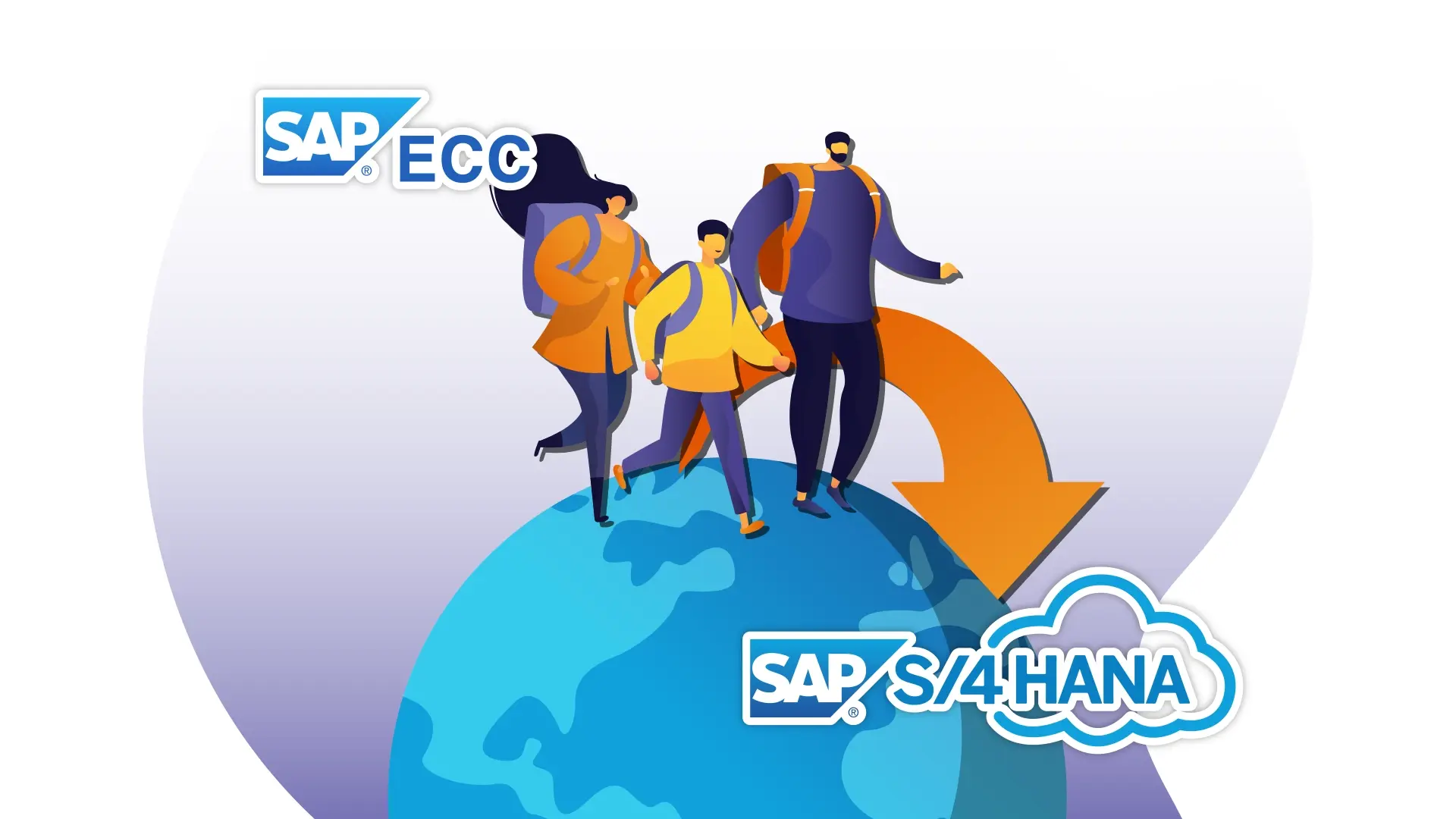
Are you a SAP customer? You've surely heard of SAP ECC or SAP S/4Hana. Both products whose names are currently very related; the reason? the upcoming end of maintenance for SAP ECC, which requires a conversion to SAP S/4HANA, its successor.
This solution, available in cloud, on-premise, or hybrid versions, saves companies time and strategy, in addition to allowing increased productivity and better optimization of business functions.
Why is it urgent to convert from ECC to S/4Hana?
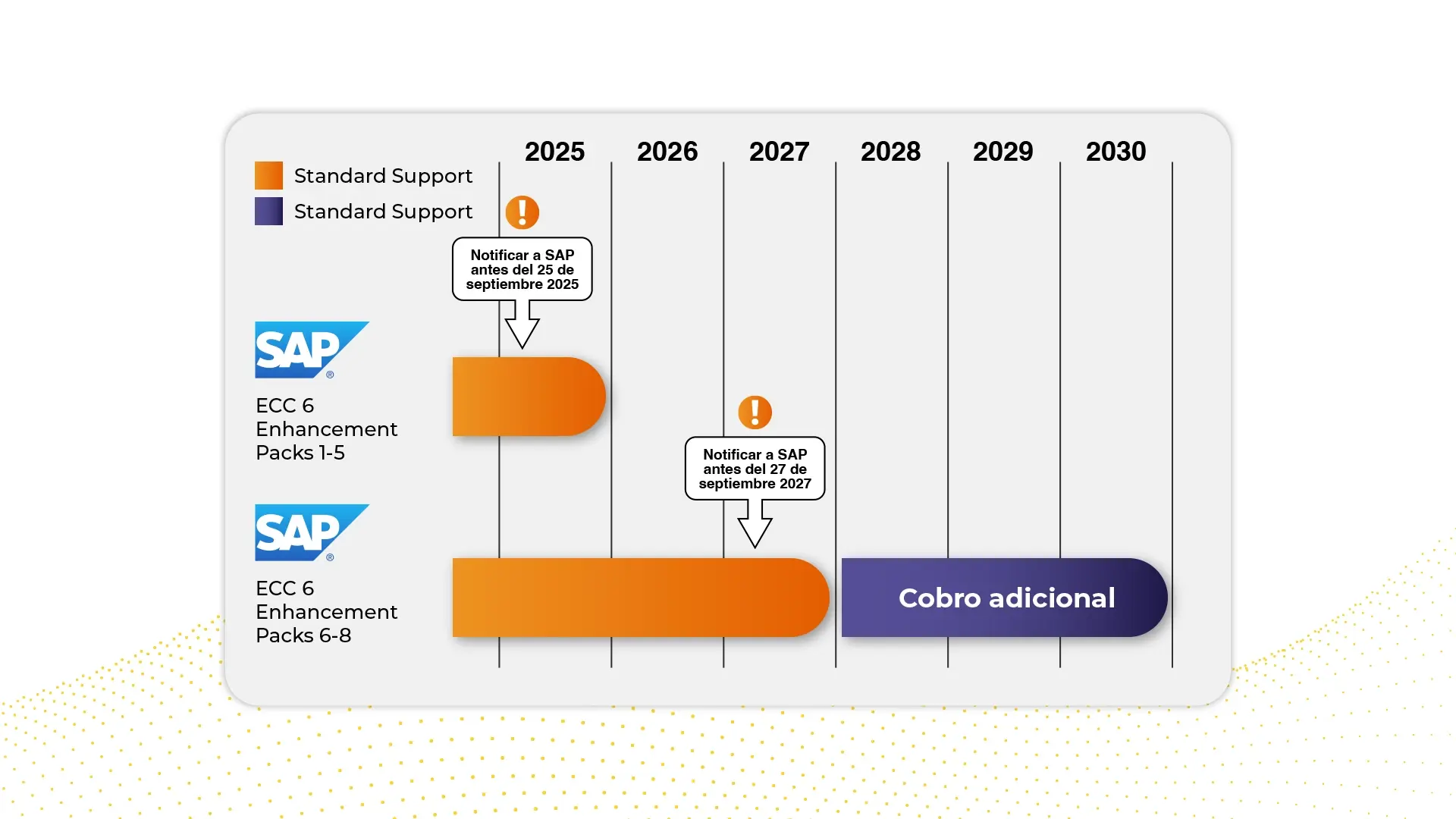
Let's start by mentioning that the announcement was made in 2020 and it was expected that by 2025 the migration would have to be mandatory for all ECC users; however, the date was extended because many companies were not yet ready to make the transition.
SAP's new deadline is 2027, and there will be an additional optional support extension until 2030, but it will have a higher cost.
The above means that, while there is still time, delaying the migration will be risky for your business because there will be higher costs and you could lose official support and be left out of the technological improvements that SAP is already integrating only in S/4HANA.
Beyond a technical issue, this migration is also a fundamental decision in the scale of growth of your company, because today, a customer who continues to operate in ECC does not have the necessary tools to adapt quickly to the changes that are occurring in the market.
At this point, organizations that have already migrated to S/4HANA and use innovation platforms like SAP BTP are technologically advancing to the point where it is possible to differentiate themselves and compete at another level. We must emphasize that it is not only about avoiding a support problem, we are about to position your company at the forefront of the transformation indicated by Industry 4.0.
2027 The new date for the change
From 2027, the ECC version will no longer be supported by SAP. This means that all companies with an SAP ECC ERP will have to have completed their conversion to SAP S/4HANA by then.
We know that converting to SAP S/4 HANA involves a significant effort for your company, both in human resources and technical capacity; however, the real problem is that there are still many customers operating in ECC and as the deadline approaches, the availability of experts decreases significantly. This can not only increase the project costs but can also generate waiting times to find consultant availability.
It's important to mention that migrating from ECC to SAP S/4 HANA is not just about transferring data from one system to another, it's the opportunity to redesign business processes and adapt them to the current needs that are requested in the market.
At Xamai, we understand that each business is different, so we offer personalized support that covers everything from the initial diagnosis to post-conversion support, and that's why we insist on working on your migration project now for several reasons:
- The conversion to S/4Hana can take several months
- S/4Hana is one of the biggest innovations from the SAP editor: it offers numerous technical advantages, especially in terms of Business Intelligence (it's a shame to have to wait until 2027 to take advantage of them!).
- As the deadline approaches, the demand for certified consultants will increase considerably, which can increase costs and make it difficult to find resources.
The advantages of S/4Hana over SAP ECC
These are the new features that S/4Hana offers to your business:
S/4HANA took the best of ECC and moved it to the HANA database, which uses a simplified data model. These solutions have been redesigned to take advantage of HANA and its intelligent innovations.
New Fiori interfaces have also been introduced and simplifications and improvements have been made. Most of the IMG configuration remains unchanged.
Over the years, SAP has created or acquired a number of solutions for identical or overlapping requirements. SAP took this opportunity to streamline and simplify its solution portfolio; this means that support has been completely discontinued for some solutions, while for others it continues, but there will be no new investments in those solutions or new developments for them.
These are generally solutions that have been replaced by newer ones or that had a low level of adoption in ECC. For example, the credit management solution (FI-AR-CR) is no longer supported and the FSCM Credit Management must now be used.
In addition to technical improvements, we must see the advantages from a strategic point of view; because a customer who remains in ECC is increasingly unprepared for the changes and movements that are taking place in the market. A company that is already operating with S/4 HANA and combines its system with developments in BTP, innovates at high speed using advanced analytics and adapting to business opportunities that give it competitive advantages.
SAP S/4 HANA will not only modernize your system and your company's areas, but will also position you on a continuous development platform.
What are the different types of approaches to migrating to S/4HANA?
There are 3 options for addressing a migration to SAP S/4HANA:
The Greenfield approach involves starting the migration from scratch. That is, performing a completely new implementation of S/4HANA, building clean processes without dragging along previous configurations or developments. We recommend this if you are looking to rethink your operation from a fresh perspective.
The Brownfield approach is more like an upgrade because the data and processes that already exist in ECC are migrated to S/4HANA, and much of the current structure is retained. In this process, all developments must be converted to be compatible with the new environment.
Finally, there is the Bluefield approach, a flexible alternative that combines the best of both worlds. With Bluefield you can select which data and processes you want to migrate (without needing to take all historical information that no longer adds value), redesign only what needs to be updated, take advantage of part of your existing configuration and, in addition, minimize downtime, since the current system can continue operating while the transformation is carried out.
Remember that every case is different and the ideal solutions must be found for your business!
SAP HANA is much more than a database. In addition to its functions as a database server, which stores and retrieves data requested by applications, SAP HANA offers advanced data search, analysis and integration capabilities, whether structured or unstructured.
Before migrating to SAP S/4HANA, a number of fundamental decisions must be made. For example, migrating to the SAP S/4HANA Cloud system requires a different approach than migrating to the SAP S/4HANA On-Premise system.
In any case, a migration requires good preparation and a transparent strategy, understandable to all sectors and stakeholders of the company.
Ready to talk to SAP specialists?
Tell us what your company needs and we'll help you find the best path.
Request information



 English
  Español de México
  Español