
Update: April 2025
Discover the versions of SAP and their main features that adapt to your business needs.
SAP ERP (Enterprise Resource Planning) is a business resource management system that integrates all the main business processes of a company. It has become the leading ERP due to its use by more than 440,000 companies worldwide, all thanks to the wide range of solutions it offers for various industries.
It is important to mention that SAP has extensive experience and knowledge in business management, having operated in the market for over 50 years, offering reliable and scalable solutions that adapt to any company.
But reaching this position has been a constant work of improving versions, which we will talk about today, and that is why SAP currently has more than 22,000 partners in 180 countries.
SAP ERP is installed with two objectives:
- Receive accurate information about the status of the company, always maintaining direction and access to updated information about the state of affairs in the company.
- Optimize business processes and improve their efficiency.
Evolution of SAP versions
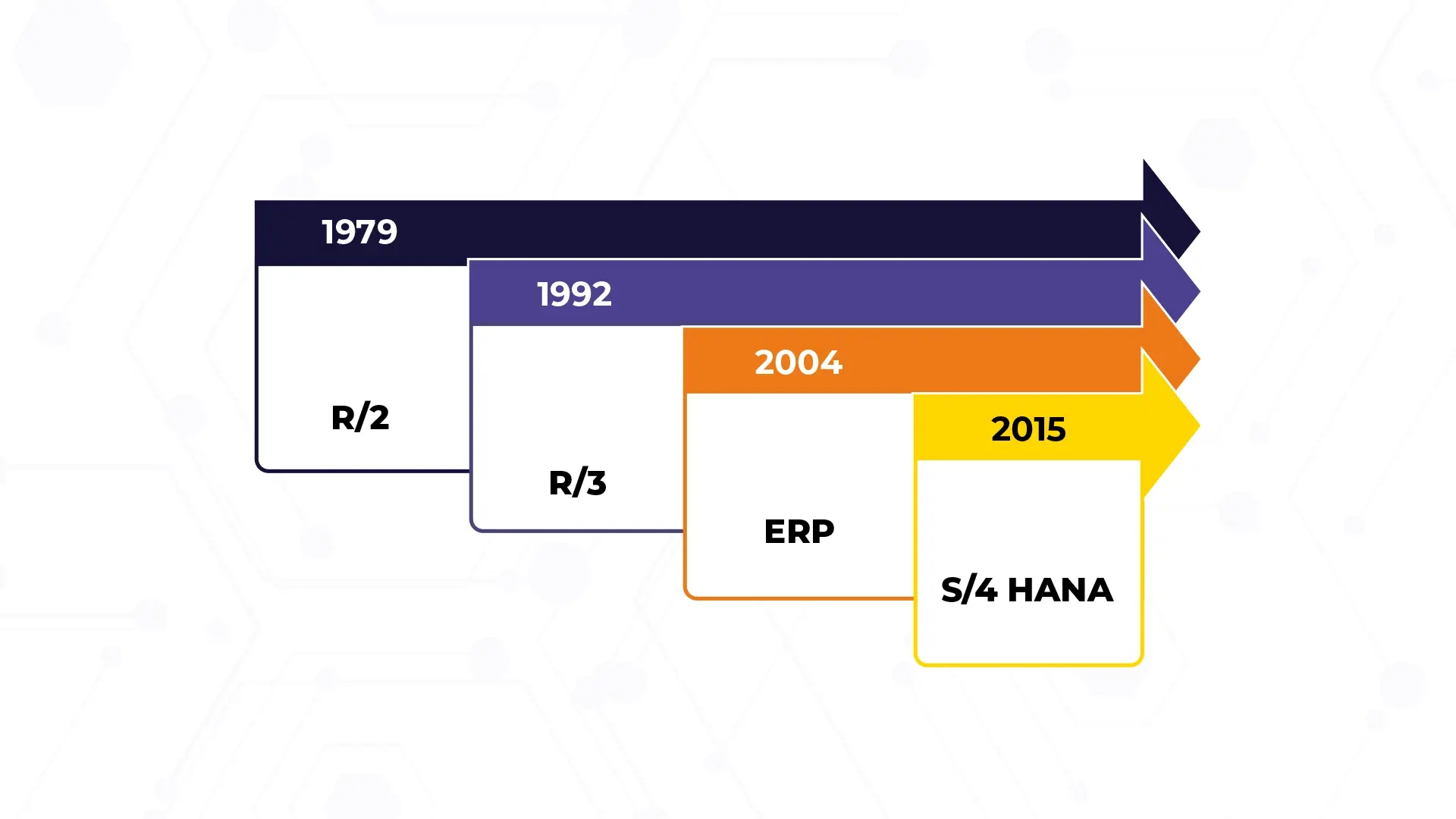
Since 1992, SAP products began to gain ground over other accounting solutions, first in Germany and shortly after in neighboring countries. By 2003, the company already dominated the European and Commonwealth of Independent States markets, with no significant competitors in its segment.
This growth was accompanied by constant evolution in the software architecture, which has undergone various key stages of transformation but always helping companies to improve every action within their processes.
SAP R/1 and SAP R/2 were the first advances
The first version of the system was SAP R/1, a DOS-based accounting software that operated on a single-tier architecture. Subsequently, SAP R/2 was launched, designed to run on mainframes, and incorporated logistics and human resources functions. This version already supported multiple languages and currencies, enabling its expansion internationally.
With the launch of SAP R/3 in the early 1990s, the company introduced a three-tier client-server architecture: client (user interface), application server, and database. This version marked a turning point by allowing greater scalability, integration between modules, and adaptation to different platforms.
SAP Basis customizing by industry
The SAP Basis platform (later called SAP NetWeaver Application Server) was the technology that enabled the construction and adaptation of applications through add-ons, facilitating customizations according to the specific needs of each industry.
At the end of the 1990s, with the expansion of the Internet and the emergence of the Unicode standard, SAP renamed its technology environment as SAP Web Application Server (Web AS), referring to its orientation towards web services and connected environments.
Subsequently, SAP R/3 Enterprise was introduced, which brought functional improvements without requiring direct modifications to the base applications. This version was an intermediate step before a major transformation.
In that process, SAP integrated various technologies and functionalities into a single platform called SAP NetWeaver, which allowed for more centralized process management, integration with other tools, and a service-oriented architecture.
From ECC to a service-oriented architecture
The evolution towards an enterprise service architecture (Enterprise Services Architecture) led to the birth of SAP ERP Central Component (SAP ECC), a version that allowed developers and partners to create composite solutions using reusable web services. This platform not only allowed the storage and processing of data in columns and rows, but also transformed ERP performance.
However, this system is nearing obsolescence, as SAP has announced the end of support for ECC, which means that companies will need to consider migrating to SAP S/4HANA, which enables real-time data analysis and better technological solutions hand in hand with Industry 4.0.
SAP S/4HANA the new era of ERP
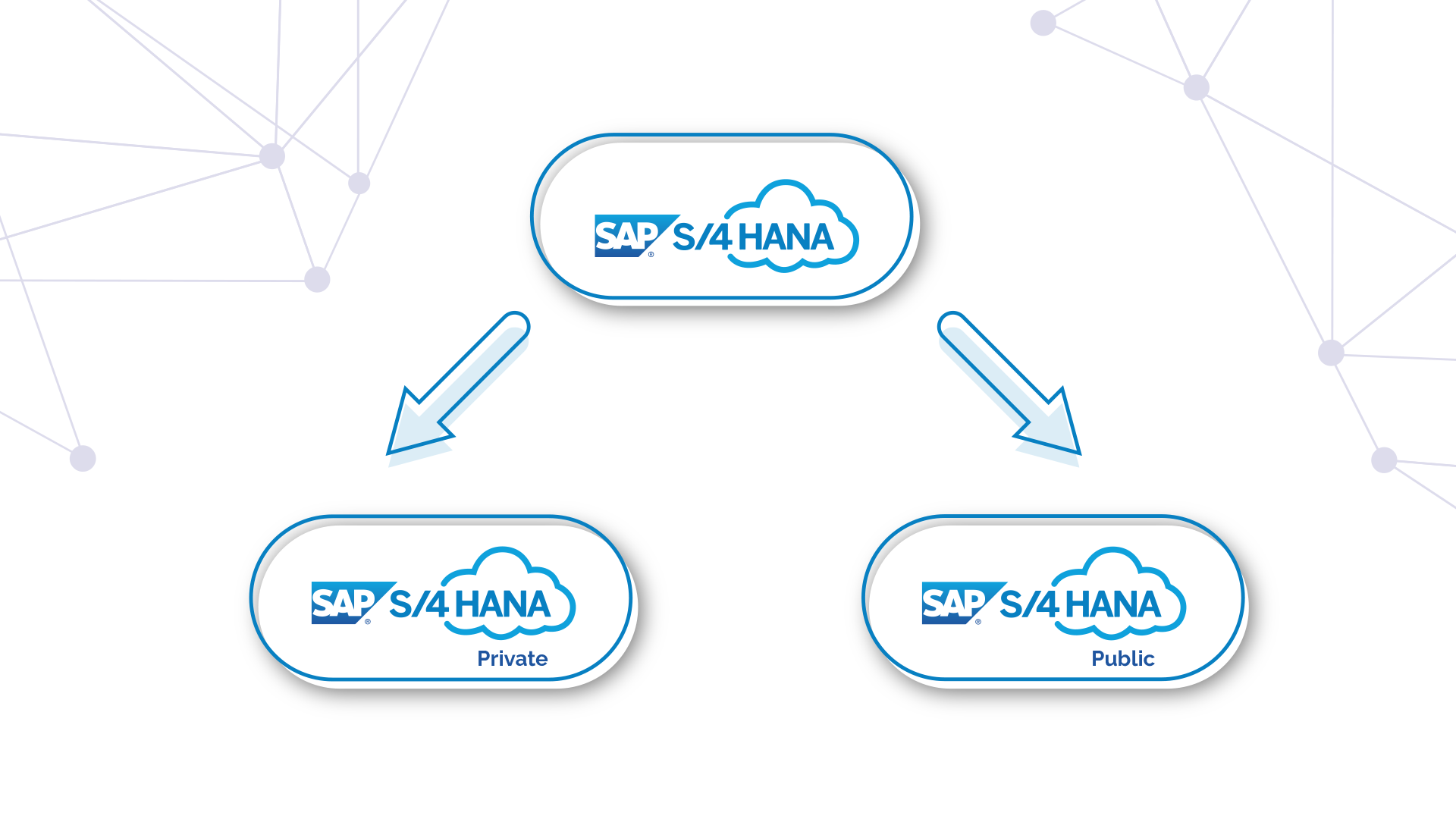
This version completely changes the way companies manage their processes in real time, in the cloud, or in hybrid environments in row, column, and object tables. As a result, SAP ERP evolved to SAP S/4 HANA.
Undoubtedly, the greatest innovation of SAP to date is this platform, which is an ERP system that uses SAP's in-memory database to store application information, the information it handles goes beyond what a human can handle, giving competitive advantages.
This allows data to be processed faster, while improving financial processes, logistics, and materials control.
The efficient management of SAP S/4HANA requires the collaboration of experts in various areas such as purchasing, manufacturing, sales and distribution, finance, quality, maintenance, warehouse, and customer service. Although each consultant specializes in a different module, they all share a solid technical foundation that allows them to actively participate in the implementation, upgrade, maintenance, and customization of the system.
Behind this functional team, there are also specialists responsible for the technical administration and security of the systems, who ensure that everything runs stably and securely.
In recent years, the number of SAP implementations has grown steadily, driving the demand for SAP consultants in an increasingly digitalized and information-saturated labor market.
Differences between SAP versions
|
SAP version |
Main focus |
Base Technology |
Key Features |
User Interface |
|
SAP S/4HANA |
Next-Generation ERP |
In-Memory Database (SAP HANA) |
Real-time Processing, Advanced Integration, Process Simplification |
SAP Fiori (modern, intuitive) |
|
SAP ERP 6.0 (ECC) |
Traditional Enterprise Resource Management |
Relational Database (non-HANA) |
Classic Functional Modules (FI, CO, SD, PP), High Stability |
SAP GUI Interface (traditional) |
|
SAP CRM |
Customer Relationship Management |
Integration with SAP ERP |
Sales, Marketing, Customer Service Management, 360-degree Customer View |
SAP Specific Interface for CRM |
|
SAP SRM |
Supplier Relationship Management |
Integration with SAP ERP |
Procurement Optimization, Bidding, Contracts, Strategic Sourcing |
SAP interface specific to SRM |
SAP applications according to version
One of SAP's great strengths is the variety of applications it offers based on the implemented version. These solutions allow covering critical processes in different business areas.
SAP S/4HANA, as a next-generation ERP, includes integrated applications for managing finance, procurement, inventory, production, human resources, customer experience, and advanced analytics. All of this in a single platform that operates in real time and integrates artificial intelligence, machine learning, the Internet of Things, and other fundamental pillars of Industry 4.0.
SAP ERP 6.0, although more traditional, also has a set of modules that provide a continuation to manage a company's core operations: accounting, production planning, logistics, maintenance, and more.
SAP CRM specializes in providing applications focused on the customer, such as sales opportunity management, campaign automation, technical support, and consumer behavior analysis.
SAP SRM offers tools focused on procurement, supplier management, contract creation, and order control. This approach allows companies to maintain more efficient and transparent business relationships.
Challenges during SAP implementation today
Implementing SAP is not a simple task. Regardless of the version, the process involves a series of challenges that companies must consider to guarantee the success of the project.
One of the main challenges is the complexity of the system. SAP is highly configurable and flexible, which, while an advantage, also requires meticulous planning and specialized technical knowledge to avoid errors.
There is also the implementation cost, which can vary depending on the size of the company, the version chosen, the degree of customization, and the existing technological infrastructure. In the case of SAP S/4HANA, it is necessary to have a robust infrastructure or resort to a cloud solution that supports its real-time capabilities.
Another important challenge is the need to adapt internal processes. Many times, companies must rethink the way they operate to align with the best practices proposed by SAP. This implies changes not only in workflows, but also in organizational culture.
Finally, the successful implementation of SAP requires constant training. Employees must be prepared to use the new technology effectively, which requires investment in training and support for change.
Ready to talk to SAP specialists?
Tell us what your company needs and we'll help you find the best path.
Request information


 English
  Español de México
  Español