


What is Burnout?
It is a special type of work-related stress that leads to a state of extreme physical or emotional exhaustion. Although it is not a medical term, it has been suggested that “burnout” is behind other medical-psychological problems such as depression and anxiety disorders. One of its main characteristics is the employee's depersonalization from their work, becoming excessively critical or unmotivated.
Various factors within our work environments can trigger burnout in workers:
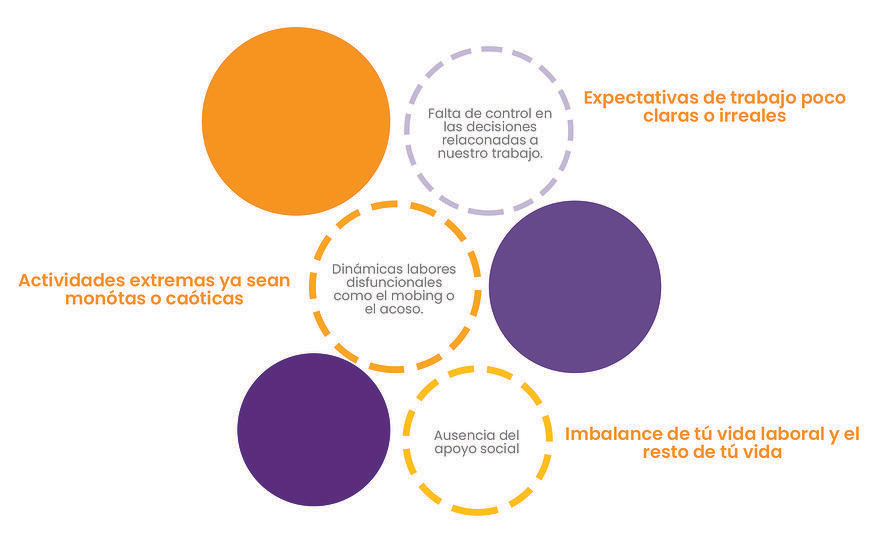
If we ignore burnout in our companies, it can lead to significant consequences such as:
- Sick leave.
- Decrease in employee productivity.
- Increase in absences.
- Increase in substance and alcohol consumption.
- Increase in cases of cardiovascular disease.
- Increase in cases of type 2 diabetes.
- Irritability and anger issues among employees.
How to combat burnout in our organizations?
1. Flexibility in working hours
Consider allowing employees to define, as much as possible, the schedules that best suit them, so they can attend to their families and have leisure and relaxation activities during the week.
2. Respect vacation periods
During the 2020 there was a lot of lack of control regarding vacation time in companies, for example:
- Employees did not take vacations because there were no places open to travel.
- Many employees who had saved up their vacations became ill or a loved one did, so they used their vacations to recover from illness or care for others.
- Employees took vacations, but as they couldn't do other activities, they used that time to continue working.
- Employees and employers who decided to compensate in money for vacation days.
We must understand that taking vacations has a purpose in our mental health. It is a period in which the person rests and has time to recover from the stress they experience day by day. In all the examples mentioned above, the objective of the vacations was not achieved and the person continued with high levels of stress without recovery. This leads to an increase in the possibility of developing burnout.
3. Take care of micromanaging
When a boss is insidiously giving instructions about the work, it takes away the employee's ability to develop appropriate strategies for the execution of their profile. And it has negative emotional consequences for the employee. In the Harvard Business Review “How to help without micromanaging” the following recommendations are made:
- That bosses use their time wisely and do not anticipate circumstances.
- Clarify that your role is to help achieve the objective and not to evaluate the worker.
- Align participation with people's needs, offer help before directly interfering in the conflict.
4. Offer empathetic leadership
Although it is always recommended that as a leader you behave as you would like to be treated, there are certain behaviors that help to exercise a more empathetic leadership:
- Stepping outside of one's own circumstances to evaluate and listen carefully to the needs of your employees.
- Involve the team with exercises like “brainstorming” to reach better solution options in the face of crisis.
- Take the time and tools to measure the work environment and get to know the employees.
- Adjust procedures and action plans with the knowledge you have of the employees.
Develop action plans for crisis events
- We must learn from the experience left by the pandemic. So that in the future a critical event finds us better prepared to face the consequences. Avoiding feelings of guilt for decisions that were necessary to take due to the ravages of the crisis; for example, mass layoffs, salary reductions, hours, etc.
Seek for the future to have a general emergency plan, anticipating different catastrophes, for example earthquakes, tsunamis or pandemics.
Communicate changes without beating around the bush and trying to be consistent with the information and the population. Explain the reason for layoffs or reduced hours.
If there is a need to rectify, do so officially, clarify and publish the necessary explanations.
Reinforce gratitude and recognition even under extraordinary circumstances.
Wellness Program
If it is within the company's possibilities, promote health programs within it, which train and teach employees to take care of their diet, exercise, manage their time and take care of their emotional-mental health. Through training or spaces for employees to exercise after work. Or teaching techniques such as guided meditation, yoga, tai chi or mindfulness.
Human Resources Management and SAP Success Factors
The issue of burnout must be addressed by the human resources area. All the mentioned strategies have to do with performance management procedures, organizational communication, time management, training and development plans and benefits. And all can be managed in a better way through SAP Success Factors.
{{cta(‘205875ac-2058-4fbc-b9e5-1181cc43a7aa’,’justifycenter’)}}
The problems that arise from not investing in the field of human resources are increasingly obvious. Therefore, companies must understand continuous change as the new normal in the world of work, understand that the company's results are based on the personnel.
The challenge is not easy, company directors must be convinced of the importance of Human Capital to achieve results. That is why SAP Success Factors has been working for the last 20 years to develop a cutting-edge tool that helps employees and employers manage resources and thus have a better quality of life.
Ready to talk to SAP specialists?
Tell us what your company needs and we'll help you find the best path.
Request information









 English
  Español de México
  Español