

The landscape of Industry 4.0 changes day by day and we must prepare to be able to adapt with flexibility to new developments.
As there are countless professional challenges and the possibilities of new technological tools that help address them grow, the number of possible solutions to create value grows exponentially.
As we have always mentioned, it is important to be accompanied by experts who help SMEs in their digital transformation journey towards Industry 4.0 and make the Digital Smart Factory or intelligent company a reality.
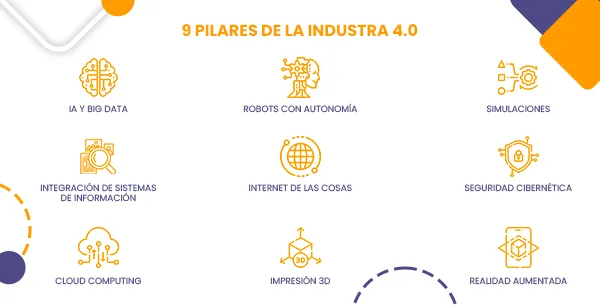
What are the 9 pillars of Industry 4.0?
- Artificial Intelligence and Big Data
- Robots with autonomy
- Simulations
- Integration of information systems
- Internet of Things (IoT)
- Cybersecurity
- Cloud computing
- 3D Printing
- Augmented Reality
1. Artificial Intelligence and Big Data
One of the pillars of Industry 4.0, it refers to the capture, collection, and analysis of a large amount of data generated by different sources to support decision-making processes. This process is known as the Internet of Behavior or IoB.
With this data, and software based on Artificial Intelligence and Machine Learning algorithms, it is possible to detect behavioral patterns that will help us, among other things, to anticipate possible peaks in demand, or conversely, to discern a possible deterioration in consumption and thus be able to take corrective measures in advance of events.
Similarly, some programs aim to improve the efficiency of a plant. The use of AI allows reducing the generation of unnecessary expenses and bad investment through machine learning.
2. Robots with autonomy
The new generation of robots is one of the pillars of Industry 4.0 because it will offer greater capacity and lower cost compared to those currently used. They will be able to interact with each other and with people, learning from these interactions with customers.
3. Simulations
Another important pillar of Industry 4.0 is the use of simulation systems, which is extended to all production processes to process data collected in real time in virtual models, with the aim of testing and optimizing machines, products and processes, and thus being able to anticipate problems before they occur.
For example, there are already state-of-the-art software programs for machine tools that allow comparing 3D machining simulation models from numerical control.
4. Integration of information systems
The integration of data and systems ensures that all departments and all commercial functions interact within a single system throughout the value chain.
Thanks to this integration, it is much easier to draw conclusions, since society is not seen as isolated blocks but as what it really is: a complex whole, in turn divided into multiple subsystems.
5. Internet of Things (IoT)
When we talk about IoT, we talk about all the technologies, tools and sensors that will allow objects in the factory, devices such as finished products, to communicate with each other and interact with humans through the network. In this way, data analysis and decision-making are decentralized, allowing for real-time responses.
6. Cybersecurity
As all this connectivity develops, there is a greater need to protect the factory's production systems and the computer network from potential threats, through cybersecurity programs.
Although this problem is often overlooked, it is important to keep it in mind from the beginning, without waiting for an incident to occur, which can be serious.
7. Cloud computing
Many companies are already using applications fully based on the cloud, but in Industry 4.0, there will always be more data exchange about the plant and, therefore, the applications for the control and management of production will also have to be available.
It is one of the pillars of Industry 4.0 because it is in the 'Cloud' where the new technological facilitators are implemented.
3D Printing
Additive manufacturing or 3D printing is used for prototyping or for the production of specific components; however, these additive manufacturing technologies are pillars of Industry 4.0 as they will be more used to manufacture batches of highly customized products.
This technology opens up previously unthinkable paths, removing obstacles for users to improve and refine their parts. In addition, 3D printing deposits material only where it is needed, so 3D printed parts are lighter.
The remaining material can be reused. This is undoubtedly a more economical and sustainable vision compared to traditional processes, such as grinding, where up to 80% of the material is lost.
Augmented Reality
Another pillar of Industry 4.0 is augmented reality, which refers to all systems that, through portable vision devices (e.g., retinal projection lenses), listening (headphones) or manipulation (gloves), add multimedia information to the reality perceived by people.
These technologies are used to provide real-time information to improve processes and decision-making.
What benefits does Industry 4.0 bring?
In conclusion and after learning about the pillars of Industry 4.0, we can talk about the following advantages:
- Improvement of company efficiency, in the work carried out and in the services offered
- Reduction of product time to market
- Reduction of operating costs
- Better management of human resources
- Improvement of competitiveness
- Reduction of waste and, therefore, better production quality
- Automation of the production process
- Reduction of downtime
- Greater efficiency in maintenance through data analysis in predictive maintenance
At Xamai, we work to help and support companies of all sizes and sectors in their digital transformation process, through the development of state-of-the-art software based on data analysis and the cloud. Contact us to embark together on the path towards Industry 4.0.
Ready to talk to SAP specialists?
Tell us what your company needs and we'll help you find the best path.
Request information







 English
  Español de México
  Español