

Industry 4.0 is a German project intended for the digitalization of the manufacturing industry; it is also known as the "Fourth Industrial Revolution".
It is important to have a correct understanding of the meaning, the principles that govern it, and the initiatives of Industry 4.0, in this way we will know its impact on the industry to consider future policies within it and its influence on its transformation.
In this article, we will provide some context and explain what Industry 4.0 is, what can be achieved with it, and the current situation in Mexico of organizations that are venturing into it.
Industry 4.0 refers to the “Fourth Industrial Revolution” and is a strategic project for the manufacturing industry. It focuses on the use of computers within manufacturing and aims for active reform through the incorporation of information technology (IT), such as artificial intelligence (AI) and the Internet of Things (IoT).
A little history
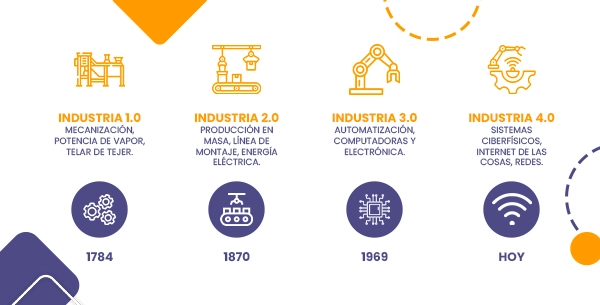
The First Industrial Revolution began in England in the mid-18th century. It mainly refers to the mechanization of factories due to the development of steam engines. This helped to drastically improve work efficiency.
The second industrial revolution is a technological innovation in heavy industries such as steel and shipbuilding, as well as in the chemical industries that use oil and electricity at the end of the 19th century in Germany and the United States. Mass production was carried out because factories used electrical energy and relied on science and technology.
Then, in the 1990s, with the rise of computers, the automation of machinery progressed significantly. This is the third industrial revolution, also known as the digital revolution.
The fourth Industrial Revolution is an extension of the 3rd Industrial Revolution.
Fourth industrial revolution
In 2011, the German government was the first in the world to work to improve the efficiency of the manufacturing industry using IoT. This initiative is said to have been the origin of the fourth industrial revolution.
At the Davos Conference in 2016, it was first proposed on a large scale and spread throughout the world.
After the Third Industrial Revolution due to the spread of computers, the development of technology advanced even further with the spread of the Internet at the same time. Technologies such as AI and IoT were born there.
The information collected through these technologies is called big data, and it is said that the fourth industrial revolution consists of making work more efficient and being able to create new services using that data.
We are living in the midst of the Fourth Industrial Revolution. In order not to be left behind with this change, it is necessary to correctly understand what IoT is and how it can be efficiently integrated into a work environment.
What is IoT?
IoT is an abbreviation of the English phrase 'Internet of Things'. Literally, it means that several 'things' are connected to the Internet, and collect data. This data and they communicate with each other via the Internet.
The most common example we have of IoT is the smartphone. Mobile phones are currently connected to the Internet, and with it we can search for information, read books, buy things, communicate and all with a single phone.
Another example are the 'smart watches' that can measure the number of steps and heartbeats and check emails; the 'smart appliances' that can be controlled remotely, etc.
In this way, IoT knows our environment, and now it has become an indispensable part of our lives.
IoT in the manufacturing industry
By introducing IoT into the manufacturing industry, the possibilities are endless, such as improving the efficiency of production lines, improving and developing products by collecting data from customers, etc.
It is said that the introduction of IoT is the most effective and the future of the industry cannot survive without the use of it.
However, it is not easy for companies that do not have a connection with IoT to introduce the latest technology; but little by little, proposals for introducing the Internet of Things, cloud computing, system development and technical consulting are emerging.
Benefits of adopting Industry 4.0
The benefits of adopting Industry 4.0 will be explained from the following three perspectives.
1. Full automation of the factory can be achieved.
As devices become connected to each other, the space for human intervention is constantly decreasing. It is no longer a dream to completely automate the manufacturing process from order placement to delivery. Even if it takes time to provide instructions using AI, it is possible to capture the operating status and issue it remotely.
Irregularities are likely to become a bottleneck when automating. Since it is quite difficult to "automatically detect irregularities and take other measures," manual intervention may be necessary for troubleshooting.
It can level the factory's operating rate.
Without the inclusion of IoT, once an online production system is established to specialize in specific products, the other lines will not function at all. There is also a limit to the amount that can be produced, and the opportunity to meet demand will be lost.
However, with the introduction of Industry 4.0, if one line can handle the production of multiple products, it will be possible to level the operating rate of each line. It is not necessary to prepare a new one to manufacture products, and at the same time, costs can be reduced.
We can provide products that customers really want.
One of the worlds that Industry 4.0 aspires to is cyber-physical systems (CPS). The idea is to evolve manufacturing by collecting a large amount of data in the real world using sensors, and other means to analyze it with a computer system in a virtual space.
The data collected is not limited to production sites such as factories. If the product itself has an information gathering mechanism, it will be possible to obtain information about how the product is used and how it is intended to be used when it reaches the consumer.
If we can create a system that returns this information, it will be the key to revolutionizing conventional market research and marketing strategies.
Challenges in utilizing Industry 4.0
To make effective use of Industry 4.0, it is necessary to focus on three issues and consider countermeasures. We will talk a little about it below.
Measures against security and failures are necessary.
Industry 4.0 makes extensive use of IT. Since everything is connected by a network, once it is breached, it can lead to access to all devices. If one of them stops due to a failure, it could lead to the paralysis of production in the entire factory, so it is necessary to act by preventing such setbacks.
However, since everything is automated, the person in charge may not have the necessary information for maintenance, how the equipment works, and where it is connected. In the unlikely event that an accident or security failure occurs, it will take time to recover, and customer trust may be affected.
Close cooperation between processes to optimize service quality.
Customers want more than just products. If the overall quality of service is not satisfied, it cannot be said that something of value has been provided. It is necessary to optimize the entire product lifecycle, including after-sales tracking.
However, even if the efficiency of production can be improved only with factory automation, it is not possible to incorporate customer requests or improve feedback.
For conventional products, the after-sales tracking portion was handled using human resources, but if Industry 4.0 is developed, it will be possible to absorb requests in real time.
Measures to prevent unemployment are also necessary.
As automation progresses, simple tasks will be handled by machines. As Industry 4.0 progresses, pure production work will be replaced by machines. On the contrary, if the time previously spent on simple tasks can be used to propose new services and build new business models, the company can grow. It is also a good idea to give employees who have traditionally been involved in production the opportunity to make such proposals.
It will be possible to take measures to avoid employees losing their jobs as much as possible, including relocation.
Industry 4.0 leads to greater value in the manufacturing industry.
By using Industry 4.0, it is possible to produce products that meet customer demand while maintaining low costs. Information obtained through interviews and surveys to understand customer demand is automatically collected with data from the IoT.
As Industry 4.0 facilitates data collection, it is believed that there will be a shift towards considering how to use it. If AI can be trained using such information, it will be possible to aim for rapid and precise production. By aiming for efficiency and responding accurately to needs, it is possible to improve the value of the company.
Industry 4.0 in Mexico.
Mexico seeks to enter the stage of the world's leading economies through digitization and conversion of processes to the Industry 4.0 model, but there are still details to be improved to move forward on this path.
The new challenge for companies is to digitalize or die, because thanks to the internet and the interconnection between machines and people that this technology makes possible, each micro, small and large company operating in the national territory must adapt.
Despite widespread awareness of the benefits of jumping into the digital world, approximately 70% of Mexican companies have not yet digitized, which prevents Mexico from becoming one of the world's leading economies.
An example of these competitive advantages that already exists in the country is in the beer industry, because according to Forbes, the technology of automation and control, as well as training in this area and the digitization of processes that the German company Siemens installed, have made Mexico the world's leading exporter of beer.
The challenges of the Fourth Industrial Revolution in Mexico.
Although the importance of digitization in the country is already a concept that companies and users know, there are still challenges to face in the face of the fourth industrial revolution and the technological development process it represents.
Mexico is late to the fourth industrial revolution for several reasons, including the lack of integration of the private sector into the higher education system, as technologies such as artificial intelligence, robotics and the Internet of Things require even more support and promotion within the country.
In addition to the above, Mexico is one of the last countries in the Organization for Economic Co-operation and Development (OECD) in terms of broadband penetration, which means that just over 14% of Mexicans have access to a fixed Internet network.
Advances in infrastructure and communications technology are key to driving the economic development of Mexican industries, so more than ever it is a moment of vital importance to promote industrial digitization and give the country a competitive advantage within Industry 4.0.
In conclusion
Industry 4.0 is a concept that refers to digital transformation and the incorporation of new information technologies into industrial production processes.
The future is now and the use of technology is necessary, at the level of devices and infrastructure, to have proper competitiveness and accelerated growth alongside large companies.
If you think that Industry 4.0 is still far from your business, you should know that our clients at Xamai are already applying Business Intelligence in their production plants. Do you want to be left behind?
Ready to talk to SAP specialists?
Tell us what your company needs and we'll help you find the best path.
Request information





 English
  Español de México
  Español